Results by title
198 books match the query 'Food' and 11 start with m

Madison Chefs
Stories of Food, Farms, and PeopleLindsay Christians and Chris Hynes
University of Wisconsin Press, 2021
Farm-to-table is a cliché, but its roots among the farmers and chefs of south-central Wisconsin are deep, vibrant, and resilient. From brats and burgers to bibimbap, Madison’s food scene looks substantially different than it did just a decade ago. Though the city has always been ahead of the locavore movement, a restaurant boom in the 2010s radically changed the dining landscape. Even when individual eateries close or chefs move on, their ideas, connections, and creativity have lasting power. Much larger cities have been unable to match the culinary variety, innovation, and depth of talent found in Wisconsin’s state capital.
Lindsay Christians’s in-depth look at nine creative, intense, and dedicated chefs captures the reason why Madison’s food culture remains a gem in America’s Upper Midwest. This beautifully illustrated book will leave you salivating—or making reservations.
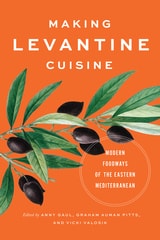
Making Levantine Cuisine
Modern Foodways of the Eastern MediterraneanEdited by Anny Gaul, Graham Auman Pitts, and Vicki Valosik
University of Texas Press, 2021
Melding the rural and the urban with the local, regional, and global, Levantine cuisine is a mélange of ingredients, recipes, and modes of consumption rooted in the Eastern Mediterranean. Making Levantine Cuisine provides much-needed scholarly attention to the region’s culinary cultures while teasing apart the tangled histories and knotted migrations of food. Akin to the region itself, the culinary repertoires that constitute Levantine cuisine endure and transform—are unified but not uniform. This book delves into the production and circulation of sugar, olive oil, and pistachios; examines the social origins of kibbe, Adana kebab, shakshuka, falafel, and shawarma; and offers a sprinkling of family recipes along the way. The histories of these ingredients and dishes, now so emblematic of the Levant, reveal the processes that codified them as national foods, the faulty binaries of Arab or Jewish and traditional or modern, and the global nature of foodways. Making Levantine Cuisine draws from personal archives and public memory to illustrate the diverse past and persistent cultural unity of a politically divided region.

Man Who Thought He Owned Water
On the Brink with American Farms, Cities, and FoodTershia d'Elgin
University Press of Colorado, 2016
When her father bought his farm—Big Bend Station—he also bought the ample water rights associated with the land and the South Platte River, confident that he had secured the necessary resources for a successful endeavor. Yet water immediately proved fickle, hard to defend, and sometimes dangerous. Eventually those rights were curtailed without compensation. Through her family’s story, d’Elgin dramatically frames the personal-scale implications of water competition, revealing how water deals, infrastructure, transport, and management create economic growth but also sever human connections to Earth’s most vital resource. She shows how water flows to cities at the expense of American-grown food, as rural land turns to desert, wildlife starves, the environment degrades, and climate change intensifies.
Depicting deep love, obsession, and breathtaking landscape, The Man Who Thought He Owned Water is an impassioned call to rebalance our relationship with water. It will be of great interest to anyone seeking to understand the complex forces affecting water resources, food supply, food security, and biodiversity in America.
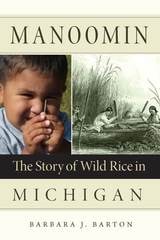
Manoomin
The Story of Wild Rice in MichiganBarbara J Barton
Michigan State University Press, 2018
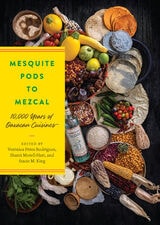
Mesquite Pods to Mezcal
10,000 Years of Oaxacan CuisinesVerónica Pérez Rodriguez, Shanti Morell-Hart, and Stacie M. King
University of Texas Press, 2024
New case studies documenting ten thousand years of cuisines across the cultures of Oaxaca, Mexico, from the earliest gathered plants, such as guajes, to the contemporary production of tejate and its health implications.
Among the richest culinary traditions in Mexico are those of the “eight regions” of the state of Oaxaca. Mesquite Pods to Mezcal brings together some of the most prominent scholars in Oaxacan archaeology and related fields to explore the evolution of the area’s world-renowned cuisines. This volume, the first to address food practices across Oaxaca through a long-term historical lens, covers the full spectrum of human occupation in Oaxaca, from the early Holocene to contemporary times. Contributors consider the deep history of agroecological management and large-scale landscape transformation, framing food production as a human-environment relation. They explore how, after the arrival of the Spanish, Oaxacan cuisines adapted, diets changed, and food became a stronger marker of identity. Examining the present, further studies document how traditional foodways persist and what they mean for contemporary Oaxacans, whether they are traveling ancient roads, working outside the region, or rebuilding after an earthquake. Together, the original case studies in this volume demonstrate how new methods and diverse theoretical approaches can come together to trace the development of a rich food tradition, one that is thriving today.

Metabolic Living
Food, Fat, and the Absorption of Illness in IndiaHarris Solomon
Duke University Press, 2016
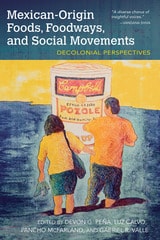
Mexican-Origin Foods, Foodways, and Social Movements
Decolonial PerspectivesDevon Peña
University of Arkansas Press, 2017
This collection of new essays offers groundbreaking perspectives on the ways that food and foodways serve as an element of decolonization in Mexican-origin communities.
The writers here take us from multigenerational acequia farmers, who trace their ancestry to Indigenous families in place well before the Oñate Entrada of 1598, to tomorrow’s transborder travelers who will be negotiating entry into the United States. Throughout, we witness the shifting mosaic of Mexican-origin foods and foodways in the fields, gardens, and kitchen tables from Chiapas to Alaska.
Global food systems are also considered from a critical agroecological perspective, including the ways colonialism affects native biocultural diversity, ecosystem resilience, and equality across species, human groups, and generations.
Mexican-Origin Foods, Foodways, and Social Movements is a major contribution to the understanding of the ways that Mexican-origin peoples have resisted and transformed food systems. It will animate scholarship on global food studies for years to come.
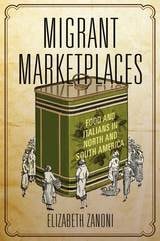
Migrant Marketplaces
Food and Italians in North and South AmericaElizabeth Zanoni
University of Illinois Press, 2018
Elizabeth Zanoni provides a cutting-edge comparative look at Italian people and products on the move between 1880 and 1940. Concentrating on foodstuffs—a trade dominated by Italian entrepreneurs in New York and Buenos Aires—Zanoni reveals how consumption of these increasingly global imports affected consumer habits and identities and sparked changing and competing connections between gender, nationality, and ethnicity. Women in particular—by tradition tasked with buying and preparing food—had complex interactions that influenced both global trade and their community economies. Zanoni conveys the complicated and often fraught values and meanings that surrounded food, meals, and shopping.
A groundbreaking interdisciplinary study, Migrant Marketplaces offers a new perspective on the linkages between migration and trade that helped define globalization in the late nineteenth and early twentieth centuries.
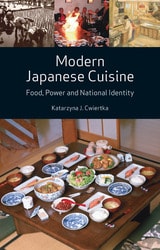
Modern Japanese Cuisine
Food, Power and National IdentityKatarzyna J. Cwiertka
Reaktion Books, 2015
Katarzyna J. Cwiertka demonstrates that key shifts in the Japanese diet were, in many cases, a consequence of modern imperialism. Exploring reforms in military catering and home cooking, wartime food management and the rise of urban gastronomy, Cwiertka shows how Japan’s numerous regional cuisines were eventually replaced by a set of foods and practices with which the majority of Japanese today ardently identify.
The result of over a decade of research, Modern Japanese Cuisine is a fascinating look at the historical roots of some of the world’s best cooking and will provide appetizing reading for scholars of Japanese culture and foodies alike.

Montane Foragers
Asana and the South-Central Andean ArchaicMark S. Aldenderfer
University of Iowa Press, 1998
Aldenderfer's investigation forms a methodological and theoretical tour de force that elucidates elevational stress—what it takes for humans to adjust and survive at high altitudes. In a masterful integration of mountain biology and ecology, he emphasizes the nature of hunter-gatherer adaptations to high-mountain environments. He carefully documents the cultural history of Asana, the first stratified, open-air site discovered in the highlands of the south-central Andes. He establishes a number of major occurrences at this revolutionary site, including the origins of plant and animal domestication and transitions to food production, the growth and packing of forager populations, and the advent of some form of complexity and social hierarchy.
The rich and diversified archaeological record recovered at Asana—which spans from 10,000 to 3,500 years ago—includes the earliest houses as well as public and ceremonial buildings in the central cordillera. Built, used, and abandoned over many millennia, the Asana structures completely transform our understanding of the antiquity and development of native American architecture. Aldenderfer's detailed archaeological case study of high-elevation foraging adaptation, his description of this extreme environment as a viable human habitat, and his theoretical model of montane foraging create a new understanding of the lifeways of foraging peoples worldwide.
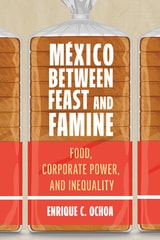
México Between Feast and Famine
Food, Corporate Power, and InequalityEnrique C. Ochoa
University of Arizona Press, 2025
As the birthplace of maize and a celebrated culinary destination, Mexico stands at the crossroads of gastronomic richness and stark social disparities. In México Between Feast and Famine Enrique C. Ochoa unveils the historical and contemporary forces behind Mexico’s polarized food systems.
México Between Feast and Famine provides one of the first comprehensive analyses of Mexico’s food systems and how they reflect the contradictions and inequalities at the heart of Mexico. Ochoa examines the historical roots and contemporary manifestations of neoliberal policies that have reshaped food production, distribution, and consumption in Mexico. Ochoa analyzes the histories of Mexico’s mega food companies, including GRUMA, Bimbo, Oxxo, Aurrera/Walmex, and reveals how corporations have captured the food system at the same time that diet-related diseases have soared. The author not only examines the economic and political dimensions of food production but also interrogates the social and cultural impacts.
As debates around food sovereignty, globalization, and sustainable development intensify globally, México Between Feast and Famine provides a timely analysis that counters conventional narratives about Mexican cuisine. Even as it looks back, this work looks to the future, where more equitable and sustainable food systems prioritize social justice and community well-being.