Results by title
147 books match the query 'Freedom' and 4 start with m

Making Life Work
Freedom and Disability in a Community Group HomeJack Levinson
University of Minnesota Press, 2010
Group homes emerged in the United States in the 1970s as a solution to the failure of the large institutions that, for more than a century, segregated and abused people with intellectual and developmental disabilities. Yet community services have not, for the most part, delivered on the promises of rights, self-determination, and integration made more than thirty years ago, and critics predominantly portray group homes simply as settings of social control.
Making Life Work is a clear-eyed ethnography of a New York City group home based on more than a year of field research. Jack Levinson shows how the group home needs the knowledgeable and voluntary participation of residents and counselors alike. The group home is an actual workplace for counselors, but for residents group home work involves working on themselves to become more autonomous. Levinson reveals that rather than being seen as the antithesis of freedom, the group home must be understood as representing the fundamental dilemmas between authority and the individual in contemporary liberal societies. No longer inmates but citizens, these people who are presumed—rightly or wrongly—to lack the capacity for freedom actually govern themselves.
Levinson, a former group home counselor, demonstrates that the group home depends on the very capacities for independence and individuality it cultivates in the residents. At the same time, he addresses the complex relationship between services and social control in the history of intellectual and developmental disabilities, interrogating broader social service policies and the role of clinical practice in the community.
[more]
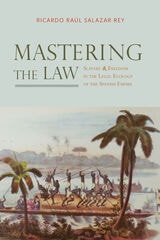
Mastering the Law
Slavery and Freedom in the Legal Ecology of the Spanish EmpireRicardo Raúl Salazar Rey
University of Alabama Press, 2020
Explores the legal relationships of enslaved people and their descendants during the sixteenth and seventeenth centuries in Spanish America
Atlantic slavery can be overwhelming in its immensity and brutality, as it involved more than 15 million souls forcibly displaced by European imperialism and consumed in building the global economy. Mastering the Law: Slavery and Freedom in the Legal Ecology of the Spanish Empire lays out the deep history of Iberian slavery, explores its role in the Spanish Indies, and shows how Africans and their descendants used and shaped the legal system as they established their place in Iberoamerican society during the seventeenth century.
Ricardo Raúl Salazar Rey places the institution of slavery and the people involved with it at the center of the creation story of Latin America. Iberoamerican customs and laws and the institutions that enforced them provided a common language and a forum to resolve disputes for Spanish subjects, including enslaved and freedpeople. The rules through which Iberian conquerors, settlers, and administrators incorporated Africans into the expanding Empire were developed out of the need of a distant crown to find an enforceable consensus. Africans and their mestizo descendants, in turn, used and therefore molded Spanish institutions to serve their interests.Salazar Rey mined extensively the archives of secular and religious courts, which are full of complex disputes, unexpected subversions, and tactical alliances among enslaved people, freedpeople, and the crown.
The narrative unfolds around vignettes that show Afroiberians building their lives while facing exploitation and inequality enforced through violence. Salazar Rey deals mostly with cases originating from Cartagena de Indias, a major Atlantic port city that supported the conquest and rule of the Indies. His work recovers the voices and indomitable ingenuity that enslaved people and their descendants displayed when engaging with the Spanish legal ecology. The social relationships animating the case studies represent the broader African experience in the Americas during the sixteenth and seventeenth centuries.
[more]
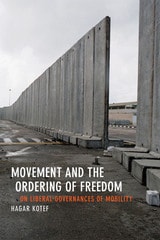
Movement and the Ordering of Freedom
On Liberal Governances of MobilityHagar Kotef
Duke University Press, 2015
We live within political systems that increasingly seek to control movement, organized around both the desire and ability to determine who is permitted to enter what sorts of spaces, from gated communities to nation-states. In Movement and the Ordering of Freedom, Hagar Kotef examines the roles of mobility and immobility in the history of political thought and the structuring of political spaces. Ranging from the writings of Locke, Hobbes, and Mill to the sophisticated technologies of control that circumscribe the lives of Palestinians in the Occupied West Bank, this book shows how concepts of freedom, security, and violence take form and find justification via “regimes of movement.” Kotef traces contemporary structures of global (im)mobility and resistance to the schism in liberal political theory, which embodied the idea of “liberty” in movement while simultaneously regulating mobility according to a racial, classed, and gendered matrix of exclusions.
[more]
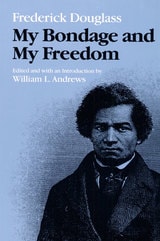
My Bondage and My Freedom
Frederick Douglass
University of Illinois Press, 1988
This is the first annotated edition of a work Eric J. Sundquist has called "a classic text of the American Renaissance." As Henry Louis Gates, Jr., has pointed out, My Bondage and My Freedom has been largely ignored by critics, in part because it is longer and less accessible than Narrative of the Life of Frederick Douglass but also because it has not up to now been "read" by a sensitive critic. "The latter reason is paramount and urgently needed to be addressed, and William Andrews is just the person to introduce Douglass's second autobiography to our generation of readers. He has few peers in nineteenth-century black criticism."
[more]