Results by title
130 books match the query 'Gay men' and 11 start with m
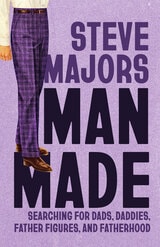
Man Made
Searching for Dads, Daddies, Father Figures, and FatherhoodSteve Majors
University of Wisconsin Press, 2025
In this poignant and provocative memoir, Steve Majors takes us on a journey of his own self-discovery as he grows from a gay boy in search of a father figure to a gay man grappling with what it means to be a father himself. In doing so, Majors creates various snapshots of time in which his—and the world’s—understanding of what it means to be a gay man changes.
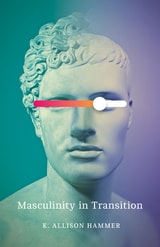
Masculinity in Transition
K. Allison Hammer
University of Minnesota Press, 2023
Locating the roots of toxic masculinity and finding its displacement in unruly culture
Masculinity in Transition analyzes shifting relationships to masculinity in canonical works of twentieth-century literature and film, as well as in twenty-first-century media, performance, and transgender poetics. Focusing on “toxic masculinity,” which has assumed new valence since 2016, K. Allison Hammer traces its roots to a complex set of ideologies embedded in the histories of settler colonialism, racial capitalism, and political fraternity, and finds that while toxic strains of masculinity are mainly associated with straight, white men, trans and queer masculinities can be implicated in these systems of power.
Hammer argues, however, that these malignant forms of masculinity are not fixed and can be displaced by “unruly alliances”—texts and relationships that reject the nationalisms and gender politics of white male hegemony and perform an urgently needed reimagining of what it means to be masculine. Locating these unruly alliances in the writings, performances, and films of butch lesbians, gay men, cisgender femmes, and trans and nonbinary individuals, Masculinity in Transition works through an archive of works of performance art, trans poetics, Western films and streaming media, global creative responses to HIV/AIDS, and working-class and “white trash” fictions about labor and unionization.
Masculinity in Transition moves the study of masculinity away from an overriding preoccupation with cisnormativity, whiteness, and heteronormativity, and toward a wider and more generative range of embodiments, identifications, and ideologies. Hammer’s bold rethinking of masculinity and its potentially toxic effects lays bare the underlying fragility of normative masculinity.
Retail e-book files for this title are screen-reader friendly with images accompanied by short alt text and/or extended descriptions.
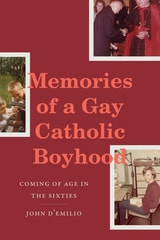
Memories of a Gay Catholic Boyhood
Coming of Age in the SixtiesJohn D'Emilio
Duke University Press, 2022
Memories of a Gay Catholic Boyhood is D’Emilio’s coming-of-age story in which he takes readers from his working-class Bronx neighborhood to an elite Jesuit high school in Manhattan to Columbia University and the political and social upheavals of the late 1960s. He shares his personal experiences of growing up in a conservative, tight-knit, multigenerational family, how he went from considering entering the priesthood to losing his faith and coming to terms with his same-sex desires. Throughout, D’Emilio outlines his complicated relationship with his family while showing how his passion for activism influenced his decision to use research, writing, and teaching to build a strong LGBTQ movement.
This is not just John D’Emilio’s personal story; it opens a window into how the conformist baby boom decade of the 1950s transformed into the tumultuous years of radical social movements and widespread protest during the 1960s. It is the story of what happens when different cultures and values collide and the tensions and possibilities for personal discovery and growth that emerge. Intimate and honest, D’Emilio’s story will resonate with anyone who has had to chart their own path in a world they did not expect to find.
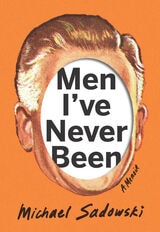
Men I've Never Been
Michael Sadowski
University of Wisconsin Press, 2021
Through wrenching tragedy and tense, life-threatening challenges, Sadowski learns to find love, purpose, and healthy self-regard. In coming to understand his identity and his place within his family, he meditates on the power of real human connection and comes to grasp the damage of his troubled upbringing and the traumas caused by toxic masculinity. By turns comic and tragic, this nuanced memoir uncovers the false selves we create to get along in the world and the price we pay to maintain them.
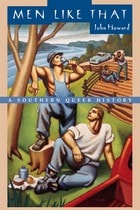
Men Like That
A Southern Queer HistoryJohn Howard
University of Chicago Press, 1999
Spanning four decades, Men Like That complicates traditional notions of a post-WWII conformist wave in America. Howard argues that the 1950s, for example, were a period of vibrant queer networking in Mississippi, while during the so-called "free love" 1960s homosexuals faced aggressive oppression. When queer sex was linked to racial agitation and when key civil rights leaders were implicated in homosexual acts, authorities cracked down and literally ran the accused out of town.
In addition to firsthand accounts, Men Like That finds representations of homosexuality in regional pulp fiction and artwork, as well as in the number one pop song about a suicidal youth who jumps off the Tallahatchie Bridge. And Howard offers frank, unprecedented assessments of outrageous public scandals: a conservative U.S. congressman caught in the act in Washington, and a white candidate for governor accused of patronizing black transgender sex workers.
The first book-length history of the queer South, Men Like That completely reorients our presuppositions about gay identity and about the dynamics of country life.
"Men Like That goes a long way towards redressing the urban bias in American lesbian and gay-history writing. . . . Howard's rigorous scholarship, which is based both on oral history and traditional historical documents . . . is enhanced by a disarmingly personal touch. . . . His insights into queerness and the mentality of the American South should be of great interest both to the professional gay historian and the general reader."—Madeleine Minson, Times Higher Education Supplement
"Howard creates a history remarkable in its complexity yet intimate in its portraiture. At long last an intimate and full vision of queer lives in America that did not unfold in San Francisco's discos."—Kirkus Reviews
"In this groundbreaking and engrossing analysis of gay male life in postwar Mississippi, Howard . . . boldly demonstrates that gay culture and sex not only existed but flourished in small towns."—Publishers Weekly, starred review
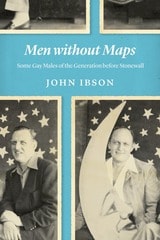
Men without Maps
Some Gay Males of the Generation before StonewallJohn Ibson
University of Chicago Press, 2019
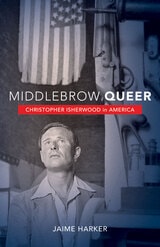
Middlebrow Queer
Christopher Isherwood in AmericaJaime Harker
University of Minnesota Press, 2013
How could one write about gay life for the mainstream public in Cold War America? Many midcentury gay American writers, hampered by external and internal censors, never managed to do it. But Christopher Isherwood did, and what makes his accomplishment more remarkable is that while he was negotiating his identity as a gay writer, he was reinventing himself as an American one. Jaime Harker shows that Isherwood refashioned himself as an American writer following his emigration from England by immersing himself in the gay reading, writing, and publishing communities in Cold War America.
Drawing extensively on Isherwood’s archives, including manuscript drafts and unpublished correspondence with readers, publishers, and other writers, Middlebrow Queer demonstrates how Isherwood mainstreamed gay content for heterosexual readers in his postwar novels while also covertly writing for gay audiences and encouraging a symbiotic relationship between writer and reader. The result—in such novels as The World in the Evening, Down There on a Visit, A Single Man, and A Meeting by the River—was a complex, layered form of writing that Harker calls “middlebrow camp,” a mode that extended the boundaries of both gay and middlebrow fiction.
Weaving together biography, history, and literary criticism, Middlebrow Queer traces the continuous evolution of Isherwood’s simultaneously queer and American postwar authorial identity. In doing so, the book illuminates many aspects of Cold War America’s gay print cultures, from gay protest novels to “out” pulp fiction.
Modern Nature
Derek Jarman
University of Minnesota Press, 2009
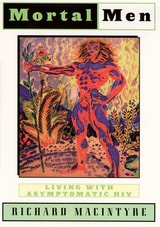
Mortal Men
Living with Asymptomatic HIVMac Intyre, Richard
Rutgers University Press, 1999
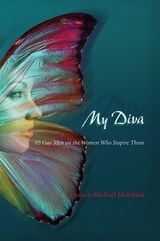
My Diva
65 Gay Men on the Women Who Inspire ThemEdited by Michael Montlack
University of Wisconsin Press, 2009
These witty and poignant short essays explore reasons for diva-worship as diverse as the writers themselves. My Diva offers both depth and glamour as it pays tribute with joy, intelligence, and fierce, fierce love.
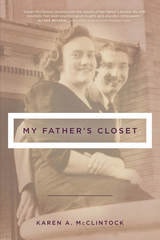
My Father’s Closet
Karen McClintock
The Ohio State University Press, 2017
“Karen McClintock reconstructs the details of her father’s double life with novelistic flair, keen psychological insight, and graceful compassion.” —Alison Bechdel
Thirty years after her father’s death, Karen McClintock sets out to find the gay father she never really knew. As we follow the unraveling family secret, we find ourselves drawn into her story as they stumble into infidelity, grieve heartbreaking losses, and remain loyal in love.
Set in Columbus, Ohio, My Father’s Closet tells the story of how just before the war, McClintock’s parents fell in love and married, while overseas in Germany the man whom she believes became her father’s lover was concealing his Jewish and gay identities in order to escape to America. A set of her father’s journals, letters her parents sent to each other during the Second World War, and a mysterious painting all lead her toward the truth about her gay father. McClintock weaves a complex secret into the fabric of lives we truly care about. And in the process, she leads us out of her father’s closet.
This gripping memoir captures the longing children feel for a distant or hidden parent and taps into the complexity of human connection and abandonment. The characters are resilient and vibrant. The hidden lovers, the nosey neighbors, and surprise lovers all show up. In the end, this extraordinary family finds ways to connect and freedom to love. Anyone who grew up with a family secret will appreciate the dynamics afoot in this fast-paced and compelling story.