Results by title
52 books match the query 'Gender identity in literature' and 3 start with m
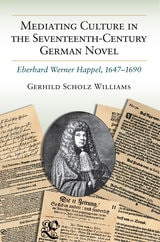
Mediating Culture in the Seventeenth-Century German Novel
Eberhard Werner Happel, 1647-1690Gerhild Scholz Williams
University of Michigan Press, 2014
Happel primarily lived and worked in the vigorous port city of Hamburg, which was a “media center” in terms of the access it offered to a wide library of books in public and private collections. Hamburg’s port status meant it buzzed with news and information, and Happel drew on this flow of data in his novels. His books deal with many topics of current interest—national identity formation, gender and sexualities, Western European encounters with neighbors to the East, confrontations with non-European and non-Western powers and cultures—and they feature multiple media, including news reports, news collections, and travel writings. As a result, Happel’s use of contemporary source material in his novels feeds our current interest in the impact of the production of knowledge on seventeenth-century narrative. Mediating Culture in the Seventeenth-Century German Novel explores the narrative wealth and multiversity of Happel’s work, examines Happel’s novels as illustrative of seventeenth-century novel writing in Germany, and investigates the synergistic relationship in Happel’s writings between the booming print media industry and the evolution of the German novel.
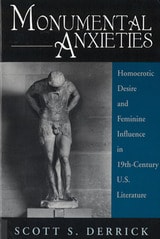
Monumental Anxieties
Homoerotic Desire and Feminine Influence in 19-th Century U.S. LiteratureDerrick, Scott S
Rutgers University Press, 1997
Scott Derrick has written an original book that contributes significantly to current revisions of the nineteenth-century American literary tradition's representation of gender and sexuality. His interpretation of feminist, lesbian-feminist, and gay issues in nineteenth-century American literature as complementary enlarges our historical understanding and helps build the coalition politics needed in these areas."-John Carlos Rowe, University of California, Irvine
Recent gender-based scholarship on nineteenth-century American literature has established male authors' crucial awareness of the competition from popular women writers. And critical work in gay studies and queer theory has stressed the importance in canonical American literature of homoerotic relations between men, even before "homosexuality" became codified at the end of the century. Scott Derrick draws on these insights to explore the ways in which male authors struggle to refigure literature-historically devalued as feminine-as a masculine and heterosexual enterprise. Derrick focuses on scenes of compositional crisis that reveal how male identity itself is at risk in the perils and possibilities of being a male author in a feminized literary marketplace.
He suggests that traditionally valued texts by Hawthorne, Poe, James, Sinclair, and Crane have at their core combustible four-sided conflicts between feminine identifications and masculine distancings, homoerotic longings and homophobic dreads, conflicts which are largely determined by domestic ideals of male and female roles within the nineteenth-century family. The negotiation of such conflicts is controlled by the nature of fiction writing, which both frees the imagination to explore forbidden fantasies and harnesses the imagination to public understandings of the proper form and content of fiction. Thus Monumental Anxieties also contributes to recent debates about the social shaping of contemporary homosexuality and to the history of American masculinity.
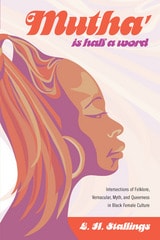
Mutha’ Is Half a Word
Intersections of Folklore, Vernacular, Myth, and Queerness in Black Female CultureL. H. Stallings
The Ohio State University Press, 2007