Results by title
97 books match the query 'Geopolitics' and 4 start with m
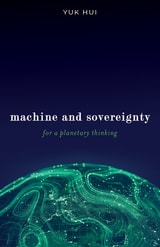
Machine and Sovereignty
For a Planetary Thinkingyuk
University of Minnesota Press, 2024
Developing a new political thought to address today’s planetary crises
What is “planetary thinking” today? Arguing that a new approach is urgently needed, Yuk Hui develops a future-oriented mode of political thought that encompasses the unprecedented global challenges we are confronting: the rise of artificial intelligence, the ecological crisis, and intensifying geopolitical conflicts.
Machine and Sovereignty starts with three premises. The first affirms the necessity of developing a new language of coexistence that surpasses the limits of nation-states and their variations; the second recognizes that political forms, including the polis, empire, and the state, are technological phenomena, which Lewis Mumford terms “megamachines.” The third suggests that a particular political form is legitimated and rationalized by a corresponding political epistemology. The planetary thinking that this book sketches departs from the opposition between mechanism and organism, which characterized modern thought, to understand the epistemological foundations of Hegel’s political state and Schmitt’s Großraum and their particular ways of conceiving the question of sovereignty. Through this reconstruction, Hui exposes the limits of the state and reflects on a new theoretical matrix based on the interrelated concepts of biodiversity, noodiversity, and technodiversity.
Arguing that we are facing the limit of modernity, of the eschatological view of history, of globalization, and of the human, Hui conceives necessary new epistemological and technological frameworks for understanding and rising to the crises of our present and our future.
Retail e-book files for this title are screen-reader friendly.

Making the World Safe for Capitalism
How Iraq Threatened the US Economic Empire and had to be DestroyedChristopher Doran
Pluto Press, 2012
The Iraq war defined the first decade of the twenty-first century – leading to mass protests and raising profound questions about domestic politics and the use of military force. Yet most explanations of the war have a narrow focus either on political personalities or oil.
Christopher Doran provides a unique perspective, arguing that the drive to war came from the threat Iraq might pose to American economic hegemony if the UN sanctions regime was ended. Doran argues that this hegemony is rooted in third world debt and corporate market access. It was protection of these arrangements that motivated US action, not Iraq’s alleged weapons of mass destruction or a simplistic desire to seize its oil.
This book will provide new insights on the war which still casts a shadow over global politics, and will have wide appeal to all those concerned about the Middle East, world peace and global development.
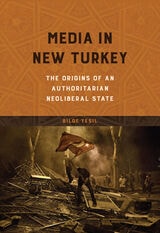
Media in New Turkey
The Origins of an Authoritarian Neoliberal StateBilge Yesil
University of Illinois Press, 2016
Yesil confronts essential questions regarding: the role of the state and military in building the structures that shaped Turkey's media system; media adaptations to ever-shifting contours of political and economic power; how the far-flung economic interests of media conglomerates leave them vulnerable to state pressure; and the ways Turkey's politicized judiciary criminalizes certain speech.
Drawing on local knowledge and a wealth of Turkish sources, Yesil provides an engrossing look at the fault lines carved by authoritarianism, tradition, neoliberal reform, and globalization within Turkey's increasingly far-reaching media.
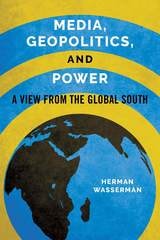
Media, Geopolitics, and Power
A View from the Global SouthHerman Wasserman
University of Illinois Press, 2018
Herman Wasserman analyzes the debates surrounding South Africa's new media presence against the backdrop of rapidly changing geopolitics. His exploration reveals how South African disputes regarding access to, and representation in, the media reflect the domination and inequality in the global communication sphere. Optimists see post-apartheid media as providing a vital space that encourages exchanges of opinion in a young democracy. Critics argue the public sphere mirrors South Africa's past divisions and privileges the viewpoints of the elite. Wasserman delves into the ways these simplistic narratives obscure the country's internal tensions, conflicts, and paradoxes even as he charts the diverse nature of South African entry into the global arena.