Results by title
278 books match the query 'Guide' and 16 start with m
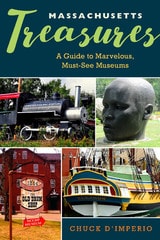
Massachusetts Treasures
A Guide to Marvelous, Must-See MuseumsChuck D'Imperio
University of Massachusetts Press, 2018
Well known for its world-renowned art museums—from the Clark Art Institute in Williamstown to the Museum of Fine Arts in Boston—Massachusetts is also home to numerous institutions with more eclectic collections and, oftentimes, lower profiles. These include Mansfield's National Black Doll Museum of History and Culture, Watertown's Plumbing Museum, and Granville's Noble and Cooley Center for Historic Preservation.
In Massachusetts Treasures, Chuck D'Imperio explores more than forty museums scattered throughout the Bay State, from Cape Cod to the Berkshires. Many—but not all—might be considered “offbeat,” and each and every one is enchanting. Through personal visits and interviews with founders and directors, D'Imperio offers an inside glimpse into some of the Commonwealth's most unique museums, providing a valuable guide for road warriors and history buffs discovering Massachusetts either for the first or the tenth time.
Maya for Travelers and Students
A Guide to Language and Culture in YucatanBy Gary Bevington
University of Texas Press, 1995
The Yucatan Peninsula draws many North American and European travelers each year to view the ruins of the pre-Columbian Classical Maya civilization and the abundant native flora and fauna. For these travelers, as well as armchair travelers and students, Gary Bevington has prepared the first general English-language introduction to Yucatec Maya, the native language of the people indigenous to the region.
Written in nontechnical terms for learners who have a basic knowledge of simple Mexican Spanish, the book presents easily understood, practical information for anyone who would like to communicate with the Maya in their native language. In addition to covering the pronunciation and grammar of Maya, Bevington includes invaluable tips on learning indigenous languages "in the field." Most helpful are his discussions of the cultural and material worlds of the Maya, accompanied by essential words and expressions for common objects and experiences. A Maya-English-Spanish glossary with extensive usage examples and an English-Maya glossary conclude the book.
Note: The supplemental audiocasette, Spoken Maya for Travelers and Students, is now available as a free download through the book's page on the University of Texas Press's website.
Medical Editing
A Guide to Learning the Craft and Building Your CareerBarbara Gastel
University of Chicago Press, 2025
Medical editing is a thriving and wide-ranging specialty within the editorial profession. Its practitioners occupy a unique ecosystem that involves its own style manuals and the ability to work with highly technical medical terminology and issues, and its work helps ensure that health practitioners, researchers, and the public receive sound, understandable medical information. Today, opportunities abound for medical editors—who come from many backgrounds and work in many settings, such as medical journals, medical institutions, and the freelance realm.
Written by an experienced and award-winning editor, Medical Editing: A Guide to Learning the Craft and Building Your Career provides a thorough introduction to the profession. At levels ranging from the punctuation mark to the publication, Barbara Gastel provides accessible and concrete instruction in editing medical writing. Distinctively, the book also explores ethical issues encountered in medical editing and other topics such as working effectively with medical authors, editing medical writing by and for nonnative users of English, and editing medical conference presentations.
For those considering entering medical editing or transitioning from other employment, the book also provides helpful career guidance. Readers will learn about the range of medical editing positions, receive advice on taking medical editing tests for employment, learn about certificates and certifications in the field, and more.
Enhanced by examples, exercises, and humor, Medical Editing will benefit both prospective and beginning medical editors while serving as a useful resource for experienced editors, teachers of courses in related fields, and supervisors mentoring interns or new hires.

Medical Readers' Theater
A Guide and ScriptsTodd L. Savitt
University of Iowa Press, 2002

Michigan Ferns and Lycophytes
A Guide to Species of the Great Lakes RegionDaniel D. Palmer
University of Michigan Press, 2018
Unlike the well-studied flowering plants and gymnosperms, Michigan’s ferns and lycophytes have long lacked a reliable, up-to-date guidebook, and this book fills that gap. Covering all 120 taxa found in the state, it features detailed keys, species descriptions, and range maps alongside precise illustrations. Readers learn about the etymology of species’ common and scientific names as well as interesting facts about their historic uses by humans and place within the Michigan ecosystem. The book also provides information on the challenging taxonomy of many ferns and lycophytes, with special attention given to the species likely to hybridize and those prone to misidentification. This is a must-have reference for anyone who wishes to learn about these important components of the Great Lakes flora.
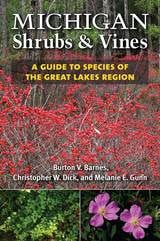
Michigan Shrubs and Vines
A Guide to Species of the Great Lakes RegionBurton V. Barnes, Christopher W. Dick, and Melanie E. Gunn
University of Michigan Press, 2016
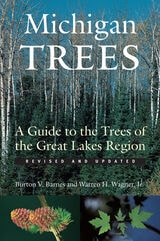
Michigan Trees, Revised and Updated
A Guide to the Trees of the Great Lakes RegionBurton V. Barnes and Warren H. Wagner, Jr.
University of Michigan Press, 2004
Now in its tenth decade of publication, Michigan Trees has been, since it was first introduced in 1913, the must-have reference book for anyone who wants to know about the trees of this unique North American region.
In this new and updated edition, several new species have been added to the lineup, as well as sections on tree ecology and fall color. Written and illustrated in a style that appeals at once to academic botanists and armchair arborphiles alike, Michigan Trees gives readers everything they need to know for identifying trees in the Great Lakes state. Included with each description are fascinating notes and asides (for example, this tidbit on the jack pine: "Parklike or savanna stands in north-central Michigan are prime habitat for the rare Kirtland's warbler that breeds nowhere else in the world."). Also includes a tree key and identification section illustrated with elegantly simple line drawings that reveal the tiny, signature details that make each tree unique.
Burton V. Barnes is Professor of Forestry at the University of Michigan. Formerly a research forester, he is best known for his research and publications in forest ecology and forest genetics.
Warren H. Wagner, Jr. was a world authority on ferns. He had been Professor Emeritus of Botany and Natural Resources at the University of Michigan before his death at the age of 80 in 2000.

Minnesota History
Guide to Reading and StudyTheodore C. Blegen
University of Minnesota Press, 1960
Minnesota History was first published in 1960. Minnesota Archive Editions uses digital technology to make long-unavailable books once again accessible, and are published unaltered from the original University of Minnesota Press editions.
Anyone interested in Minnesota history, whether as a teacher, as a student, or as a general reader, will find this an invaluable guide to reading and study. The book contains an outline of the state's history, questions and suggestions for the student, and lists of reading material for each of the 42 topical sections into which the outline is divided.
The outline covers the entire history of the state from the time of the Indians, before the French and British explorations, to the present. The reading references include accounts written from the seventeenth through the twentieth centuries. The aim in preparing the reading lists was to include any article or book bearing upon the Minnesota story which met the qualifications of good historical writing and fair accessibility. Materials of particular interest or importance to the topic under consideration are so designated, and there are liberal annotations to help the reader in his choice of readings. References which are particularly appropriate for young readers are also specially designated. A number of maps are provided for additional guidance.
This is a complete revision of a book long out of print, Minnesota History: A Study Outline by Theodore C. Blegen.
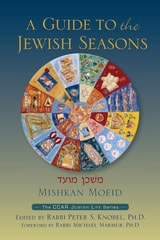
Mishkan Moeid
A Guide to the Jewish SeasonsRabbi Peter S. Knobel, PhD
Central Conference of American Rabbis, 2013
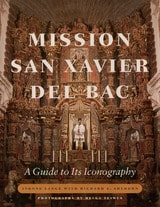
Mission San Xavier del Bac
A Guide to Its IconographyYvonne Lange with Richard E. Ahlborn; Photographs by Helga Teiwes
University of Arizona Press, 2004
This book is the first study of the iconography at San Xavier since its restoration in the 1990s by an international team of professional conservators. It expands our understanding of the numerous Catholic images and emblems of San Xavier through a close analysis of the newly revealed iconographic elements and an interpretation of the significance of their placement. It also proposes that the selection of specific religious themes and their locations was determined by an unfamiliar convention based on a tree-like design, in which the founder of a religious Order appears as the root and followers above in later branchings—an inversion of the more familiar top-to-bottom hierarchy.
Historians Lange and Ahlborn identify all the saintly images and religious elements that adorn San Xavier and suggest how and why they are so arranged. They examine the sculptures and paintings of the church from the façade throughout the cruciform interior in order to determine the organizational concepts that underlie their placement. They note that the selection of images in this Franciscan mission follows traditional Roman Catholic practice for decorating churches in order to instruct novices and reinforce the teaching of conversion in a pictographic catechism of Church doctrine. In short, the book is a dictionary of religious personages and symbols that will help the visitor identify the biblical stories and people portrayed, as well as associated signs and symbols. Entries include a description of the subject, its location, appropriate cross-references, and a bibliography. Recent illustrations by photographer Helga Teiwes and a floor plan facilitate the location of images by visitors.
A handsome, large-format book featuring more than one hundred photographs and supporting line illustrations, Lange and Ahlborn’s work confirms the significance of San Xavier’s iconography for art historians, students of religion, and visitors alike. It is both an incomparable guide and valuable reference source for the famed mission’s magnificent artistic heritage.
Module 17
Implementing DACS: A Guide to the Archival Content StandardCory Nimer
Society of American Archivists, 2017
Montana Pay Dirt
Guide To Mining Camps Of Treasure StateMuriel Sibell Wolle
Ohio University Press, 1963
Moths in Your Pocket
A Guide to the Saturn and Sphinx Moths of the Upper MidwestJim Durbin, Frank Olsen, and Tom Jantscher
University of Iowa Press, 2014
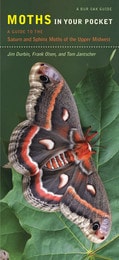
The Saturniid, or Giant Silk moths, are well named. Their large size—up to 6.5 inches for the cecropia moth—and the soft silky browns, greens, and oranges of their wings are unforgettable when they appear at a lighted window at night. Equally well named are the Sphinx or Hawk moths, important pollinators that hover like hummingbirds when nectar-feeding at dusk and even in daylight. The caterpillars of both families can be just as distinctive as the adults, as anyone who has ever come upon a tobacco or a tomato hornworm can attest.
For each species the authors have included common and scientific names, wingspan, and time of flight for the adults at this final stage in their life cycle. Striking photographs of the adult moths and of their larval stages make this guide as beautiful as it is useful.
For all naturalists captivated by the clear window eyespots of a Swallow-tailed Luna moth, the dark eyespots and bright yellow “pupils” of an Io moth, or the extendable proboscis of a White-lined Sphinx moth flitting from one moss rose to another, the photographs and descriptions in Moths in Your Pocket will be an invaluable reference.
Motivation for Learning
A Guide for the Teacher of the Young AdultStanford C. Ericksen
University of Michigan Press, 1974

Mushrooms in Your Pocket
A Guide to the Mushrooms of IowaDonald M. And Lois H. Huffman & Tiffany
University of Iowa Press, 2004
In addition to crocuses and robins, springtime in Iowa brings out another harbinger of warmer weather: mushrooms. Melting snow and warmer temperatures provide optimal opportunity for mushroom enthusiasts; people of all ages can be found wandering the woods, clutching bags and hoping to spot a clump of elusive morels. Now, for budding naturalists, beginning mushroom hunters, and professionals outside of the area of mycology, Donald Huffman and Lois Tiffany have provided this laminated guide to the most common mushrooms of Iowa.
The guide illustrates forty-three species of Iowa mushrooms using color photos that show the fungi in the wild, from the yellow morel to the destroying angel to the pear-shaped puffball. Huffman and Tiffany give common and scientific names, descriptions of caps and stalks, descriptions of where the mushrooms can be found (on the ground in woods, in clusters on fallen logs, etc.), the season when they are most likely to be seen, plus information on edibility from the “choice edible” yellow morel, much coveted by generations of mushroom hunters, to the poisonous false morel.
Mushrooms’ diverse forms and variety of colors, along with their seemingly mysterious appearances and disappearances, have long made them objects of fascination. Mushrooms in Your Pocket will be an invaluable companion for finding and identifying these unusual and interesting organisms.
Mythology of the Lenape
Guide and TextsJohn Bierhorst
University of Arizona Press, 1995
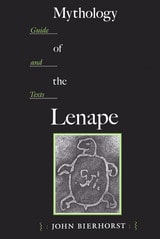
This catalog of Lenape mythology, featuring synopses of all known Lenape tales, was assembled by folklorist John Bierhorst from historical sources and from material collected by linguists and ethnographers—a difficult task in light of both the paucity of research done on Lenape mythology and the fragmentation of traditional Lenape culture over the past three centuries.
Bierhorst here offers an unprecedented guide to the Lenape corpus with supporting texts. Part one of the "Guide" presents a thematic summary of the folkloric tale types and motifs found throughout the texts; part two presents a synopsis of each of the 218 Lenape narratives on record; part three lists stories of uncertain origin; and part four compares types and motifs occurring in Lenape myths with those found in myths of neighboring Algonquian and Iroquoian cultures.
In the "Texts" section of the book, Bierhorst presents previously unpublished stories collected in the early twentieth century by ethnographers M. R. Harrington and Truman Michelson. Included are two versions of the Lenape trickster cycle, narratives accounting for dance origins, Lenape views of Europeans, and tales of such traditional figures as Mother Corn and the little man of the woods called Wemategunis.
By gathering every available example of Lenape mythology, Bierhorst has produced a work that will long stand as a definitive reference. Perhaps more important, it restores to the land in which the Lenape once thrived a long-missing piece of its Native literary heritage.