62 books match the query 'Hawaii' and 4 start with m
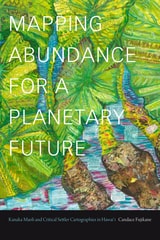
cover of Mapping Abundance for a Planetary Future: Kanaka Maoli and Critical Settler Cartographies in Hawai'i

Mapping Abundance for a Planetary Future

Kanaka Maoli and Critical Settler Cartographies in Hawai'i

Candace Fujikane

Duke University Press, 2021

In Mapping Abundance for a Planetary Future, Candace Fujikane contends that the practice of mapping abundance is a radical act in the face of settler capital's fear of an abundance that feeds. Cartographies of capital enable the seizure of abundant lands by enclosing "wastelands" claimed to be underdeveloped. By contrast, Kanaka Maoli (Native Hawaiian) cartographies map the continuities of abundant worlds. Vital to restoration movements is the art of kilo, intergenerational observation of elemental forms encoded in storied histories, chants, and songs. As a participant in these movements, Fujikane maps the ecological lessons of these elemental forms: reptilian deities who protect the waterways, sharks who swim into the mountains, the navigator Māui who fishes up the islands, the deities of snow and mists on Mauna Kea. The laws of these elements are now being violated by toxic waste dumping, leaking military jet fuel tanks, and astronomical-industrial complexes. As Kānaka Maoli and their allies stand as land and water protectors, Fujikane calls for a profound attunement to the elemental forms in order to transform climate events into renewed possibilities for planetary abundance.
[more]
cover of Mark Twain on the Move: A Travel Reader

Mark Twain on the Move

A Travel Reader

Alan Gribben

University of Alabama Press, 2008

Journeys, humor, and insight from Mark Twain's travel narratives - America’s literary master.

Mark Twain on the Move gathers the very best passages from all five of Mark Twain’s travel narratives: The Innocents Abroad (1869), Roughing It (1872), A Tramp Abroad (1880), Life on the Mississippi (1883), and Following the Equator (1897). Although Twain’s travel narratives were his best sellers throughout his career, modern readers are largely unfamiliar with them. Thus, readers are not only missing some of Twain’s most hilarious and insightful material, they are also missing a complete understanding of a beloved literary and cultural icon.

Mark Twain on the Move presents the best of these works—sometimes respectful, often irreverent and outlandish—at their most lively and captures his renowned experiences as an American tourist. And they demonstrate why Twain’s greatest popularity in his lifetime derived from his travel writings rather than from his novels. Twain was always entertaining and provocative while on the move and this collection captures that fabled energy for modern readers.
[more]
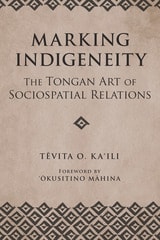
cover of Marking Indigeneity: The Tongan Art of Sociospatial Relations

Marking Indigeneity

The Tongan Art of Sociospatial Relations

Tevita O. Ka‘ili; Foreword by ‘Okusitino Mahina

University of Arizona Press, 2017

Tongans, the native people of the Kingdom of Tonga in the South Pacific, are a highly mobile indigenous group. Like their seafaring ancestors, they are constantly on the move across tā (time) and vā (space). Carrying their traditions with them, Tongans living in Maui, Hawai‘i, actively mediate those dimensions by extending the time-space structure of certain activities and places in order to practice tauhi vā—the marking of time to sustain harmonious relations and create beautiful sociospatial relations.

In Marking Indigeneity, Tevita O. Ka‘ili examines the conflicts and reconciliation of indigenous time-space within the Tongan community in Maui, as well as within the time-space of capitalism. Using indigenous theory, he provides an ethnography of the social relations of the highly mobile Tongans.

Focusing on tauhi vā, Ka‘ili notes certain examples of this time marking: the faikava gatherings that last from sunset to sunrise, long eating gatherings, long conversations (talanoa), the all-night funeral wakes, and the early arrival to and late departure from meetings and celebrations. Ka‘ili also describes the performing art of tauhi vā, which creates symmetry through the performance of social duties (fatongia). This gives rise to powerful feelings of warmth, elation, and honor among the performers. Marking Indigeneity offers an ethnography of the extension of time-space that is rooted in ancient Moana oral traditions, thoughtfully illustrating the continuation of these traditions.
 
[more]
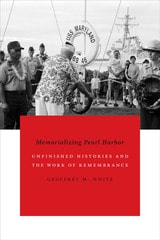
cover of Memorializing Pearl Harbor: Unfinished Histories and the Work of Remembrance

Memorializing Pearl Harbor

Unfinished Histories and the Work of Remembrance

Geoffrey M. White

Duke University Press, 2016

Memorializing Pearl Harbor examines the challenge of representing history at the site of the attack that brought America into World War II. Analyzing moments in which history is re-presented—in commemorative events, documentary films, museum design, and educational programming—Geoffrey M. White shows that the memorial to the Pearl Harbor bombing is not a fixed or singular institution. Rather, it has become a site in which many histories are performed, validated, and challenged. In addition to valorizing military service and sacrifice, the memorial has become a place where Japanese veterans have come to seek recognition and reconciliation, where Japanese Americans have sought to correct narratives of racial mistrust, and where Native Hawaiians have challenged their ongoing erasure from their own land. Drawing on extended ethnographic fieldwork, White maps these struggles onto larger controversies about public history, museum practices, and national memory.
[more]