Results by title
82 books match the query 'Hermeneutics' and 3 start with m
Making Sense in Life and Literature
Hans Ulrich Gumbrecht
University of Minnesota Press, 1992
“The translation of these essays by Gumbrecht on literary theory and history marks the appearance in English of one of Europe’s most learned, productive, and inventive scholars. Their range is extraordinary. They show that Gumbrecht is not only a sophisticated theorist and historian of literature, but a master practitioner of cultural studies.” --Hayden White, University of California, Santa Cruz
[more]
Michel Foucault
Beyond Structuralism and HermeneuticsHubert L. Dreyfus and Paul Rabinow
University of Chicago Press, 1983
This book, which Foucault himself has judged accurate, is the first to provide a sustained, coherent analysis of Foucault's work as a whole.
To demonstrate the sense in which Foucault's work is beyond structuralism and hermeneutics, the authors unfold a careful, analytical exposition of his oeuvre. They argue that during the of Foucault's work became a sustained and largely successful effort to develop a new method—"interpretative analytics"—capable fo explaining both the logic of structuralism's claim to be an objective science and the apparent validity of the hermeneutical counterclaim that the human sciences can proceed only by understanding the deepest meaning of the subject and his tradition.
"There are many new secondary sources [on Foucault]. None surpass the book by Hubert Dreyfus and Paul Rabinow. . . . The American paperback edition contains Foucault's 'On the Genealogy of Ethics,' a lucid interview that is now our best source for seeing how he construed the whole project of the history of sexuality."—David Hoy, London Review of Books
[more]
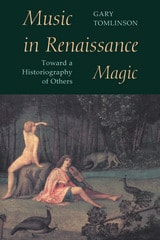
Music in Renaissance Magic
Toward a Historiography of OthersGary Tomlinson
University of Chicago Press, 1994
Magic enjoyed a vigorous revival in sixteenth-century Europe, attaining a prestige lost for over a millennium and becoming, for some, a kind of universal philosophy. Renaissance music also suggested a form of universal knowledge through renewed interest in two ancient themes: the Pythagorean and Platonic "harmony of the celestial spheres" and the legendary effects of the music of bards like Orpheus, Arion, and David. In this climate, Renaissance philosophers drew many new and provocative connections between music and the occult sciences.
In Music in Renaissance Magic, Gary Tomlinson describes some of these connections and offers a fresh view of the development of early modern thought in Italy. Raising issues essential to postmodern historiography—issues of cultural distance and our relationship to the others who inhabit our constructions of the past —Tomlinson provides a rich store of ideas for students of early modern culture, for musicologists, and for historians of philosophy, science, and religion.
"A scholarly step toward a goal that many composers have aimed for: to rescue the idea of New Age Music—that music can promote spiritual well-being—from the New Ageists who have reduced it to a level of sonic wallpaper."—Kyle Gann, Village Voice
"An exemplary piece of musical and intellectual history, of interest to all students of the Renaissance as well as musicologists. . . . The author deserves congratulations for introducing this new approach to the study of Renaissance music."—Peter Burke, NOTES
"Gary Tomlinson's Music in Renaissance Magic: Toward a Historiography of Others examines the 'otherness' of magical cosmology. . . . [A] passionate, eloquently melancholy, and important book."—Anne Lake Prescott, Studies in English Literature
[more]