Results by title
715 books match the query 'Higher' and 26 start with m
MOOCs and Their Afterlives
Experiments in Scale and Access in Higher EducationEdited by Elizabeth Losh
University of Chicago Press, 2017
Elizabeth Losh has gathered experts from across disciplines—education, rhetoric, philosophy, literary studies, history, computer science, and journalism—to tease out lessons and chart a course into the future of open, online education. Instructors talk about what worked and what didn’t. Students share their experiences as participants. And scholars consider the ethics of this education. The collection goes beyond MOOCs to cover variants such as hybrid or blended courses, SPOCs (Small Personalized Online Courses), and DOCCs (Distributed Open Collaborative Course). Together, these essays provide a unique, even-handed look at the MOOC movement and will serve as a thoughtful guide to those shaping the next steps for open education.
Machine Scoring of Student Essays
Truth and Consequencesedited by Patricia Freitag Ericsson & Rich Haswell
Utah State University Press, 2006
The current trend toward machine-scoring of student work, Ericsson and Haswell argue, has created an emerging issue with implications for higher education across the disciplines, but with particular importance for those in English departments and in administration. The academic community has been silent on the issue—some would say excluded from it—while the commercial entities who develop essay-scoring software have been very active.
Machine Scoring of Student Essays is the first volume to seriously consider the educational mechanisms and consequences of this trend, and it offers important discussions from some of the leading scholars in writing assessment.
Reading and evaluating student writing is a time-consuming process, yet it is a vital part of both student placement and coursework at post-secondary institutions. In recent years, commercial computer-evaluation programs have been developed to score student essays in both of these contexts. Two-year colleges have been especially drawn to these programs, but four-year institutions are moving to them as well, because of the cost-savings they promise. Unfortunately, to a large extent, the programs have been written, and institutions are installing them, without attention to their instructional validity or adequacy.
Since the education software companies are moving so rapidly into what they perceive as a promising new market, a wider discussion of machine-scoring is vital if scholars hope to influence development and/or implementation of the programs being created. What is needed, then, is a critical resource to help teachers and administrators evaluate programs they might be considering, and to more fully envision the instructional consequences of adopting them. And this is the resource that Ericsson and Haswell are providing here.
Major Trade-Offs
The Surprising Truths about College Majors and Entry-Level JobsCorey Moss-Pech
University of Chicago Press, 2025
Humanities majors are used to answering the question, “So, what are you going to do with that degree?” The common misconception is that students in humanities programs don’t learn any useful skills for the real world. In Major Trade-Offs, sociologist Corey Moss-Pech argues that not only do humanities majors learn real-world skills, but they actually use them when they graduate. Despite this discrepancy, graduates with so-called practical degrees like business and engineering are much more likely to find employment, and they earn higher salaries. Why do we belittle a liberal arts education despite the valuable skills that students acquire during their studies?
Major Trade-Offs addresses this question by following students from different majors as they enter the workforce. To understand the relationship between majors and entry-level jobs, Moss-Pech conducted nearly 200 interviews with roughly ninety students from four majors at a large Midwestern university: engineering, business, English, and communications. He follows these students through their senior years, chronicling their internships and the support their universities provide in helping them pursue their career paths. He found that graduates from practical majors entered the labor market successfully, typically through structured internship programs. However, many ended up in entry-level jobs that, while well-paid, were largely clerical and didn’t necessarily require a degree to perform. On the other hand, liberal arts majors rarely accessed structured internships and were largely left to carve out their own paths, but did use their degree skills once they secured a job. These results challenge popular myths about the “marketability” of these different majors and offer a new vision for the future of higher education. Liberal arts skills are essential in the labor market, and yet educators and policymakers still push resources into the practical arts, perpetuating the myth that those majors are more valuable while depriving students of a well-rounded education and leaving them no better prepared for the workforce than liberal arts students.
Of interest to students, educators, and employers, Major Trade-Offs calls on colleges and universities to advocate for liberal arts majors, leveling the playing field for students as they plan for entry-level work.
Major Trade-Offs
The Surprising Truths about College Majors and Entry-Level JobsCorey Moss-Pech
University of Chicago Press, 2025
This is an auto-narrated audiobook version of this book.
An eye-opening look at the relationship between students’ majors and their entry-level jobs.
Humanities majors are used to answering the question, “So, what are you going to do with that degree?” The common misconception is that students in humanities programs don’t learn any useful skills for the real world. In Major Trade-Offs, sociologist Corey Moss-Pech argues that not only do humanities majors learn real-world skills, but they actually use them when they graduate. Despite this discrepancy, graduates with so-called practical degrees like business and engineering are much more likely to find employment, and they earn higher salaries. Why do we belittle a liberal arts education despite the valuable skills that students acquire during their studies?
Major Trade-Offs addresses this question by following students from different majors as they enter the workforce. To understand the relationship between majors and entry-level jobs, Moss-Pech conducted nearly 200 interviews with roughly ninety students from four majors at a large Midwestern university: engineering, business, English, and communications. He follows these students through their senior years, chronicling their internships and the support their universities provide in helping them pursue their career paths. He found that graduates from practical majors entered the labor market successfully, typically through structured internship programs. However, many ended up in entry-level jobs that, while well-paid, were largely clerical and didn’t necessarily require a degree to perform. On the other hand, liberal arts majors rarely accessed structured internships and were largely left to carve out their own paths, but did use their degree skills once they secured a job. These results challenge popular myths about the “marketability” of these different majors and offer a new vision for the future of higher education. Liberal arts skills are essential in the labor market, and yet educators and policymakers still push resources into the practical arts, perpetuating the myth that those majors are more valuable while depriving students of a well-rounded education and leaving them no better prepared for the workforce than liberal arts students.
Of interest to students, educators, and employers, Major Trade-Offs calls on colleges and universities to advocate for liberal arts majors, leveling the playing field for students as they plan for entry-level work.
Making Academic Presentations
What Every University Student Needs to KnowRobyn Brinks Lockwood
University of Michigan Press, 2023
The book includes a variety of tasks that will help students practice developing and analyzing presentations as well as practice projects for applying these lessons. In addition, rubrics and evaluation forms are included for instructors to adapt and use for evaluation purposes.
Making Administrative Work Visible
Data-Driven Advocacy for Understanding the Labor of Writing Program AdministrationLeigh Graziano
Utah State University Press, 2023
The collection has three parts, each of which focuses on the most confounding challenges facing WPAs as well as the most compelling sites of their contributions to administration, labor in higher education, and the discipline’s collective obligation to forwarding the goals of social justice and advocacy: Advocating through Representations of WPA Labor, Advocating by Accounting for Time and Labor, and Advocating in and through Complex Institutional Contexts. The chapters use data to share and track the work functions, job titles, grand narratives, program assessments, tenure and promotion, email practices, and more undertaken by WPAs in their administrative capacities. Chapters also surface narratives for future data and studies to be done by other scholars.
By taking up and answering questions about the range of WPA work—and the invisibility of much of that work—Making Administrative Work Visible creates avenues toward accounting for and acknowledging the complex activity systems in which WPAs lead the work of the university and advocate for data-driven strategies needed to sustain this foundational area of higher education.
Contributors: Kamila Albert, Brooke Anderson, Sheila Carter-Tod, Amy Cicchino, Ana Cortés Lagos, Kristi Murray Costello, Jennifer Cunningham, Ryan Dippre, Kimberly Emmons, Genevieve García de Müeller, Jill Gladstein, Caleb González, Michael Healy, Lyra Hilliard, Kristine Johnson, Seth Kahn, Rita Malenczyk, Troy Mikanovich, Lilian Mina, Angela Mitchell, Greer Murphy, Kate Navickas, Michael Neal, Patti Poblete, Jan Rieman, Heather Robinson, Katelyn Stark, Mary Stewart, Natalie Stillman-Webb, Lizbett Tinoco, Lisa Tremain, Martha Wilson Schaffer
Making Sense of the College Curriculum
Faculty Stories of Change, Conflict, and AccommodationZemsky, Robert
Rutgers University Press, 2018
Making the Radical University
Identity and Politics on the American College Campus, 1966–1991Elizabeth M. Kalbfleisch
University of Massachusetts Press, 2024
In the 1960s, professors, students, and activists on the political Left viewed college curricula as useful sites for political transformation. They coordinated efforts to alter general education requirements at the college level to foster change in American thought, with greater openness toward people who had previously been excluded, including women, people of color, the poor and working classes, people with disabilities, and members of the LGBTQ community. Their work reshaped American culture and politics, while prompting a significant backlash from conservatives attempting to, in their view, protect classical education from modern encroachment.
Elizabeth M. Kalbfleisch details how American universities became a battleground for identity politics from the 1960s through the 1980s. Focusing on two case studies at Stanford University and the University of Texas at Austin, Making the Radical University examines how curricular changes led to polarizing discussions nationwide around academic standards and identity politics, including the so-called canon wars. Today, these debates have only become more politically charged, complex, and barbed.
Making the World Global
U.S. Universities and the Production of the Global ImaginaryIsaac A. Kamola
Duke University Press, 2019
Making, Keeping, and Losing Friends
How Campuses Shape College Students' NetworksJanice M. McCabe
University of Chicago Press, 2025
We’re all familiar with the sentiment that “college is the best time of your life.” Along with a newfound sense of freedom, students have a unique opportunity to forge lifelong friendships at a point in life when friendship is particularly important. Why is it, then, that so many college students are falling victim to what the US Surgeon General termed an “epidemic of loneliness and isolation”? How do different aspects of college life help or hinder students’ ability to form deep connections?
In Making, Keeping, and Losing Friends: How Campuses Shape College Students’ Networks, sociologist Janice M. McCabe shows that the way a college is structured—whether students live in dorms or commute, study abroad or stay close to campus, have plentiful common areas for clubs to meet or not—can either encourage or hinder the making of meaningful friendships. Based on interviews with 95 students on three distinct campuses—a small private college (Dartmouth College), a large public university (University of New Hampshire), and a non-residential community college (Manchester Community College)—McCabe captures a wide range of experiences and discovers how features of the campuses make it easier or harder for students to make and keep friends. She shows how and why, across all three institutions, some students thrive in deep and lasting friendships with their peers.
As McCabe’s research reveals, we need to look at the structures of students’ networks, the institutions they attend, and the importance of their identities in these places if we are to truly uncover and address the loneliness epidemic facing today’s young adults.
Mama, PhD
Women Write about Motherhood and Academic LifeEvans, Elrena
Rutgers University Press, 2008
Amid these disadvantages, what is a Mama, PhD to do? This literary anthology brings together a selection of deeply felt personal narratives by smart, interesting women who explore the continued inequality of the sexes in higher education and suggest changes that could make universities more family-friendly workplaces.
The contributors hail from a wide array of disciplines and bring with them a variety of perspectives, including those of single and adoptive parents. They address topics that range from the level of policy to practical day-to-day concerns, including caring for a child with special needs, breastfeeding on campus, negotiating viable maternity and family leave policies, job-sharing and telecommuting options, and fitting into desk/chair combinations while eight months pregnant.
Candid, provocative, and sometimes with a wry sense of humor, the thirty-five essays in this anthology speak to and offer support for any woman attempting to combine work and family, as well as anyone who is interested in improving the university's ability to live up to its reputation to be among the most progressive of American institutions.
Manufacturing Morals
The Values of Silence in Business School EducationMichel Anteby
University of Chicago Press, 2013
In an era when many organizations are focused on principles of responsibility, Harvard Business School has long tried to promote better business standards. Anteby’s rich account reveals the surprising role of silence and ambiguity in HBS’s process of codifying morals and business values. As Anteby describes, at HBS specifics are often left unspoken; for example, teaching notes given to faculty provide much guidance on how to teach but are largely silent on what to teach. Manufacturing Morals demonstrates how faculty and students are exposed to a system that operates on open-ended directives that require significant decision-making on the part of those involved, with little overt guidance from the hierarchy. Anteby suggests that this model—which tolerates moral complexity—is perhaps one of the few that can adapt and endure over time.
Manufacturing Morals is a perceptive must-read for anyone looking for insight into the moral decision-making of today’s business leaders and those influenced by and working for them.
Mapping Racial Literacies
College Students Write about Race and SegregationSophie R. Bell
Utah State University Press, 2020
This textual ethnography embeds early college students’ writing in deep historical and theoretical contexts and looks for new ways that their writing contributes to and reshapes contemporary understandings of how US and global citizens are thinking about race. The book is a teaching narrative, tracing a teaching journey that considers student writing not only in the moments it is assigned but also in continual revisions of the course, making it a useful tool in helping college-age students see, explore, and articulate the role of race in determining their life experiences and opportunities.
Sophie Bell’s work narrates the experiences of a white teacher making mistakes in teaching about race and moving forward through those mistakes, considering that process valuable and, in fact, necessary. Providing a model for future scholars on how to carve out a pedagogically responsive identity as a teacher, Mapping Racial Literacies contributes to the scholarship on race and writing pedagogy and encourages teachers of early college classes to bring these issues front and center on the page, in the classroom, and on campus.
Masters of Theory
Cambridge and the Rise of Mathematical PhysicsAndrew Warwick
University of Chicago Press, 2003
When Isaac Newton published the Principia three centuries ago, only a few scholars were capable of understanding his conceptually demanding work. Yet this esoteric knowledge quickly became accessible in the nineteenth and early twentieth centuries when Britain produced many leading mathematical physicists. In this book, Andrew Warwick shows how the education of these "masters of theory" led them to transform our understanding of everything from the flight of a boomerang to the structure of the universe.
Warwick focuses on Cambridge University, where many of the best physicists trained. He begins by tracing the dramatic changes in undergraduate education there since the eighteenth century, especially the gradual emergence of the private tutor as the most important teacher of mathematics. Next he explores the material culture of mathematics instruction, showing how the humble pen and paper so crucial to this study transformed everything from classroom teaching to final examinations. Balancing their intense intellectual work with strenuous physical exercise, the students themselves—known as the "Wranglers"—helped foster the competitive spirit that drove them in the classroom and informed the Victorian ideal of a manly student. Finally, by investigating several historical "cases," such as the reception of Albert Einstein's special and general theories of relativity, Warwick shows how the production, transmission, and reception of new knowledge was profoundly shaped by the skills taught to Cambridge undergraduates.
Drawing on a wealth of new archival evidence and illustrations, Masters of Theory examines the origins of a cultural tradition within which the complex world of theoretical physics was made commonplace.
Michigan State University
The Rise of a Research University and the New Millennium, 1970-2005Douglas A. Noverr
Michigan State University Press, 2015
Through the vicissitudes of government funding and other challenges, the university has established itself as a renowned research and educational institution with a remarkably rich array of facilities, scientists, and researchers who continue to make landmark contributions to their fields. At the same time it has strived to be known for its accessibility, diversity, equality of opportunity, and antidiscrimination policies and practices. Michigan State University sheds new light on the growth of this dynamic and multifaceted institution.
Minding Bodies
How Physical Space, Sensation, and Movement Affect LearningSusan Hrach
West Virginia University Press, 2021
What happens to teaching when you consider the whole body (and not just “brains on sticks”)?
Starting from new research on the body—aptly summarized as “sitting is the new smoking”—Minding Bodies aims to help instructors improve their students’ knowledge and skills through physical movement, attention to the spatial environment, and sensitivity to humans as more than “brains on sticks.” It shifts the focus of adult learning from an exclusively mental effort toward an embodied, sensory-rich experience, offering new strategies to maximize the effectiveness of time spent learning together on campus as well as remotely.
Minding Bodies draws from a wide range of body/mind research in cognitive psychology, kinesiology, and phenomenology to bring a holistic perspective to teaching and learning. The embodied learning approaches described by Susan Hrach are inclusive, low-tech, low-cost strategies that deepen the development of disciplinary knowledge and skills. Campus change-makers will also find recommendations for supporting a transformational mission through an attention to students’ embodied learning experiences.
Misbehaving Science
Controversy and the Development of Behavior GeneticsAaron Panofsky
University of Chicago Press, 2014
In Misbehaving Science, Aaron Panofsky traces the field of behavior genetics back to its origins in the 1950s, telling the story through close looks at five major controversies. In the process, Panofsky argues that persistent, ungovernable controversy in behavior genetics is due to the broken hierarchies within the field. All authority and scientific norms are questioned, while the absence of unanimously accepted methods and theories leaves a foundationless field, where disorder is ongoing. Critics charge behavior geneticists with political motivations; champions say they merely follow the data where they lead. But Panofsky shows how pragmatic coping with repeated controversies drives their scientific actions. Ironically, behavior geneticists’ struggles for scientific authority and efforts to deal with the threats to their legitimacy and autonomy have made controversy inevitable—and in some ways essential—to the study of behavior genetics.
Misconceiving Merit
Paradoxes of Excellence and Devotion in Academic Science and EngineeringMary Blair-Loy and Erin A. Cech
University of Chicago Press, 2022
In Misconceiving Merit, sociologists Mary Blair-Loy and Erin A. Cech uncover the cultural foundations of a paradox. On one hand, academic science, engineering, and math revere meritocracy, a system that recognizes and rewards those with the greatest talent and dedication. At the same time, women and some racial and sexual minorities remain underrepresented and often feel unwelcome and devalued in STEM. How can academic science, which so highly values meritocracy and objectivity, produce these unequal outcomes?
Blair-Loy and Cech studied more than five hundred STEM professors at a top research university to reveal how unequal and unfair outcomes can emerge alongside commitments to objectivity and excellence. The authors find that academic STEM harbors dominant cultural beliefs that not only perpetuate the mistreatment of scientists from underrepresented groups but hinder innovation. Underrepresented groups are often seen as less fully embodying merit compared to equally productive white and Asian heterosexual men, and the negative consequences of this misjudgment persist regardless of professors’ actual academic productivity. Misconceiving Merit is filled with insights for higher education administrators working toward greater equity as well as for scientists and engineers striving to change entrenched patterns of inequality in STEM.
Mission and Margin
A Practical Guide to University FinancesDaniel Diermeier and Brett C. Sweet
University of Chicago Press, 2025
An insider’s guide to university finances, for non-insiders.
The finances of higher education have never been more challenging. From two-year institutions to the Ivy Leagues, from department chairs to provosts, administrators face revenue shortfalls and financial insecurity. A fundamental understanding of financial management is more essential than ever for university leaders at every level—as is a true partnership between academic leaders and their CFOs.
In Margin and Mission, Daniel Diermeier and Brett Sweet distill the principles for successful financial management in higher education, based on their work together at Vanderbilt University. Their concise, practical guide develops the reader’s understanding step-by-logical-step with the help of real-world examples. Margin and Mission aims to give university leaders, from board members to department chairs, the knowledge to make sound economic decisions that preserve their institutions’ purpose—even in the face of uncertainty.
Moral Problems in Higher Education
Steven Cahn
Temple University Press, 2011
Moral Problems in Higher Education brings together key essays that explore ethical issues in academia. The editor and contributors-all noted philosophers and educators-consider such topics as academic freedom and tenure, free speech on campus, sexual harassment, preferential student admissions, affirmative action in faculty appointments, and the ideal of a politically neutral university. Chapters address possible restrictions on research because of moral concerns, the structure of peer review, telling the truth to colleagues and students, and concerns raised by intercollegiate athletics.
Cahn selects two key readings in each area to offer a readable introductory guide to these critical subjects for students studying academic ethics and higher education policy. In addition to the selections and a general introduction, Cahn provides study questions for use in the classroom.
Contributors include Scott F. Aikin, Derek Bok, William G. Bowen, Myles Brand, Richard T. DeGeorge, Paul D. Eisenberg, Leslie Pickering Francis, Martin P. Golding, Philip Kitcher, Charles R. Lawrence III, David Lewis, Paul J. Olscamp, Nancy Tuana, David Shatz, George Sher, Robert L. Simon, Robert B. Talisse, Stephan Thernstrom, Abigail Thernstrom, Laurence Thomas, Robert Paul Wolff, and the editor.
More than Lore
Reminiscences of Marion TalbotMarion Talbot
University of Chicago Press, 2015
Originally published in 1936, More than Lore is a unique firsthand account of the early days of the university, capturing the excitement and travails of life on an academic frontier. Talbot shares gossip from the faculty lounge, relays student antics in the dorms, and tells stories from the living rooms of Hyde Park. It’s also a fascinating look at life as an early twentieth-century college woman, with scandals over improper party invitations and underground sororities, petitions calling for more female professors, and campaigns to have students be known as “university women” instead of “college girls.” With Talbot as our guide, we reenter a lost world where simply to be a woman was to be a pioneer and where the foundations of the modern undergrad experience were being established.
Mothering by Degrees
Single Mothers and the Pursuit of Postsecondary EducationDuquaine-Watson, Jillian M.
Rutgers University Press, 2017
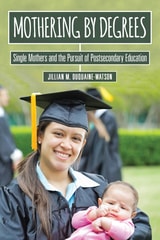
In Mothering by Degrees, Jillian Duquaine-Watson shows how single mothers pursuing college degrees must navigate a difficult course as they attempt to reconcile their identities as single moms, college students, and in many cases, employees. They also negotiate a balance between what they think a good mother should be, and what society is telling them, and how that affects their choices to go to college, and whether to stay in college or not.
The first book length study to focus on the lives and experiences of single mothers who are college students, Mothering by Degrees points out how these women are influenced by dominant American ideologies of motherhood, and the institutional parameters of the schools they attend, and argues for increased attention to the specific ways in which the choices, challenges, and opportunities available to mothers are shaped within their specific environments, as well as the ways in which mothers help shape those environments...
Multimodal Composing and Writing Transfer
Kara Poe Alexander
Utah State University Press, 2024
Over the past two decades the concepts of multimodal composing and writing transfer have grown and reshaped the nature of writing studies, but rarely have the ways in which these areas overlap been studied. This collection shows how this shift in writing studies has been mutually informative, covering a wider range of contexts for multimodality and writing transfer than just in first-year composition courses. It places composition teaching practices and multimodal research in conversation with learning transfer theory to provide an in-depth examination of how they influence one another.
Multimodal Composing and Writing Transfer develops these intersections to connect multimodal composition and writing practices across a wide array of fields and contexts. Scholars across disciplines, postsecondary writing teachers, writing program administrators, writing center directors, and graduate students will find this collection indispensable.
My Culture, My Color, My Self
Heritage, Resilience, and Community in the Lives of Young AdultsToby S. Jenkins
Temple University Press, 2013
In her vibrant ethnography My Culture, My Color, My Self, Toby Jenkins provides engrossing, in-depth interviews and poignant snapshots of young adults talking about their lives and culture. She recounts D'Leon's dream to become a positive example for African American men, and Francheska describing how her late mother inspired her appreciation of her Boricua heritage. In these and other portraits, Jenkins considers the role that cultural education and engagement plays in enhancing educational systems, neighborhood programs, and community structures.
My Culture, My Color, My Self also features critical essays that focus on broader themes such as family bonds, education, and religion. Taken together, Jenkins shows how people of color use their culture as both a politic of social survival and a tool for social change.
My Many Selves
The Quest for a Plausible HarmonyWayne C. Booth
Utah State University Press, 2006
His memoir, My Many Selves, is both an incisive self-examination and a creative approach to retelling his life. Writing his autobiography became a quest to harmonize the diverse, discordant parts of his identity and resolve the conflicts in what he thought and believed. To see himself clearly and whole, he broke his self down, personified the fragments, uncovered their roots in his life, and engaged his multiple identities and experiences in dialogue. Basic to his story and to its lifelong concerns with ethics and rhetoric was his youth in rural Utah. He valued that background, while acknowledging its ambiguous influence on him, and continued to identify himself as Mormon, though he renounced most Latter-day Saint doctrines.
Wayne Booth died in October 2005, soon after completing work on his autobiography.
Myanmar’s Spring Revolution
Students, Higher Education and Political ChangeMarie Lall and Ikuko Okamoto
University College London, 2026
Drawing on firsthand research in a conflict-affected region, this book offers a powerful case study of revolution, displacement, and institutional failure after Myanmar's 2021 military coup.
The 2021 military coup in Myanmar was received as a moral shock by a large part of the country's population. The book gives voice to the students and academics who were key to the youth-led post-coup protests and are still fighting the military with their bodies and minds, by taking up arms and creating their own higher education institutions.