Results by title
89 books match the query 'Historic sites' and 6 start with m
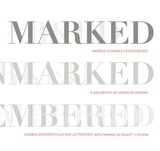
Marked, Unmarked, Remembered
A Geography of American MemoryAndrew Lichtenstein
West Virginia University Press, 2017
These powerful photographs by award-winning photojournalist Andrew Lichtenstein are interspersed with short essays by some of the leading historians of the United States. The book is introduced with substantive meditations on meaning and landscape by Alex Lichtenstein, editor of the American Historical Review, and Edward T. Linenthal, former editor of the Journal of American History. Individually, these images convey American history in new and sometimes startling ways. Taken as a whole, the volume amounts to a starkly visual reckoning with the challenges of commemorating a violent and conflictual history of subjugation and resistance that we forget at our peril.
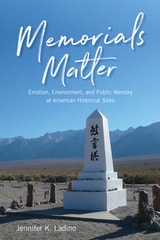
Memorials Matter
Emotion, Environment, and Public Memory at American Historical SitesJennifer K. Ladino
University of Nevada Press, 2019
In Memorials Matter, author Jennifer Ladino investigates the natural and physical environments of seven diverse National Park Service (NPS) sites in the American West and how they influence emotions about historical conflict and national identity. Chapters center around the region’s diverse inhabitants (Mexican, Chinese, Japanese, African, and Native Americans) and the variously traumatic histories these groups endured—histories of oppression, exploitation, incarceration, slavery, and genocide. Drawing on material ecocritical theory, Ladino emphasizes the ideological and political importance of memorials and how they evoke visceral responses that are not always explicitly “storied,” but nevertheless matter in powerful ways.
In this unique blend of narrative scholarship and critical theory, Ladino demonstrates how these memorial sites and their surrounding landscapes, combined with written texts, generate emotion and shape our collective memory of traumatic events. She urges us to consider our everyday environments and to become attuned to features and feelings we might have otherwise overlooked.
Mickey Mouse History and Other Essays on American Memory
Michael Wallace
Temple University Press, 1996
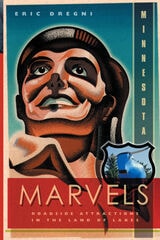
Minnesota Marvels
Roadside Attractions in the Land of LakesEric Dregni
University of Minnesota Press, 2001
Only in Minnesota can you snap a Polaroid of a fifty-five-foot-tall grinning green man with a size seventy-eight shoe or marvel at the spunk of a Swede who dedicated his life to spinning a gigantic ball of twine. The world’s largest hockey stick, as well as the biggest pelican, prairie chicken, turkey, fish, otter, fox, and loon also make Minnesota their home. Where else can you ponder the mysterious "miracle meat" of Spam in a museum dedicated to pork products or have your head examined by the phrenology machines at the Museum of Questionable Medical Devices?
Minnesota Marvels is a tour of the inspired, bizarre, brilliant, scandalous, and funny sites around the state. Look up in wonder at the several Paul Bunyan statues, including the original (Bemidji), the tallest (Akeley), and the largest talking version (Brainerd). Ease on down the road to visit the first home of the heel-tapping native of Grand Rapids, Judy Garland, or walk the "main street" of Sauk Centre immortalized by native son Sinclair Lewis. See the birthplaces of Charles Lindbergh, the Mayo brothers, the Greyhound bus, the snowmobile, and the ice-cream sandwich.
Minnesota is also the home of such attractions as the Minneapolis Sculpture Garden and the world’s largest aerial lift bridge in Duluth, and architectural wonders such as Frank Lloyd Wright’s modernist gas station in Cloquet and Frank Gehry’s arresting Weisman Art Museum. Stunning mansions with histories of ghost sightings, the hangouts and lairs of infamous gangsters, and old-fashioned breweries dot the state.
Conveniently organized by town name and illustrated throughout, Minnesota Marvels is the perfect light-hearted guide for entertaining road trips all over the state.
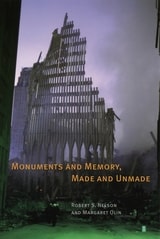
Monuments and Memory, Made and Unmade
Edited by Robert S. Nelson and Margaret Olin
University of Chicago Press, 2003
Examining how monuments preserve memory, these essays demonstrate how phenomena as diverse as ancient drum towers in China and ritual whale-killings in the Pacific Northwest serve to represent and negotiate time. Connecting that history to the present with an epilogue on the World Trade Center, Monuments and Memory, Made and Unmade is pertinent not only for art historians but for anyone interested in the turbulent history of monuments—a history that is still very much with us today.
Contributors:
Stephen Bann, Jonathan Bordo, Julia Bryan-Wilson, Jas Elsner, Tapati Guha-Thakurta, Robert S. Nelson, Margaret Olin, Ruth B. Phillips, Mitchell Schwarzer, Lillian Lan-ying Tseng, Richard Wittman, Wu Hung
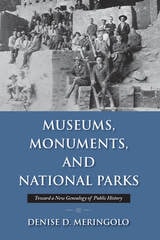
Museums, Monuments, and National Parks
Toward a New Genealogy of Public HistoryDenise D. Meringolo
University of Massachusetts Press, 2012
All of these developments included interpretive activities that shaped public understanding of the past. Yet it was not until the emergence of the education-oriented National Park Service history program in the 1920s and 1930s that public history found an institutional home that grounded professional practice simultaneously in the values of the emerging discipline and in government service. Even thereafter, tensions between administrators in Washington and practitioners on the ground at National Parks, monuments, and museums continued to define and redefine the scope and substance of the field. The process of definition persists to this day, according to Meringolo, as public historians establish a growing presence in major universities throughout the United States and abroad.