Results by title
783 books match the query 'History & Theory' and 34 start with m
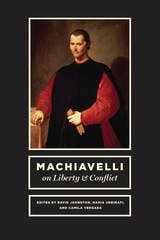
Machiavelli on Liberty and Conflict
Edited by David Johnston, Nadia Urbinati, and Camila Vergara
University of Chicago Press, 2017
With Machiavelli on Liberty and Conflict, David Johnston, Nadia Urbinati, and Camila Vergara have brought together the most recent research on The Prince, with contributions from many of the leading scholars of Machiavelli, including Quentin Skinner, Harvey Mansfield, Erica Benner, John McCormick, and Giovanni Giorgini. Organized into four sections, the book focuses first on Machiavelli’s place in the history of political thought: Is he the last of the ancients or the creator of a new, distinctly modern conception of politics? And what might the answer to this question reveal about the impact of these disparate traditions on the founding of modern political philosophy? The second section contrasts current understandings of Machiavelli’s view of virtues in The Prince. The relationship between political leaders, popular power, and liberty is another perennial problem in studies of Machiavelli, and the third section develops several claims about that relationship. Finally, the fourth section explores the legacy of Machiavelli within the republican tradition of political thought and his relevance to enduring political issues.
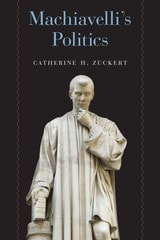
Machiavelli's Politics
Catherine H. Zuckert
University of Chicago Press, 2017
Starting with Machiavelli’s two major political works, Zuckert persuasively shows that the moral revolution Machiavelli sets out in The Prince lays the foundation for the new form of democratic republic he proposes in the Discourses. Distrusting ambitious politicians to serve the public interest of their own accord, Machiavelli sought to persuade them in The Prince that the best way to achieve their own ambitions was to secure the desires and ambitions of their subjects and fellow citizens. In the Discourses, he then describes the types of laws and institutions that would balance the conflict between the two in a way that would secure the liberty of most, if not all. In the second half of her book, Zuckert places selected later works—La Mandragola, The Art of War, The Life of Castruccio Castracani, Clizia, and Florentine Histories—under scrutiny, showing how Machiavelli further developed certain aspects of his thought in these works. In The Art of War, for example, he explains more concretely how and to what extent the principles of organization he advanced in The Prince and the Discourses ought to be applied in modern circumstances. Because human beings act primarily on passions, Machiavelli attempts to show readers what those passions are and how they can be guided to have productive rather than destructive results.
A stunning and ambitious analysis, Machiavelli’s Politics brilliantly shows how many conflicting perspectives do inform Machiavelli’s teachings, but that one needs to consider all of his works in order to understand how they cohere into a unified political view. This is a magisterial work that cannot be ignored if a comprehensive understanding of the philosopher is to be obtained.
Machiavelli's Virtue
Harvey C. Mansfield
University of Chicago Press, 1996
"The book brings together essays that have mapped [Mansfield's] paths of reflection over the past thirty years. . . . The ground, one would think, is ancient and familiar, but Mansfield manages to draw out some understandings, or recognitions, jarringly new."—Hadley Arkes, New Criterion
"Mansfield's book more than rewards the close reading it demands."—Colin Walters, Washington Times
"[A] masterly new book on the Renaissance courtier, statesman and political philosopher. . . . Mansfield seeks to rescue Machiavelli from liberalism's anodyne rehabilitation."—Roger Kimball, The Wall Street Journal

Machiavelli
The Chief Works and Others, 3 volume setAllan Gilbert, ed.
Duke University Press, 0
“A most remarkable achievement.”—Felix Gilbert, Renaissance Quarterly
Machiavelli
The Chief Works and Others, 3 volume setAllan Gilbert, ed.
Duke University Press, 0
“A most remarkable achievement.”—Felix Gilbert, Renaissance Quarterly
Machiavelli
The Chief Works and Others, Vol. IIIAllan Gilbert, ed.
Duke University Press, 1989
Allan Gilbert is unquestionably the most accurate and reliable translator of Machiavelli into English; the publication of this edition is an altogether happy occasion. Students of the history of political thought owe a particular debt of gratitude to Allan Gilbert.”—Dante Germino, The Journal of Politics
“A most remarkable achievement.”—Felix Gilbert, Renaissance Quarterly

Making Institutions Work in Peru
Democracy, Development and Inequality Since 1980Edited by John Crabtree
University of London Press, 2006
Contributors include Paulo Drino (University of Manchester), Cynthia Sanborn (Centro de Investigaciones, Universidad del Pacifico, Lima), Carlos Monge (Participacion Ciudadana, Lima), Fernando Rospigliosi (Instituto de Estudios Peruanos, Lima), Pedro Franck (Departamento de Economia, Universidad Catolica, Lima), Fernando Eguren (Centro Peruano de Ciencias Sociales, Lima), Rosemary Thorp (Queen Elizabeth House/St Antony's College, Oxford), Eduardo Dargent (University of Texas,Austin), Coletta Youngers (Washington Office on Latin America,Washington D.C.), Francisco Durand (University of Texas, San Antonio), Jose Tavara (Departamento de Economia, Universidad Catolica, Lima, and OSIPTEL), and Richard Webb (Instituto Cuanto and Central Bank of Peru).
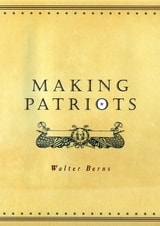
Making Patriots
Walter Berns
University of Chicago Press, 2001
Although Samuel Johnson once remarked that "patriotism is the last refuge of scoundrels," over the course of the history of the United States we have seen our share of heroes: patriots who have willingly put their lives at risk for this country and, especially, its principles. And this is even more remarkable given that the United States is a country founded on the principles of equality and democracy that encourage individuality and autonomy far more readily than public spiritedness and self-sacrifice.
Walter Berns's Making Patriots is a pithy and provocative essay on precisely this paradox. How is patriotism inculcated in a system that, some argue, is founded on self-interest? Expertly and intelligibly guiding the reader through the history and philosophy of patriotism in a republic, from the ancient Greeks through contemporary life, Berns considers the unique nature of patriotism in the United States and its precarious state. And he argues that while both public education and the influence of religion once helped to foster a public-minded citizenry, the very idea of patriotism is currently under attack.
Berns finds the best answers to his questions in the thought and words of Abraham Lincoln, who understood perhaps better than anyone what the principles of democracy meant and what price adhering to them may exact. The graves at Arlington and Gettysburg and Omaha Beach in Normandy bear witness to the fact that self-interested individuals can become patriots, and Making Patriots is a compelling exploration of how this was done and how it might be again.

Making the Forever War
Marilyn B. Young on the Culture and Politics of American MilitarismMary L. Dudziak
University of Massachusetts Press, 2021
Making the Forever War brings Young's articles and essays on American war together for the first time, including never before published works. Moving from the first years of the Cold War to Korea, Vietnam, and more recent "forever" wars in Iraq and Afghanistan, Young reveals the ways in which war became ever-present, yet more covert and abstract, particularly as aerial bombings and faceless drone strikes have attained greater strategic value. For Young, U.S. empire persisted because of, not despite, the inattention of most Americans. The collection concludes with an afterword by prominent military historian Andrew Bacevich.
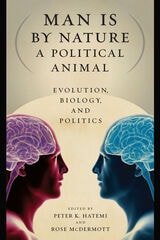
Man Is by Nature a Political Animal
Evolution, Biology, and PoliticsEdited by Peter K. Hatemi and Rose McDermott
University of Chicago Press, 2011
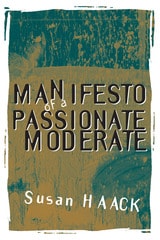
Manifesto of a Passionate Moderate
Unfashionable EssaysSusan Haack
University of Chicago Press, 1998
"The virtue of Haack's book, and I mean virtue in the ethical sense, is that it embodies the attitude that it exalts. . . Haack's voice is urbane, sensible, passionate—the voice of philosophy that matters. How good to hear it again."—Jonathan Rauch, Reason
"A tough mind, confident of its power, making an art of logic . . . a cool mastery."—Paul R. Gross, Wilson Quarterly
"Few people are better able to defend the notion of truth, and in strong, clear prose, than Susan Haack . . . a philosopher of great distinction."—Hugh Lloyd-Jones, National Review
"If you relish acute observation and straight talk, this is a book to read."—Key Reporter (Phi Beta Kappa)
"Everywhere in this book there is the refreshing breeze of common sense, patiently but inexorably blowing."—Roger Kimball, Times Literary Supplement
"A refreshing alternative to the extremism that characterizes so much rhetoric today."—Kirkus Reviews

Manufacturing Discontent
The Trap of Individualism in Corporate SocietyMichael Perelman
Pluto Press, 2005
Perelman describes the manufacture of unhappiness—the continual generation of dissatisfaction with products people are encouraged to purchase and quickly discard—and the complex techniques corporations employ to avoid responsibility and accountability to their workers, consumers and the environment. He outlines ways in which individuals can surpass individualism and instead work together to check the growing power of corporations.
While other books have surveyed the corporate landscape, or decried modern consumerism, Perelman, a professor of economics, places these ideas within a proper economic and historical context. He explores the limits of corporate accountability and responsibility, and investigates the relation between a wide range of phenomena such as food, fear and terrorism. Highly readable, Manufacturing Discontent will appeal to anyone with an interest in the way society works—and what really determines the rights of individuals in a corporate society.
Michael Perelman, Professor of Economics at California State University, Chico, received his Ph.D. from the University of California, Berkeley. He is the author of several books on economics and economic thought, including Railroading Economics (Routledge, 2006); Class Warfare in the Information Age (Palgrave Macmillan, 2000); The Invention of Capitalism (Duke University Press, 2000) and The Perverse Economy (Palgrave Macmillan, 2003).

Marginalized in the Middle
Alan Wolfe
University of Chicago Press, 1996
"In applying a realist approach to controversies over immigration, pornography, race relations, and the apparent communications gap between the genders, Wolfe seeks to demonstrate the advantages of combining the insights of criticism and the tools of social science."—Library Journal
"A plea for a return to liberal thinking, an insistence on the value of 'social criticism beyond politics.' "—Washington Post Book World
"[Wolfe] surveys contemporary public discourse on racial and sexual relations, welfare policy, immigration, pornography, education and cultural politics . . . he manages to bring some fresh thinking to most of these stale debates."—T. J. Jackson Lears, New York Times Book Review
Marx and other Four-Letter Words
Edited by Georgina Blakeley and Valerie Bryson
Pluto Press, 2005
Yet these concepts, within a specifically Marxist framework, are not always easy to understand. This book is an ideal student introduction that explains, in clear and concise chapters, the precise meaning and implications of each of Marx's key concepts. Furthermore, the contributors show how these ideas continue to be relevant, and how they relate to modern society.
The contributors include leading academics in the field of politicial science. Outlining clearly what each concept means, they move on to situate it within cutting-edge contemporary political theory.
Concepts include historical materialism, capitalism, class, the state, imperialism, the division of labour, oppression, production and reproduction, revolution, working class internationalism, equality and democracy.
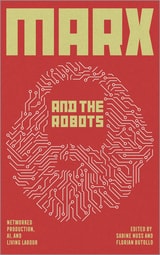
Marx and the Robots
Networked Production, AI, and Human LabourFlorian Butollo
Pluto Press, 2022
It covers a broad range of digital aspects now proliferating across our work and lives, including chapters on the digitalization of agriculture, robotics in the factory and the labor process on crowdworking platforms. It looks to how 20th century Marxist predictions of the 'workerless factory' are, or are not, coming true, and how 'Platform Capitalism' should be understood and critiqued.
Through rich empirical, theoretical and historical material, this book is necessary reading for those wanting a clear overview of our digital world.
Marx at the Margins
On Nationalism, Ethnicity, and Non-Western SocietiesKevin B. Anderson
University of Chicago Press, 2010
In Marx at the Margins, Kevin Anderson uncovers a variety of extensive but neglected texts by the well-known political economist which cast what we thought we knew about his work in a startlingly different light. Analyzing a variety of Marx’s writings, including journalistic work written for the New York Tribune, Anderson presents us with a Marx quite at odds with our conventional interpretations. Rather than providing us with an account of Marx as an exclusively class-based thinker, Anderson here offers a portrait of Marx for the twenty-first century: a global theorist whose social critique was sensitive to the varieties of human social and historical development, including not just class, but nationalism, race, and ethnicity, as well.
Marx at the Margins ultimately argues that alongside his overarching critique of capital, Marx created a theory of history that was multi-layered and not easily reduced to a single model of development or revolution. Through highly-informed readings on work ranging from Marx’s unpublished 1879–82 notebooks to his passionate writings about the antislavery cause in the United States, this volume delivers a groundbreaking and canon-changing vision of Karl Marx that is sure to provoke lively debate in Marxist scholarship and beyond.
Marx at the Margins
On Nationalism, Ethnicity, and Non-Western SocietiesKevin B. Anderson
University of Chicago Press, 2016
Marx's 'Eighteenth Brumaire'
(Post)Modern InterpretationsEdited by Mark Cowling and James Martin
Pluto Press, 2002
Marx's account of the rise of Louis-Napoleon Bonaparte is one of his most important texts. Written after the defeat of the 1848 revolution in France and Bonaparte's subsequent coup, it is a concrete analysis that raises enduring theoretical questions about the state, class conflict and ideology.
Unlike his earlier analyses, Marx develops a nuanced argument concerning the independence of the state from class interests, the different types of classes, and the determining power of ideas and imagery in politics. In the Eighteenth Brumaire he applies his 'materialist conception of history' to an actual historical event with extraordinary subtlety and an impressive, powerful command of language.
This volume contains the most recent and widely acclaimed translation of the Eighteenth Brumaire by Terrell Carver, together with a series of specially commissioned essays on the importance of the Brumaire in Marx's canon. Contributors discuss its continuing significance and interest, the historical background and its contemporary relevance for political philosophy and history.
Marx's Dream
From Capitalism to CommunismTom Rockmore
University of Chicago Press, 2018
With Marx’s Dream, Tom Rockmore offers a much-needed alternative view, distinguishing rigorously between Marx and Marxism. Rockmore breaks with the Marxist view of Marx in three key ways. First, he shows that the concern with the relation of theory to practice—reflected in Marx’s famous claim that philosophers only interpret the world, while the point is to change it—arose as early as Socrates, and has been central to philosophy in its best moments. Second, he seeks to free Marx from his unsolicited Marxist embrace in order to consider his theory on its own merits. And, crucially, Rockmore relies on the normal standards of philosophical debate, without the special pleading to which Marxist accounts too often resort. Marx’s failures as a thinker, Rockmore shows, lie less in his diagnosis of industrial capitalism’s problems than in the suggested remedies, which are often unsound.
Only a philosopher of Rockmore’s stature could tackle a project this substantial, and the results are remarkable: a fresh Marx, unencumbered by doctrine and full of insights that remain salient today.
Matterphorics
On the Laws of TheoryDaniela Gandorfer
Duke University Press, 2026
Max Weber
A Critical IntroductionKieran Allen
Pluto Press, 2004
Means Without End
Notes on PoliticsGiorgio Agamben
University of Minnesota Press, 2000
Media Constrained by Context
International Assistance and Democratic Media Transition in the Western BalkansKristina Irion
Central European University Press, 2018
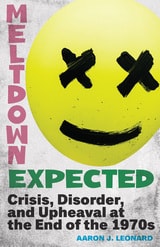
Meltdown Expected
Crisis, Disorder, and Upheaval at the end of the 1970sAaron J. Leonard
Rutgers University Press, 2024
Meltdown Expected tells the story of the power shifts from late 1978 through 1979 whose repercussions are still being felt. Iran’s revolution led to a hostage crisis while neighbouring Afghanistan became the site of a proxy war between the USSR and the US, who supplied aid to Islamic mujahideen fighters that would later form the Taliban. Meanwhile, as tragedies like the Jonestown mass suicide and the assassination of Harvey Milk captured the nation’s attention, the government quietly reasserted and expanded the FBI’s intelligence powers. Drawing from recently declassified government documents and covering everything from Three Mile Island to the rise of punk rock, Aaron J. Leonard paints a vivid portrait of a tumultuous yet pivotal time in American history.
Modern Hungarian Society in the Making
András Gero
Central European University Press, 1995
Modern Isonomy
Democratic Participation and Human Rights Protection as a System of Equal RightsGerald Stourzh
University of Chicago Press, 2021
The ideal, Stourzh argues, is a state, and indeed a world, in which individual rights, including the right to participate in politics equally, are clearly defined and possessed by all. Stourzh begins with ancient Greek thought contrasting isonomy—which is associated with the rule of the many—with “gradated societies,” oligarchies, and monarchies. He then discusses the American experiment with the development of representative democracy as well as the French Revolution, which proclaimed that all people are born and remain free and with equal rights. But progress on the creation and protection of rights for all has been uneven. Stourzh discusses specifically the equalization of slaves, peasants, women, Jews, and indigenous people. He demonstrates how deeply intertwined the protection of equal rights is with the development of democracy and gives particular attention to the development of constitutional adjudication, notably the constitutional complaint of individuals. He also discusses the international protection human rights. Timely and thought-provoking, Modern Isonomy is an erudite exploration of political and human rights.
Modernity, Islam, and Secularism in Turkey
Bodies, Places, and TimeAlev Cinar
University of Minnesota Press, 2005
Montesquieu and the Despotic Ideas of Europe
An Interpretation of "The Spirit of the Laws"Vickie B. Sullivan
University of Chicago Press, 2017
Nowhere is Montesquieu’s critique of the despotic ideas of Europe more powerful than in his enormously influential The Spirit of the Laws, and Vickie B. Sullivan guides readers through Montesquieu’s sometimes veiled, yet sharply critical accounts of Machiavelli, Hobbes, Aristotle, and Plato, as well as various Christian thinkers. He finds deleterious consequences, for example, in brutal Machiavellianism, in Hobbes’s justifications for the rule of one, in Plato’s reasoning that denied slaves the right of natural defense, and in the Christian teachings that equated heresy with treason and informed the Inquisition.
In this new reading of Montesquieu’s masterwork, Sullivan corrects the misconception that it offers simple, objective observations, showing it instead to be a powerful critique of European politics that would become remarkably and regrettably prescient after Montesquieu’s death when despotism wound its way through Europe.
Montesquieu's Philosophy of Liberalism
A Commentary on The Spirit of the LawsThomas L. Pangle
University of Chicago Press, 1973
Moral Economies of Corruption
State Formation and Political Culture in NigeriaSteven Pierce
Duke University Press, 2016
Moral Politics
What Conservatives Know That Liberals Don'tGeorge Lakoff
University of Chicago Press, 1996
Movement and the Ordering of Freedom
On Liberal Governances of MobilityHagar Kotef
Duke University Press, 2015

Mugwumps, Morals and Politics 1884-1920
Gerald W. McFarland
University of Massachusetts Press, 1975
The conventional approach has been to concentrate on only a dozen or so of the best known Mugwumps and to trace their careers no further than 1900. In contrast, McFarland greatly extends the number of individuals whose activities must be considered reflections of the movement, discussing a sample of hundreds of active Mugwumps, and traces their careers well into the twentieth century.
Mugwump orthodoxy is demonstrated by an examination of their largely negative goals in the anti-Blaine bolt of 1884, their narrow political program during the late 1880s, and their politically disastrous loyalty to Grover Cleveland. But their innovative side is also highlighted by a searching analysis of their successes, including their participation in the movement to professionalize such occupations as law, medicine, and higher education, and their contributions to urban, political, and social reform.