Results by title
57 books match the query 'Horror' and 4 start with m
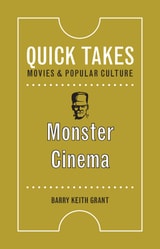
Monster Cinema
Grant, Barry Keith
Rutgers University Press, 2018
Armed with an encyclopedic knowledge of film history, Grant presents us with an eclectic array of monster movies, from Nosferatu to Get Out. As he discovers, although monster movies might claim to be about Them!, they are really about the capacity for horror that lurks within each of us.
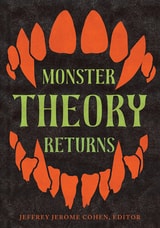
Monster Theory Returns
Jeffrey Jerome Cohen
University of Minnesota Press, 2027
Exploring monsters as critical guides to understanding what it means to be human in a perilous world
Thirty years after the publication of Jeffrey Jerome Cohen’s groundbreaking Monster Theory, the field it helped create has grown into a dynamic and influential area of interdisciplinary scholarship. Monster Theory Returns gathers twenty-six original essays exploring an extraordinary range of monstrous figures, from demons and vampires to microbes and emerging posthuman forms, illuminating urgent questions of belonging, political violence, environmental change, and the boundaries of the human itself.
Combining historical depth with a global perspective, these lively essays show that monsters are far more than figures of fear. They are powerful cultural tools for thinking through crises in a perilous and rapidly changing world.
Contributors: U. Melissa Anyiwo, U of Scranton; Benjamin Ash, Arizona State U; Stephen T. Asma, Columbia College, Chicago; Michael M. Chemers, U of California, Santa Cruz; Eli Cumings, Columbia U; Rebecca Duncan, Linnaeus U; Michael Dylan Foster, U of California, Davis; Renée Fox, U of California, Santa Cruz; Kaja Franck, U of Hertfordshire; Rosemarie Garland-Thomson, Emory U; Brandon R. Grafius, Ecumenical Theological Seminary; Anya Heise-von der Lippe, U of Tübingen; Mary Kate Hurley, Ohio U; Anson Koch-Rein, U of North Carolina; Agnieszka Kotwasińska, U of Warsaw; Riva Lehrer; Sherry C.M. Lindquist, Western Illinois U; Iyad Malouf, Tel Aviv U; Asa Simon Mittman, California State U, Chico; Kirsten Møllegaard, U of Hawai‘i at Hilo; Alan S. Montroso, U of Maryland; David Robinson; Margrit Shildrick, Stockholm U; Jeffrey Andrew Weinstock, Central Michigan U; Emily Zarka, Arizona State U
Retail e-book files for this title are screen-reader friendly with images accompanied by short alt text and/or extended descriptions.
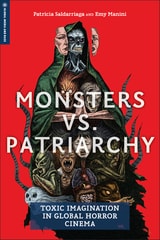
Monsters vs. Patriarchy
Toxic Imagination in Global Horror CinemaPatricia Saldarriaga
Rutgers University Press, 2025
Monsters vs. Patriarchy examines female monstrosity as it appears in horror films from around the world and considers specific political, scientific, and historical contexts to better understand how we construct and reconstruct monstrosity, using an intersectional approach to examine the imposition of gender and racial hierarchies that support national power structures. The authors contend that monstrous female cinematic subjects, including ghosts, witches, cannibals, and posthuman beings, are becoming empowered, using the tools of their monstrification to smash the colonial, white supremacist, and misogynist structures that created them.
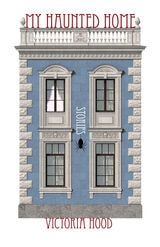
My Haunted Home
StoriesVictoria Hood
University of Alabama Press, 2022
WINNER OF FC2’s RONALD SUKENICK INNOVATIVE FICTION PRIZE
Meditations on the ways grief is felt and harvested—the funny, the sorrowful, the surreal, and the unmentionable
The stories in My Haunted Home delve in startling ways into the lives of the obsessed, the grieving, and the truly haunted. Victoria Hood conjures a shifting range of narrators through an unstable range of worlds where mothers might be dead, girls compulsively shove peanuts inside their ears, agoraphobia traps people inside their houses, and cats won’t eat your soup. In “The Teeth, the Way I Smile,” a daughter who looks like her dead mother manifests grief both in her house and her body. In “Smelly Smelly,” a woman slowly comes to realize her boyfriend has been dead for weeks. In “You, Your Fault,” we explore the unfolding love of two women who love every part of each other—including the parts that fixate on arson and murder.
Each story is a bite-size piece of haunting candy on a necklace of obsession holding them together. Hood probes the worlds of what can be haunted, unpacking the ways in which hauntings can be manifested in physical forms, mentally harvested and lived through, and even a change in what is haunting.