Results by title
69 books match the query 'Images' and 2 start with m
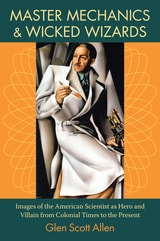
Master Mechanics and Wicked Wizards
Images of the American Scientist as Hero and Villain from Colonial Times to the PresentGlen Scott Allen
University of Massachusetts Press, 2009
From the earliest depictions of Benjamin Franklin and his kite experiment to 21st-century renderings of mad scientists, representations of American scientists in the popular media reveal a great deal about our cultural hopes and fears. In an entertaining and insightful survey of popular media over three hundred years of American history—religious tracts, political cartoons, literature, theater, advertising, art, comic books, radio, music, television, and film—Glen Scott Allen examines the stereotypes assigned to scientists for what they tell us about America's pride in its technological achievements as well as our prejudices about certain “suspect” kinds of scientific investigation.
Working in the tradition of cultural studies, Allen offers an analysis that is historically comprehensive and critically specific. Integrating both “high” literature and “low” comedy, he delves into the assumptions about scientists—good, bad, and mad—that have been shaped by and have in turn shaped American cultural forces. Throughout the book, his focus is on why certain kinds of scientists have been lionized as American heroes, while others have been demonized as anti-American villains.
Allen demonstrates that there is a continuous thread running from the seminal mad scientists of Hawthorne's nineteenth-century fiction to modern megalomaniacs like Dr. Strangelove; that marketing was as important to the reputation of the great independent inventors as technological prowess was; and that cultural prejudices which can be traced all the way back to Puritan ideology are at work in modern scientific controversies over cloning and evolution.
The periods and movements examined are remarkably far-ranging: the literature and philosophy of the Romantics; the technology fairs and utopian fiction of the nineteenth century; political movements of the 1930s and 1940s; the science fiction boom of the 1950s; the space and arms races of the 1960s and 1970s; the resurgence of pseudo-sciences in the 1980s and 1990s. This book will be of interest not just to teachers and students of cultural studies and the history of science and technology but to anyone interested in American culture and how it shapes our experience and defines our horizons.

Mirage-Land
Images of NevadaWilbur S. Shepperson
University of Nevada Press, 1996