Results by title
53 books match the query 'In art' and 4 start with m
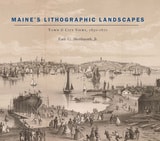
Maine’s Lithographic Landscapes
Town and City Views, 1830-1870Earle G. Shettleworth Jr.
Brandeis University Press, 2020
During the nineteenth century, Americans celebrated their towns and cities through printed landscapes. In Maine, lithographs were commissioned from such leading artists as Fitz Henry Lane and talented, lesser known local artists, such as Esteria Butler. This book reproduces many of these works and provides insights into how these growing centers of commerce and industry viewed themselves and wished to be viewed by others.
It’s the perfect book for those who love Maine, both full-time residents and those who make it a beloved summer destination.
Published in association with the Bowdoin College Museum of Art on the occasion of the bicentennial of Maine statehood.
Mapping The Empty
Eight Artists And NevadaWilliam L. Fox
University of Nevada Press, 1999
Meadows of Memory
Images of Time and Tradition in American Art and CultureBy Michael Kammen
University of Texas Press, 1992
"History painting," for many people, conjures up Washington Crossing the Delaware and other paintings of heroic historical events. But history has made its way into considerably more American art than such obvious examples, in the view of Michael Kammen. In three thought-provoking and innovative essays, Kammen ranges from the Renaissance to the twentieth century, from central Europe to the western United States, and from elegant oil painting to folk sculpture to show the transformations of Old World icons of time into New World images of social memory and tradition.
In the first essay, Kammen demonstrates how American artists and artisans modified European emblems of time in response to their New World setting. In the second essay concerning nineteenth-century landscape art, he explores how artists used space to represent the movement of American culture through time. In the final essay, he looks at two distinctively American motifs of collective memory and tradition—old houses and elm trees. Throughout this interdisciplinary study, Kammen draws his examples from well-known and lesser-known artists, as well as from diverse American writers. Over 100 black-and-white illustrations accompany the text.
Of interest to all students of American culture, Meadows of Memory raises intriguing questions about the American paradox of desiring to conquer mutability while yearning for emblems of a (perhaps imagined?) past.
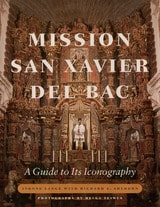
Mission San Xavier del Bac
A Guide to Its IconographyYvonne Lange with Richard E. Ahlborn; Photographs by Helga Teiwes
University of Arizona Press, 2004
This book is the first study of the iconography at San Xavier since its restoration in the 1990s by an international team of professional conservators. It expands our understanding of the numerous Catholic images and emblems of San Xavier through a close analysis of the newly revealed iconographic elements and an interpretation of the significance of their placement. It also proposes that the selection of specific religious themes and their locations was determined by an unfamiliar convention based on a tree-like design, in which the founder of a religious Order appears as the root and followers above in later branchings—an inversion of the more familiar top-to-bottom hierarchy.
Historians Lange and Ahlborn identify all the saintly images and religious elements that adorn San Xavier and suggest how and why they are so arranged. They examine the sculptures and paintings of the church from the façade throughout the cruciform interior in order to determine the organizational concepts that underlie their placement. They note that the selection of images in this Franciscan mission follows traditional Roman Catholic practice for decorating churches in order to instruct novices and reinforce the teaching of conversion in a pictographic catechism of Church doctrine. In short, the book is a dictionary of religious personages and symbols that will help the visitor identify the biblical stories and people portrayed, as well as associated signs and symbols. Entries include a description of the subject, its location, appropriate cross-references, and a bibliography. Recent illustrations by photographer Helga Teiwes and a floor plan facilitate the location of images by visitors.
A handsome, large-format book featuring more than one hundred photographs and supporting line illustrations, Lange and Ahlborn’s work confirms the significance of San Xavier’s iconography for art historians, students of religion, and visitors alike. It is both an incomparable guide and valuable reference source for the famed mission’s magnificent artistic heritage.