Results by title
84 books match the query 'In motion pictures' and 5 start with m
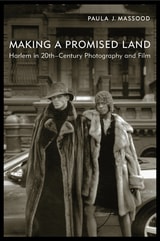
Making a Promised Land
Harlem in Twentieth-Century Photography and FilmMassood, Paula J.
Rutgers University Press, 2013
Making a Promised Land examines the interconnected histories of African American representation, urban life, and citizenship as documented in still and moving images of Harlem over the last century. Paula J. Massood analyzes how photography and film have been used over time to make African American culture visible to itself and to a wider audience and charts the ways in which the “Mecca of the New Negro” became a battleground in the struggle to define American politics, aesthetics, and citizenship. Visual media were first used as tools for uplift and education. With Harlem’s downturn in fortunes through the 1930s, narratives of black urban criminality became common in sociological tracts, photojournalism, and film. These narratives were particularly embodied in the gangster film, which was adapted to include stories of achievement, economic success, and, later in the century, a nostalgic return to the past. Among the films discussed are Fights of Nations (1907), Dark Manhattan (1937), The Cool World (1963), Black Caesar (1974), Malcolm X (1992), and American Gangster (2007). Massood asserts that the history of photography and film in Harlem provides the keys to understanding the neighborhood’s symbolic resonance in African American and American life, especially in light of recent urban redevelopment that has redefined many of its physical and demographic contours.
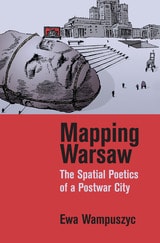
Mapping Warsaw
The Spatial Poetics of a Postwar CityEwa Wampuszyc
Northwestern University Press, 2018
Juxtaposing close readings of photo books, socialist-era newsreels called the Polska Kronika Filmowa, the comedies of Leonard Buczkowski and Jan Fethke, the writing and films of Tadeusz Konwicki, and a case study on the Palace of Culture and Science—a "gift" from none other than Stalin—this study investigates the rhetorical and visual, rather than physical, reconstruction of Warsaw in various medias and genres.
Ewa Wampuszyc roots her analysis in the historical context of the postwar decade and shows how and why Poland's capital became an essential part of a propaganda program inspired by communist ideology and the needs of a newly established socialist People's Republic. Mapping Warsaw demonstrates how physical space manifests itself in culture, and how culture, history, and politics leave an indelible mark on places. It points out ways in which we take for granted our perception of space and the meanings we assign to it.
Memories Of Underdevelopment
Chanan, Michael
Rutgers University Press, 1990
This double volume includes the complete continuity script of Memories, as well as the complete novel, Inconsolable Memories, upon which the film is based. An interview with Alea is reproduced here, as well as documentation of the political controversy that surrounded the film in this country. Michael Chanan's introduction places the film in the context of Cuban political and cultural history. The volume also includes a biographical sketch of Alea, a chronology of the Cuban Revolution, reviews, commentary, a filmography, and a bibliography.Michael Chanan lives in England, where he teaches and writes on film. He is the author of The Cuban Image: Cinema and Cultural Politics in Cuba.
Mexico City in Contemporary Mexican Cinema
By David William Foster
University of Texas Press, 2002
Just as Mexican national life has come to center on the sprawling, dynamic, almost indefinable metropolis of Mexico City, so recent Mexican cinema has focused on the city not merely as a setting for films but almost as a protagonist in its own right, whose conditions both create meaning for and receive meaning from the human lives lived in its midst. Through close readings of fourteen recent critically acclaimed films, this book watches Mexican cinema in this process of producing cultural meaning through its creation, enaction, and interpretation of the idea of Mexico City.
David William Foster analyzes how Mexican filmmakers have used Mexico City as a vehicle for exploring such issues as crime, living space, street life, youth culture, political and police corruption, safety hazards, gender roles, and ethnic and social identities. The book is divided into three sections. "Politics of the City" examines the films Rojo amanecer,Novia que te vea,Frida, naturaleza viva, and Sexo, pudor y lágrimas. "Human Geographies" looks at El Callejón de los Milagros,Mecánica nacional,El castillo de la pureza,Todo el poder, and Lolo. "Mapping Gender" discusses Danzón,De noche vienes,Esmeralda,La tarea,Lola, and Entre Pancho Villa y una mujer desnuda.
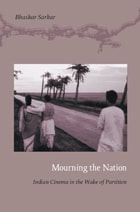
Mourning the Nation
Indian Cinema in the Wake of PartitionBhaskar Sarkar
Duke University Press, 2009
Sarkar tracks the initial reticence to engage with the trauma of 1947 and the subsequent emergence of a strong Partition discourse, revealing both the silence and the eventual “return of the repressed” as strands of one complex process. Connecting the relative silence of the early decades after Partition to a project of postcolonial nation-building and to trauma’s disjunctive temporal structure, Sarkar develops an allegorical reading of the silence as a form of mourning. He relates the proliferation of explicit Partition narratives in films made since the mid-1980s to disillusionment with post-independence achievements, and he discusses how current cinematic memorializations of 1947 are influenced by economic liberalization and the rise of a Hindu-chauvinist nationalism. Traversing Hindi and Bengali commercial cinema, art cinema, and television, Sarkar provides a history of Indian cinema that interrogates the national (a central category organizing cinema studies) and participates in a wider process of mourning the modernist promises of the nation form.