Results by title
83 books match the query 'Inclusive Education' and 2 start with m
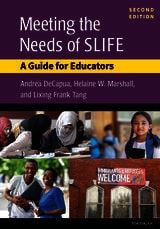
Meeting the Needs of SLIFE, Second Ed.
A Guide for EducatorsAndrea DeCapua, Helaine W. Marshall, and Lixing Frank Tang
University of Michigan Press, 2020
Like its predecessor, this book is grounded in research and is designed to be an accessible and practical resource for teachers, staff, and administrators who work with students with limited or interrupted formal education. Chapters 3-5 focus on classroom instruction, but others address issues of concern to administrators and staff too. For example, Chapter 6 explores different program models for SLIFE instruction, but the planning and commitment to creating a successful program require the involvement of many across the school community, not just teachers.
This edition features case studies, model programs, and teaching techniques and tips; also included is a new chapter focused on the Mutually Adaptive Learning Paradigm (MALP (R)). A major theme of this new edition is moving school personnel away from a deficit perspective, when it comes to teaching SLIFE, and toward one of difference. The goal is to help all stakeholders in the school community create and foster inclusion of, and equity for, a population that is all too often marginalized, ignored, and underserved.
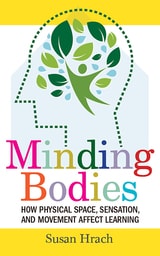
Minding Bodies
How Physical Space, Sensation, and Movement Affect LearningSusan Hrach
West Virginia University Press, 2021
What happens to teaching when you consider the whole body (and not just “brains on sticks”)?
Starting from new research on the body—aptly summarized as “sitting is the new smoking”—Minding Bodies aims to help instructors improve their students’ knowledge and skills through physical movement, attention to the spatial environment, and sensitivity to humans as more than “brains on sticks.” It shifts the focus of adult learning from an exclusively mental effort toward an embodied, sensory-rich experience, offering new strategies to maximize the effectiveness of time spent learning together on campus as well as remotely.
Minding Bodies draws from a wide range of body/mind research in cognitive psychology, kinesiology, and phenomenology to bring a holistic perspective to teaching and learning. The embodied learning approaches described by Susan Hrach are inclusive, low-tech, low-cost strategies that deepen the development of disciplinary knowledge and skills. Campus change-makers will also find recommendations for supporting a transformational mission through an attention to students’ embodied learning experiences.