54 books match the query 'Indians in literature' and 4 start with m
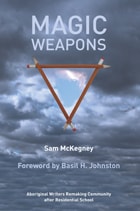
cover of Magic Weapons: Aboriginal Writers Remaking Community after Residential School

Magic Weapons

Aboriginal Writers Remaking Community after Residential School

Sam McKegney

University of Manitoba Press, 2007
The legacy of the residential school system ripples throughout Native Canada, its fingerprints on the domestic violence, poverty, alcoholism, drug abuse, and suicide rates that continue to cripple many Native communities. Magic Weapons is the first major survey of Indigenous writings on the residential school system, and provides groundbreaking readings of life writings by Rita Joe (Mi’kmaq) and Anthony Apakark Thrasher (Inuit) as well as in-depth critical studies of better known life writings by Basil Johnston (Ojibway) and Tomson Highway (Cree). Magic Weapons examines the ways in which Indigenous survivors of residential school mobilize narrative in their struggles for personal and communal empowerment in the shadow of attempted cultural genocide. By treating Indigenous life-writings as carefully crafted aesthetic creations and interrogating their relationship to more overtly politicized historical discourses, Sam McKegney argues that Indigenous life-writings are culturally generative in ways that go beyond disclosure and recompense, re-envisioning what it means to live and write as Indigenous individuals in post-residential school Canada.
[more]
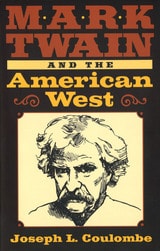
cover of Mark Twain and the American West

Mark Twain and the American West

Joseph L. Coulombe

University of Missouri Press, 2003
In Mark Twain and the American West, Joseph Coulombe explores how Mark Twain deliberately manipulated contemporary conceptions of the American West to create and then modify a public image that eventually won worldwide fame. He establishes the central role of the western region in the development of a persona that not only helped redefine American manhood and literary celebrity in the late nineteenth century, but also produced some of the most complex and challenging writings in the American canon.
Coulombe sheds new light on previously underappreciated components of Twain’s distinctly western persona. Gathering evidence from contemporary newspapers, letters, literature, and advice manuals, Coulombe shows how Twain’s persona in the early 1860s as a hard-drinking, low-living straight-talker was an implicit response to western conventions of manhood. He then traces the author’s movement toward a more sophisticated public image, arguing that Twain characterized language and authorship in the same manner that he described western men: direct, bold, physical, even violent. In this way, Twain capitalized upon common images of the West to create himself as a new sort of western outlaw—one who wrote.
Coulombe outlines Twain’s struggle to find the proper balance between changing cultural attitudes toward male respectability and rebellion and his own shifting perceptions of the East and the West. Focusing on the tension between these goals, Coulombe explores Twain’s emergence as the moneyed and masculine man-of-letters, his treatment of American Indians in its relation to his depiction of Jim in Adventures of Huckleberry Finn, the enigmatic connection of Huck Finn to the natural world, and Twain’s profound influence on Willa Cather’s western novels.
Mark Twain and the American West is sure to generate new interest and discussion about Mark Twain and his influence. By understanding how conventions of the region, conceptions of money and class, and constructions of manhood intersect with the creation of Twain’s persona, Coulombe helps us better appreciate the writer’s lasting effect on American thought and literature through the twentieth century and into the twenty-first.
[more]
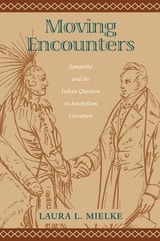
cover of Moving Encounters: Sympathy and the Indian Question in Antebellum Literature

Moving Encounters

Sympathy and the Indian Question in Antebellum Literature

Laura L. Mielke

University of Massachusetts Press, 2008

An old Indian woman comforts two young white children she finds lost in the woods and lovingly carries them back to their eager parents. A frontiersman sheds tears over the grave of a Mohican youth, holding hands with the mourning father. According to Laura L. Mielke, such emotionally charged scenes between whites and Indians paradoxically flourished in American literature from 1820 to 1850, a time when the United States government developed and applied a policy of Indian removal. 

Although these “moving encounters,” as Mielke terms them, often promoted the possibility of mutual sympathy between Native Americans and Euro-Americans, they also suggested that these emotional links were inherently unstable, potentially dangerous, and ultimately doomed. At the same time, the emphasis on Indian-white sympathy provided an opportunity for Indians and non-Native activists to voice an alternative to removal and acculturation, turning the language of a sentimental U.S. culture against its own imperial impulse. Mielke details not only how such writers as James Fenimore Cooper and Henry Rowe Schoolcraft forecast the inevitable demise of Indian-white sympathy, but also how authors like Lydia Maria Child and William Apess insisted that a language of feeling could be used to create shared community or defend American Indian sovereignty. In this way, Moving Encounters sheds new light on a wide range of texts concerning the “Indian Question” by emphasizing their engagement with popular sentimental forms and by challenging the commonly held belief that all Euro-American expressions of sympathy for American Indians in this period were fundamentally insincere. While portraits of Indian-white sympathy often prompted cynical rejoinders from parodists, many never lost faith in the power of emotion to overcome the greed and prejudice fueling the dispossession of American Indians.
[more]
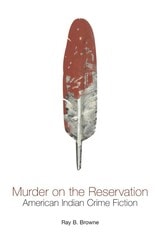
cover of Murder on the Reservation: American Indian Crime Fiction

Murder on the Reservation

American Indian Crime Fiction

Ray B. Browne

University of Wisconsin Press, 2004

In Murder on the Reservation, Ray B. Browne surveys the work of several of the best-known writers of crime fiction involving Indian characters and references virtually every book that qualifies as an Indian-related mystery. Browne believes that within the genre of crime fiction all people are equal, and the increasing role of Indian characters in criminal fiction proves what an important role this genre plays as a powerful democratizing force in American society. He endeavors to both analyze and evaluate the individual work of the authors, and at the same time, provide a commentary on the various attitudes towards race relations in the United States that each author presents. Some Indian fiction is intended to right the wrongs the authors feel have been leveled against Indians. Other authors use Indian lore and Indian locales as exotic elements and locations for the entertaining and commercially successful stories they want to write. Browne’s analysis includes authors and works of all backgrounds, with mysteries of first-class murder both on and off the reservation.
[more]