Results by title
73 books match the query 'Indians of Central America' and 7 start with m
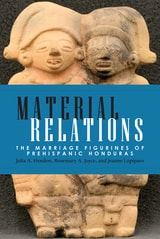
Material Relations
The Marriage Figurines of Prehispanic HondurasJulia A. Hendon
University Press of Colorado, 2014
They examine the production, use, and disposal of marriage figurines from six sites—Campo Dos, Cerro Palenque, Copán, Currusté, Tenampua, and Travesia—and explore their role in rituals and ceremonies, as well as in the forming of social bonds and the celebration of relationships among communities. They find evidence of historical traditions reproduced over generations through material media in social relations among individuals, families, and communities, as well as social differences within this network of connected yet independent settlements.
Material Relations provides a new and dynamic understanding of how social houses functioned via networks of production and reciprocal exchange of material objects and will be of interest to Mesoamerican archaeologists, anthropologists, and art historians.
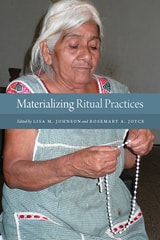
Materializing Ritual Practices
Lisa M. Johnson
University Press of Colorado, 2021
Ritual action produces sequences of creation, destruction, and transformation, which involve a variety of materials that are active and agential. The materialities of ritual may persist at temporal scales long beyond the lives of humans or be as ephemeral as spoken words, music, and scents. In this book, archaeologists and ethnographers, including specialists in narrative, music, and ritual practice, explore the rhythms and materiality of rituals that accompany everyday actions, like the construction of houses, healing practices, and religious festivals, and that paced commemoration of rulers, ancestor veneration, and relations with spiritual beings in the past.
Connecting the kinds of observed material discursive practices that ethnographers witness to the sedimented practices from which archaeologists infer similar practices in the past, Materializing Ritual Practices addresses how specific materialities encourage repetition in ritual actions and, in other circumstances, resist changes to ritual sequences. The volume will be of interest to cultural anthropologists, archaeologists, and linguists with interests in Central America, ritual, materiality, and time.
Contributors: M. Charlotte Arnauld, Giovani Balam Caamal, Isaac Barrientos, Cedric Becquey, Johann Begel, Valeria Bellomia, Juan Carillo Gonzalez, Maire Chosson, Julien Hiquet, Katrina Kosyk, Olivier Le Guen, Maria Luisa Vasquez de Agredos Pascual, Alessandro Lupo, Philippe Nondedeo, Julie Patrois, Russel Sheptak, Valentina Vapnarsky, Francisca Zalaquett Rock
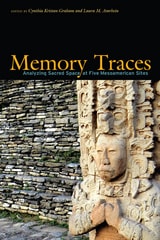
Memory Traces
Analyzing Sacred Space at Five Mesoamerican SitesCynthia Kristan-Graham
University Press of Colorado, 2015
In Memory Traces, art historians and archaeologists come together to examine the nature of sacred space in Mesoamerica. Through five well-known and important centers of political power and artistic invention in Mesoamerica—Tetitla at Teotihuacan, Tula Grande, the Mound of the Building Columns at El Tajín, the House of the Phalli at Chichén Itzá, and Tonina—contributors explore the process of recognizing and defining sacred space, how sacred spaces were viewed and used both physically and symbolically, and what theoretical approaches are most useful for art historians and archaeologists seeking to understand these places.
Memory Traces acknowledges that the creation, use, abandonment, and reuse of sacred space have a strongly recursive relation to collective memory and meanings linked to the places in question and reconciles issues of continuity and discontinuity of memory in ancient Mesoamerican sacred spaces. It will be of interest to students and scholars of Mesoamerican studies and material culture, art historians, architectural historians, and cultural anthropologists.
Contributors: Laura M. Amrhein, Nicholas P. Dunning, Rex Koontz, Cynthia Kristan-Graham, Matthew G. Looper, Travis Nygard, Keith M. Prufer, Matthew H. Robb, Patricia J. Sarro, Kaylee Spencer, Eric Weaver, Linnea Wren
Mesoamerican Healers
Edited by Brad R. Huber and Alan R. Sandstrom
University of Texas Press, 2001
Healing practices in Mesoamerica span a wide range, from traditional folk medicine with roots reaching back into the prehispanic era to westernized biomedicine. These sometimes cooperating, sometimes competing practices have attracted attention from researchers and the public alike, as interest in alternative medicine and holistic healing continues to grow.
Responding to this interest, the essays in this book offer a comprehensive, state-of-the-art survey of Mesoamerican healers and medical practices in Mexico and Guatemala. The first two essays describe the work of prehispanic and colonial healers and show how their roles changed over time. The remaining essays look at contemporary healers, including bonesetters, curers, midwives, nurses, physicians, social workers, and spiritualists. Using a variety of theoretical approaches, the authors examine such topics as the intersection of gender and curing, the recruitment of healers and their training, healers' compensation and workload, types of illnesses treated and recommended treatments, conceptual models used in diagnosis and treatment, and the relationships among healers and between indigenous healers and medical and political authorities.
Mesoamerican Lithic Technology
Kenneth Hirth
University of Utah Press, 2003
Any overview of prehispanic society in the Americas would identify its obsidian core-blade production as a unique and highly inventive technology. Normally termed prismatic blades, these long, parallel-sided flakes are among the sharpest cutting tools ever produced by humans. Their standardized form permitted interchangeable use, and such blades became the cutting tool of choice throughout Mesoamerica between 600–800 B.C. Because considerable production skill is required, increased demand may have stimulated the appearance of craft specialists who played an integral role in Mesoamerican society. Some investigators have argued that control over obsidian also had a significant effect on the development and organization of chiefdom and state-level societies.
While researchers have long recognized the potential of obsidian studies, recent work has focused primarily on compositional analysis to reconstruct trade and distribution networks. Study of blade production has received much less attention, and many aspects of this highly evolved craft are still lost.
This volume seeks to identify current research questions in Mesoamerican lithic technology and to demonstrate that replication studies coupled with experimental research design are valuable analytical approaches to such questions.
Mesoamerican Ritual Economy
Archaeological and Ethnological PerspectivesE. Christian Wells
University Press of Colorado, 2007
Exploring the intersection of spirituality and materiality, Mesoamerican Ritual Economy will be of interest to all scholars studying how worldview and belief motivate economic behavior. The authors consider a diverse set of Mesoamerican cultural patterns in order to investigate the ways in which ritual and economic practices influenced each other in the operation of communities, small-scale societies, and state-level polities. Contributors include: Sarah B. Barber, Frances F. Berdan, Karla L. Davis-Salazar, Barbara W. Fash, William L. Fash, Antonia E. Foias, Arthur A. Joyce, Brigitte Kovacevich, Ben A. Nelson, Enrique Rodríguez-Alegría, Katherine A. Spielmann, John M. Watanabe, E. Christian Wells.
Mobility and Migration in Ancient Mesoamerican Cities
M. Charlotte Arnauld
University Press of Colorado, 2024
In a series of data-rich chapters that address specific evidence for movement in their respective study areas, an international group of scholars assesses mobility through the isotopic and demographic analysis of human remains, stratigraphic identification of gaps in occupation, and local intensification of water capture in the Maya lowlands. Others examine migration through the integration of historic and archaeological evidence in Michoacán and Yucatán and by registering how daily life changed in response to the influx of new people in the Basin of Mexico.
Offering a range of critical insights into the vital and under-studied role that mobility and migration played in complex agrarian societies, Mobility and Migration in Ancient Mesoamerican Cities will be of value to Mesoamericanist archaeologists, ethnohistorians, and bioarchaeologists and to any scholars working on complex societies.
Contributors:
Jaime J. Awe, Meggan Bullock, Sarah C. Clayton, Andrea Cucina, Véronique Darras, Nicholas P. Dunning, Mélanie Forné, Marion Forest, Carolyn Freiwald, Elizabeth Graham, Nancy Gonlin, Julie A. Hoggarth, Linda Howie, Elsa Jadot, Kristin V. Landau, Eva Lemonnier, Dominique Michelet, David Ortegón Zapata, Prudence M. Rice, Thelma N. Sierra Sosa, Michael P. Smyth, Vera Tiesler, Eric Weaver