50 books match the query 'Industrial Management' and 4 start with m

cover of Manufacturing Consent: Changes in the Labor Process Under Monopoly Capitalism

Manufacturing Consent

Changes in the Labor Process Under Monopoly Capitalism

Michael Burawoy

University of Chicago Press, 1982

Since the 1930s, industrial sociologists have tried to answer the question, Why do workers not work harder? Michael Burawoy spent ten months as a machine operator in a Chicago factory trying to answer different but equally important questions: Why do workers work as hard as they do? Why do workers routinely consent to their own exploitation?

Manufacturing Consent, the result of Burawoy's research, combines rich ethnographical description with an original Marxist theory of the capitalist labor process. Manufacturing Consent is unique among studies of this kind because Burawoy has been able to analyze his own experiences in relation to those of Donald Roy, who studied the same factory thirty years earlier. Burawoy traces the technical, political, and ideological changes in factory life to the transformations of the market relations of the plant (it is now part of a multinational corporation) and to broader movements, since World War II, in industrial relations.

[more]
cover of Media and Management

Media and Management

Rutvica Andrijasevic

University of Minnesota Press, 2021

An essential account of how the media devices we use today inherit the management practices governing factory labor

This book argues that management is enabled by media forms, just as media gives life to management. Media technologies central to management have included the stopwatch, the punch card, the calculator, and the camera, while management theories are taught in printed and virtual textbooks and online through TED talks. In each stage of the evolving relationship between workers and employers, management innovations are learned through media, with media formats producing fresh opportunities for management.

Drawing on rich historical and ethnographic case studies, this book approaches key instances of the industrial and service economy—the legacy of Toyotism in today’s software industry, labor mediators in electronics manufacturing in Central and Eastern Europe, and app-based food-delivery platforms in China—to push media and management studies in new directions. Media and Management offers a provocative insight on the future of labor and media that inevitably cross geographical boundaries.
[more]
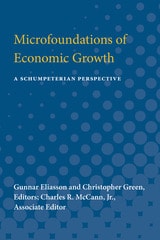
cover of Microfoundations of Economic Growth: A Schumpeterian Perspective

Microfoundations of Economic Growth

A Schumpeterian Perspective

Gunnar Eliasson and Christopher Green, Editors; Charles R. McCann, Jr., Associate Editor

University of Michigan Press, 1998
The contributors to this volume seek further understanding of the microfoundations of economic growth. It focuses on three subjects that interested the great Austrian and Harvard economist, Joseph A. Schumpeter: innovation, technological change, and economic growth. The first part of the volume treats institutions, markets, and entrepreneurs, without which analysis of the firm makes little or no sense. The second part focuses on the firm as innovator, placing heavy emphasis on the role of knowledge formation. The subjects of innovation and knowledge formation are approached from three perspectives: theoretical; industry (case) studies; and empirical (cross section and panel data) analysis. In the third part of the book the action moves from the firm to the "macro" or economy-wide level. The volume's unique feature is combining institutions, the innovative behavior of firms, and an intuitively dynamic, macroeconomic analysis, all from a Schumpeterian perspective. It is argued that the study of micro-institutions such as firms and the evolving nature of markets are necessary ingredients to understanding macro-oriented phenomena such as economic growth. It is in this sense, then, that the book is concerned with microfoundations. Contributors are Daniele Archibugi, Spyros Arvanitis, David B. Audretsch, John R. Baldwin, Gerard Ballot, Pontus Braunerhjelm, Dagobert L. Brito, Uwe Cantner, Bo Carlsson, Robert W. Clower, Richard Day, Rinaldo Evangelista, Jan Glete, Horst Hanusch, Heinz Hollenstein, Michael D. Intrilgator, George Johnson, Joanne Johnson, Aija Leiponen, Staffan Laestadius, Richard N. Langlois, Frank M. Machovec, Maureen McKelvey, Valentina Meiciani, Douglass C. North, Giulio Perani, Andreas Pyka, Fabio Rapiti, Roberto Simonetti, Frank Stafford, Paula E. Stephan, Erol Taymaz, Clas Wihlborg, Erica R. Worth, and S. Y. Wu. Gunnar K. Eliasson is Professor of Industrial Economics, Royal Technical Institute (KTH), Stockholm. Christopher Green is Professor of Economics, McGill University. Charles R. McCann, Jr., is Research Associate, Department of Economics, University of Pittsburgh.
[more]
cover of Microfoundations of Economic Growth: A Schumpeterian Perspective

Microfoundations of Economic Growth

A Schumpeterian Perspective

Gunnar Eliasson and Christopher Green, Editors, and Charles R. McCann Jr., Associate Editor

University of Michigan Press, 1998

The contributors to this volume seek further understanding of the microfoundations of economic growth. It focuses on three subjects that interested the great Austrian and Harvard economist, Joseph A. Schumpeter: innovation, technological change, and economic growth. The first part of the volume treats institutions, markets, and entrepreneurs, without which analysis of the firm makes little or no sense. The second part focuses on the firm as innovator, placing heavy emphasis on the role of knowledge formation. The subjects of innovation and knowledge formation are approached from three perspectives: theoretical; industry (case) studies; and empirical (cross section and panel data) analysis. In the third part of the book the action moves from the firm to the "macro" or economy-wide level. The volume's unique feature is combining institutions, the innovative behavior of firms, and an intuitively dynamic, macroeconomic analysis, all from a Schumpeterian perspective. It is argued that the study of micro-institutions such as firms and the evolving nature of markets are necessary ingredients to understanding macro-oriented phenomena such as economic growth. It is in this sense, then, that the book is concerned with microfoundations. Contributors are Daniele Archibugi, Spyros Arvanitis, David B. Audretsch, John R. Baldwin, Gerard Ballot, Pontus Braunerhjelm, Dagobert L. Brito, Uwe Cantner, Bo Carlsson, Robert W. Clower, Richard Day, Rinaldo Evangelista, Jan Glete, Horst Hanusch, Heinz Hollenstein, Michael D. Intrilgator, George Johnson, Joanne Johnson, Aija Leiponen, Staffan Laestadius, Richard N. Langlois, Frank M. Machovec, Maureen McKelvey, Valentina Meiciani, Douglass C. North, Giulio Perani, Andreas Pyka, Fabio Rapiti, Roberto Simonetti, Frank Stafford, Paula E. Stephan, Erol Taymaz, Clas Wihlborg, Erica R. Worth, and S. Y. Wu. Gunnar K. Eliasson is Professor of Industrial Economics, Royal Technical Institute (KTH), Stockholm. Christopher Green is Professor of Economics, McGill University. Charles R. McCann, Jr., is Research Associate, Department of Economics, University of Pittsburgh.
[more]