Results by title
58 books match the query 'Intellectual property' and 4 start with m
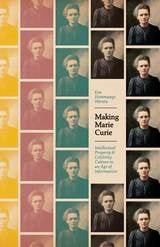
Making Marie Curie
Intellectual Property and Celebrity Culture in an Age of InformationEva Hemmungs Wirtén
University of Chicago Press, 2015
Making Marie Curie explores what went into the creation of this icon of science. It is not a traditional biography, or one that attempts to uncover the “real” Marie Curie. Rather, Eva Hemmungs Wirtén, by tracing a career that spans two centuries and a world war, provides an innovative and historically grounded account of how modern science emerges in tandem with celebrity culture under the influence of intellectual property in a dawning age of information. She explores the emergence of the Curie persona, the information culture of the period that shaped its development, and the strategies Curie used to manage and exploit her intellectual property. How did one create and maintain for oneself the persona of scientist at the beginning of the twentieth century? What special conditions bore upon scientific women, and on married women in particular? How was French identity claimed, established, and subverted? How, and with what consequences, was a scientific reputation secured?
In its exploration of these questions and many more, Making Marie Curie provides a composite picture not only of the making of Marie Curie, but the making of modern science itself.
Making and Unmaking Intellectual Property
Creative Production in Legal and Cultural PerspectiveEdited by Mario Biagioli, Peter Jaszi, and Martha Woodmansee
University of Chicago Press, 2011
Rules regulating access to knowledge are no longer the exclusive province of lawyers and policymakers and instead command the attention of anthropologists, economists, literary theorists, political scientists, artists, historians, and cultural critics. This burgeoning interdisciplinary interest in “intellectual property” has also expanded beyond the conventional categories of patent, copyright, and trademark to encompass a diverse array of topics ranging from traditional knowledge to international trade. Though recognition of the central role played by “knowledge economies” has increased, there is a special urgency associated with present-day inquiries into where rights to information come from, how they are justified, and the ways in which they are deployed.
Making and Unmaking Intellectual Property, edited by Mario Biagioli, Peter Jaszi, and Martha Woodmansee, presents a range of diverse—and even conflicting—contemporary perspectives on intellectual property rights and the contested sources of authority associated with them. Examining fundamental concepts and challenging conventional narratives—including those centered around authorship, invention, and the public domain—this book provides a rich introduction to an important intersection of law, culture, and material production.
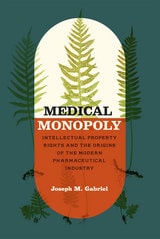
Medical Monopoly
Intellectual Property Rights and the Origins of the Modern Pharmaceutical IndustryJoseph M. Gabriel
University of Chicago Press, 2014
Drawing on a wealth of previously unused archival material, Medical Monopoly combines legal, medical, and business history to offer a sweeping new interpretation of the origins of the complex and often troubling relationship between the pharmaceutical industry and medical practice today. Joseph M. Gabriel provides the first detailed history of patent and trademark law as it relates to the nineteenth-century pharmaceutical industry as well as a unique interpretation of medical ethics, therapeutic reform, and the efforts to regulate the market in pharmaceuticals before World War I. His book will be of interest not only to historians of medicine and science and intellectual property scholars but also to anyone following contemporary debates about the pharmaceutical industry, the patenting of scientific discoveries, and the role of advertising in the marketplace.
Music and Cultural Rights
Edited by Andrew N. Weintraub and Bell Yung
University of Illinois Press, 2009
Contributors are Nimrod Baranovitch, Adriana Helbig, Javier F. Leon, Ana María Ochoa, Silvia Ramos, Helen Rees, Felicia Sandler, Amy Ku'uleialoha Stillman, Ricardo D. Trimillos, Andrew N. Weintraub, and Bell Yung.