Results by title
366 books match the query 'International' and 18 start with m

Making Endless War
The Vietnam and Arab-Israeli Conflicts in the History of International LawBrian Cuddy and Victor Kattan, Editors
University of Michigan Press, 2023
Making Endless War is built on the premise that any attempt to understand how the content and function of the laws of war changed in the second half of the twentieth century should consider two major armed conflicts, fought on opposite edges of Asia, and the legal pathways that link them together across time and space. The Vietnam and Arab-Israeli conflicts have been particularly significant in the shaping and attempted remaking of international law from 1945 right through to the present day. This carefully curated collection of essays by lawyers, historians, philosophers, sociologists, and political geographers of war explores the significance of these two conflicts, including their impact on the politics and culture of the world’s most powerful nation, the United States of America. The volume foregrounds attempts to develop legal rationales for the continued waging of war after 1945 by moving beyond explaining the end of war as a legal institution, and toward understanding the attempted institutionalization of endless war.

Masters of Contemporary Brazilian Song
MPB, 1965-1985By Charles A. Perrone
University of Texas Press, 1993
Masters of Contemporary Brazilian Song is a critical study of MPB (música popular brasileira), a term that refers to varieties of urban popular music of the 1960s and 1970s, incorporating samba, Bossa Nova, and new materials.
Measurement of Nontariff Barriers
Alan V. Deardorff and Robert M. Stern, Editors
University of Michigan Press, 1998
Measuring Economic Sustainability and Progress
Edited by Dale W. Jorgenson, J. Steven Landefeld, and Paul Schreyer
University of Chicago Press, 2014
The latest in the NBER’s influential Studies in Income and Wealth series, which has played a key role in the development of national account statistics in the United States and other nations, this volume explores collaborative solutions between academics, policy researchers, and official statisticians to some of today’s most important economic measurement challenges. Contributors to this volume extend past research on the integration and extension of national accounts to establish an even more comprehensive understanding of the distribution of economic growth and its impact on well-being, including health, human capital, and the environment. The research contributions assess, among other topics, specific conceptual and empirical proposals for extending national accounts.
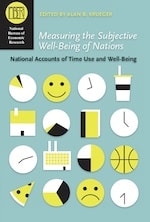
Measuring the Subjective Well-Being of Nations
National Accounts of Time Use and Well-BeingEdited by Alan B. Krueger
University of Chicago Press, 2009
Surely everyone wants to know the source of happiness, and indeed, economists and social scientists are increasingly interested in the study and effects of subjective well-being. Putting forward a rigorous method and new data for measuring, comparing, and analyzing the relationship between well-being and the way people spend their time—across countries, demographic groups, and history—this book will help set the agenda of research and policy for decades to come.
It does so by introducing a system of National Time Accounting (NTA), which relies on individuals’ own evaluations of their emotional experiences during various uses of time, a distinct departure from subjective measures such as life satisfaction and objective measures such as the Gross Domestic Product. A distinguished group of contributors here summarize the NTA method, provide illustrative findings about well-being based on NTA, and subject the approach to a rigorous conceptual and methodological critique that advances the field. As subjective well-being is topical in economics, psychology, and other social sciences, this book should have cross-disciplinary appeal.
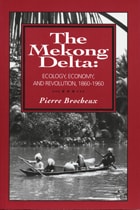
Mekong Delta
Ecology, Economy, and Revolution, 1860-1960Pierre Brocheux
University of Wisconsin Press, 1995
Mexican Financial Development
By Dwight S. Brothers and Leopoldo Solís M.
University of Texas Press, 1966
The development of the Mexican financial system as it has related to the remarkable growth of the Mexican economy is examined in this book.
Believing that a better understanding of the past will permit a more nearly accurate appraisal of contemporary problems and facilitate the choice of intelligent policies in the future, the authors present a detailed chronicle and analysis of components of the Mexican financial system, with primary emphasis on the period from 1940 to the mid-1960s.
Separate chapters are devoted to the money and capital market, the formulation and execution of monetary and financial policies, and the nature of Mexican financial experience in both the public and private sectors of the economy. The authors offer a theoretical explanation of the record of Mexican experience, based upon their analysis of relationships between monetary policy, domestic stability, and external equilibrium, as well as upon their analysis of factors governing the growth of domestic indebtedness, the development of financial intermediation, and the operation of the loanable funds market. The final chapter of the book, a review of Mexican experience from 1960 to 1965, speculates with respect to the future course of Mexican financial development and offers specific proposal for future monetary and financial policies.
This record of Mexican financial development contains much that should be of interest to others engaged in related theoretical and empirical studies, including many lessons for those countries confronted with circumstances and problems not too unlike those encountered in Mexico.
Mexican Immigration to the United States
Edited by George J. Borjas
University of Chicago Press, 2007
From debates on Capitol Hill to the popular media, Mexican immigrants are the subject of widespread controversy. By 2003, their growing numbers accounted for 28.3 percent of all foreign-born inhabitants of the United States. Mexican Immigration to the United States analyzes the astonishing economic impact of this historically unprecedented exodus. Why do Mexican immigrants gain citizenship and employment at a slower rate than non-Mexicans? Does their migration to the U.S. adversely affect the working conditions of lower-skilled workers already residing there? And how rapid is the intergenerational mobility among Mexican immigrant families?
This authoritative volume provides a historical context for Mexican immigration to the U.S. and reports new findings on an immigrant influx whose size and character will force us to rethink economic policy for decades to come. Mexican Immigration to the United States will be necessary reading for anyone concerned about social conditions and economic opportunities in both countries.
Monetary Politics
Exchange Rate Cooperation in the European UnionThomas H. Oatley
University of Michigan Press, 1998
Money and Liberation
The Micropolitics of Alternative Currency MovementsPeter North
University of Minnesota Press, 2007
Is conventional money simply a discourse? Is it merely a socially constructed unit of exchange? If money is not an actual thing, are people then free to make collective agreements to use other forms of currency that might work more effectively for them? Proponents of “better money” argue that they have created currencies that value people more than profitability, ensuring that human needs are met with reasonable costs and decent wages—and supporting local economies that emphasize local sustainability. How did proponents develop these new economies? Are their claims valid?
Grappling with these questions and more, Money and Liberation examines the experiences of groups who have tried to build a more equitable world by inventing new forms of money. Presenting in-depth profiles of the trading networks that have been constructed both historically and more recently, including Local Exchange Trading Schemes (England), Green Dollars (New Zealand), Talente (Hungary), and the barter system in Argentina, Peter North shows how the use of currency has been redefined as part of political action, revealing surprising political ambiguity and a nuanced understanding of the potential and limits on alternative currencies as a resistance practice.
Peter North is lecturer in geography at the University of Liverpool.

Money and Power
Great Predators in the Political Economy of DevelopmentSarah Bracking
Pluto Press, 2009
Sarah Bracking explores the role of governments and development finance institutions in managing the markets in which the poorest countries operate. These institutions -- the 'Great Predators' -- are trapping the populations of the south in a permanent cycle of austerity.
Bracking examines the political economy relations between states. She shows how pseudo-public 'development' institutions retain complete economic control over Southern markets, yet the international system is itself unregulated. Operating in the interests of North America and the European Union, they have a political purpose, and yet serve to cloud the brute power relations between states.
This book will be of interest to anyone studying debt and development, global financial institutions, and the way the world economy is regulated and governed.
Mozambique's Experience in Building a National Extension System
Helder Gemo
Michigan State University Press, 2005
Agricultural extension services are undergoing rapid change in many countries, with a shift in funding and management from the public to the private sector. This is especially true in Africa, where donors from industrial countries, and more recently from the middle-income developing countries such as Chile, have historically promoted and financed those extension models. Currently, African nations are being encouraged to import the Farmer Field School extension model, which is meeting with some success in Asia.
Mozambique, a former Portuguese colony, became independent in 1975 but was wracked by civil war in the 1980s. It was unable to establish its public extension service until 1987. The authors analyze the growth and evolution of extension from 1987 to 2004, as provided by public, private, and NGO sources in Mozambique.
This work highlights the Ministry of Agriculture's drive to develop and test both local and imported extension models and share its experience with other African countries.
Much Ado about Culture
North American Trade DisputesKeith Acheson and Christopher Maule
University of Michigan Press, 2001
Music and German National Identity
Celia Applegate and Pamela Potter
University of Chicago Press, 2002
This book explores the questions of how music came to be associated with German identity, when and how Germans came to be regarded as the "people of music," and how music came to be designated as "the most German art." Drawing on the expertise of leading scholars in German history, musicology, and German literature, the essays assembled here examine philosophy, literature, politics, and social currents, as well as the creation and performance of folk music, art music, church music, jazz, and pop to explore the ways in which music has continued to play a central role in the German national imagination and in shaping German identity.
Music and Social Change in South Africa
Maskanda Past and PresentKathryn Olsen
Temple University Press, 2014
Working closely with translated song lyrics and musical notation-and applying musical and socio-political analysis to this music and its cultural context-Olsen argues that maskanda offers insight into how the post-apartheid ideal of social transformation is experienced by those who were marginalized for most of the twentieth century.
Drawing on a decade of research, Olsen strives to demystify the Zulu part of contemporary experience in South Africa and to reveal some of the complexities of the social, economic, and political landscape of contemporary South Africa.
Music as Mao's Weapon
Remembering the Cultural RevolutionLei X. Ouyang
University of Illinois Press, 2022
China's Cultural Revolution (1966-1976) produced propaganda music that still stirs unease and, at times, evokes nostalgia. Lei X. Ouyang uses selections from revolutionary songbooks to untangle the complex interactions between memory, trauma, and generational imprinting among those who survived the period of extremes. Interviews combine with ethnographic fieldwork and surveys to explore both the Cultural Revolution's effect on those who lived through it as children and contemporary remembrance of the music created to serve the Maoist regime. As Ouyang shows, the weaponization of music served an ideological revolution but also revolutionized the senses. She examines essential questions raised by this phenomenon, including: What did the revolutionization look, sound, and feel like? What does it take for individuals and groups to engage with such music? And what is the impact of such an experience over time?
Perceptive and provocative, Music as Mao's Weapon is an insightful look at the exploitation and manipulation of the arts under authoritarianism.

Music in the Castle
Troubadours, Books, and Orators in Italian Courts of the Thirteenth, Fourteenth, and Fifteenth CenturiesF. Alberto Gallo
University of Chicago Press, 1996
In the first of three elegant essays, Gallo examines the troubadours who traveled to northern Italian courts from Provence during the thirteenth century. He discusses their performance practices, the verbal and musical sophistication of their songs, and their role in the daily life of courtiers at Genoa, Ferrara, and Monferrato. The second essay concerns the now dispersed collection of the Visconti library at Pavia. Here, Gallo examines how this collection expressed the tastes of the fourteenth-century court of Giangaleazzo Visconti, how French arts were imported and imitated at Pavia, and the effects this had on music heard at the court. In the final essay, Gallo looks at the fifteenth-century tradition of improvised music, and especially the virtuoso lute player Pietrobono. Mythologized in literary circles of his day, Pietrobono becomes a point of departure for a discussion of the entire vision of music of Italian humanists, from Guarino Veronese to Aurelio Brandolini.
Music on the Move
Danielle Fosler-Lussier
University of Michigan Press, 2020