Results by title
54 books match the query 'Islamic Studies' and 9 start with m

Malaika and the Seven Heavens
A Memoir of My Encounters with IslamToyin Falola
University of Michigan Press, 2025
Although faith is a lifelong journey, Falola identifies key moments in his upbringing that shaped his perception of faith, such as observing Islamic prayers, witnessing the significance of pilgrimage, engaging with spiritual leaders, and interacting with both Muslims and non-Muslims. By blending personal observations and reflections with the broader historical and cultural contexts of Islam, the book provides a unique perspective on the lived experiences of Muslims. In addition, Falola’s comparative perspective on the interaction of Christianity, Islam, and African Traditional Religion illustrates how these faiths influence and coexist with one another. Chapters explore firsthand experiences at madrassas, Islamic education, the influence of Islamic music on Yoruba culture, the historical importance of places like Oja Oba in Ibadan, the role of women in Islam, the intersection of traditional medicine with Islamic healing practices, and the broader social and political implications of Islam in Nigerian cities such as Ilorin and Lagos. Ultimately, Malaika and the Seven Heavens aims to foster a deeper appreciation for our shared humanity, inspire meaningful conversations that bridge cultural divides, and enrich our collective knowledge.
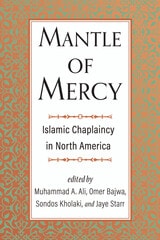
Mantle of Mercy
Islamic Chaplaincy in North AmericaMuhammad A. Ali
Templeton Press, 2022
Working in a variety of settings—including hospitals, prisons, universities, and the armed forces—Muslim chaplains encounter unique challenges on a daily basis, requiring them to call upon the resources of their Islamic faith with wisdom and tenderness. The contributors to this volume explore these circumstances vividly and honestly. Their personal stories are instructive of how Islamic principles can be employed with spiritual insight to bring strength and comfort to the sick and suffering.

Medina by the Bay
Scenes of Muslim Study and SurvivalMaryam Kashani
Duke University Press, 2023

Moroccan Islam
Tradition and Society in a Pilgrimage CenterBy Dale F. Eickelman
University of Texas Press, 1976
This book is one of the first comprehensive studies of Islam as locally understood in the Middle East. Specifically, it is concerned with the prevalent North African belief that certain men, called marabouts, have a special relation to God that enables them to serve as intermediaries and to influence the well-being of their clients and kin. Dale F. Eickelman examines the Moroccan pilgrimage center of Boujad and unpublished Moroccan and French archival materials related to it to show how popular Islam has been modified by its adherents to accommodate new social and economic realities. In the course of his analysis he demonstrates the necessary interrelationship between social history and the anthropological study of symbolism.
Eickelman begins with an outline of the early development of Islam in Morocco, emphasizing the "maraboutic crisis" of the fourteenth through sixteenth centuries. He also examines the history and social characteristics of the Sherqawi religious lodge, on which the study focuses, in preprotectorate Morocco. In the central portion of the book, he analyzes the economic activities and social institutions of Boujad and its rural hinterland, as well as some basic assumptions the townspeople and tribesmen make about the social order. Finally, there is an intensive discussion of maraboutism as a phenomenon and the changing local character of Islam in Morocco.
In focusing on the "folk" level of Islam, rather than on "high culture" tradition, the author has made possible a more general interpretation of Moroccan society that is in contrast with earlier accounts that postulated a marked discontinuity between tribe and town, past and present.
Moving In and Out of Islam
By Karin van Nieuwkerk
University of Texas Press, 2018
Embracing a new religion, or leaving one’s faith, usually constitutes a significant milestone in a person’s life. While a number of scholars have examined the reasons why people convert to Islam, few have investigated why people leave the faith and what the consequences are for doing so. Taking a holistic approach to conversion and deconversion, Moving In and Out of Islam explores the experiences of people who have come into the faith along with those who have chosen to leave it—including some individuals who have both moved into and out of Islam over the course of their lives.
Sixteen empirical case studies trace the processes of moving in or out of Islam in Western and Central Europe, the United States, Canada, and the Middle East. Going beyond fixed notions of conversion or apostasy, the contributors focus on the ambiguity, doubts, and nonlinear trajectories of both moving in and out of Islam. They show how people shifting in either direction have to learn or unlearn habits and change their styles of clothing, dietary restrictions, and ways of interacting with their communities. They also look at how communities react to both converts to the religion and converts out of it, including controversies over the death penalty for apostates. The contributors cover the political aspects of conversion as well, including debates on radicalization in the era of the “war on terror” and the role of moderate Islam in conversions.
Multicultural Politics
Racism, Ethnicity, and Muslims in BritainTariq Modood
University of Minnesota Press, 2005
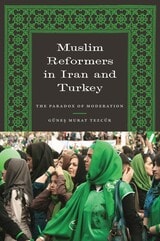
Muslim Reformers in Iran and Turkey
The Paradox of ModerationBy Güneş Murat Tezcür
University of Texas Press, 2010
Moderation theory describes the process through which radical political actors develop commitments to electoral competition, political pluralism, human rights, and rule of law and come to prefer negotiation, reconciliation, and electoral politics over provocation, confrontation, and contentious action. Revisiting this theory through an examination of two of the most prominent moderate Islamic political forces in recent history, Muslim Reformers in Iran and Turkey analyzes the gains made and methods implemented by the Reform Front in the Islamic Republic of Iran and the Justice and Development Party in Turkey.
Both of these groups represent Muslim reformers who came into continual conflict with unelected adversaries who attempted to block their reformist agendas. Based on extensive field research in both locales, Muslim Reformers in Iran and Turkey argues that behavioral moderation as practiced by these groups may actually inhibit democratic progress. Political scientist Güneş Murat Tezcür observes that the ability to implement conciliatory tactics, organize electoral parties, and make political compromises impeded democracy when pursued by the Reform Front and the Justice and Development Party. Challenging conventional wisdom, Tezcür's findings have broad implications for the dynamics of democratic progress.
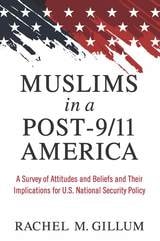
Muslims in a Post-9/11 America
A Survey of Attitudes and Beliefs and Their Implications for U.S. National Security PolicyRachel M. Gillum
University of Michigan Press, 2018
Muslims in a Post-9/11 America examines how public fears about Muslims in the United States compare with the reality of American Muslims’ attitudes on a range of relevant issues. While most research on Muslim Americans focuses on Arab Muslims, a quarter of the Muslim American population, Rachel Gillum includes perspectives of Muslims from various ethnic and national communities—from African Americans to those of Pakistani, Iranian, or Eastern European descent. Using interviews and one of the largest nationwide surveys of Muslim Americans to date, Gillum examines more than three generations of Muslim American immigrants to assess how segments of the Muslim American community are integrating into the U.S. social fabric, and how they respond to post-9/11 policy changes. Gillum’s findings challenge perceptions of Muslims as a homogeneous, isolated, un-American, and potentially violent segment of the U.S. population.
Despite these realities, negative political rhetoric around Muslim Americans persists. The findings suggest that the policies designed to keep America safe from terrorist attacks may have eroded one of law enforcement’s greatest assets in the fight against violent extremism—a relationship of trust and goodwill between the Muslim American community and the U.S. government. Gillum argues for policies and law enforcement tactics that will bring nuanced understandings of this diverse category of Americans and build trust, rather than alienate Muslim communities.
Muslims of Metropolis
The Stories of Three Immigrant Families in the WestRajagopalan, Kavitha
Rutgers University Press, 2008
The Muslim population globally is comprised of hundreds of ethnic, linguistic, and religious sub-communities. Yet, more often than not, the public conflates these diverse and unrelated communities, branding Muslim immigrants as a single, suspicious, and culturally antagonistic group of people. Generalizations like these have compromised many Muslim immigrants' sense of belonging and acceptance in places where they have lived, in some cases, for three or four generations.
In Muslims of Metropolis, Kavitha Rajagopalan takes a much needed step in personalizing and humanizing our understanding of the Muslim diaspora. Tracing the stories of three very different families-a Palestinian family moving to London, a Kurdish family moving to Berlin, and a Bangladeshi family moving to New York-she reveals a level of complexity and nuance that is seldom considered. Through their voices and in their words, Rajagopalan describes what prompted these families to leave home, what challenges they faced in adjusting to their new lives, and how they came to view their place in society. Interviews with community leaders, social justice organizations, and with academics and political experts in each of the countries add additional layers of insight to how broad political issues, like nationalist conflict, immigration reform, and antiterrorism strategies affect the lives of Muslims who have migrated in search of economic stability and personal happiness.
Although recent thinking about immigration policy in the United States and Europe emphasizes the importance of long-term integration, a global attitude that continues to sensationalize divisions between Muslim and other communities thwarts this possibility. Integration cannot occur with policy solutions alone-people must feel that they belong to a larger society. Whether read as simple stories or broader narratives, the voices in this revealing book are among the many speaking against generalization, prejudice, and fear that has so far surrounded Muslims living in the West.