185 books match the query 'Jazz' and 9 start with m
cover of Make It New: Reshaping Jazz in the 21st Century

Make It New

Reshaping Jazz in the 21st Century

Bill Beuttler

Lever Press, 2019

As jazz enters its second century it is reasserting itself as dynamic and relevant. Boston Globe jazz writer and Emerson College professor Bill Beuttler reveals new ways in which jazz is engaging with society through the vivid biographies and music of Jason Moran, Vijay Iyer, Rudresh Mahanthappa, The Bad Plus, Miguel Zenón, Anat Cohen, Robert Glasper, and Esperanza Spalding. These musicians are freely incorporating other genres of music into jazz—from classical (both western and Indian) to popular (hip-hop, R&B, rock, bluegrass, klezmer, Brazilian choro)—and other art forms as well (literature, film, photography, and other visual arts). This new generation of jazz is increasingly more international and is becoming more open to women as instrumentalists and bandleaders. Contemporary jazz is reasserting itself as a force for social change, prompted by developments such as the Black Lives Matter, #MeToo movements, and the election of Donald Trump.
[more]
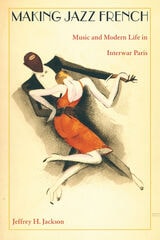
cover of Making Jazz French: Music and Modern Life in Interwar Paris

Making Jazz French

Music and Modern Life in Interwar Paris

Jeffrey H. Jackson

Duke University Press, 2003

Between the world wars, Paris welcomed not only a number of glamorous American expatriates, including Josephine Baker and F. Scott Fitzgerald, but also a dynamic musical style emerging in the United States: jazz. Roaring through cabarets, music halls, and dance clubs, the upbeat, syncopated rhythms of jazz soon added to the allure of Paris as a center of international nightlife and cutting-edge modern culture. In Making Jazz French, Jeffrey H. Jackson examines not only how and why jazz became so widely performed in Paris during the 1920s and 1930s but also why it was so controversial.

Drawing on memoirs, press accounts, and cultural criticism, Jackson uses the history of jazz in Paris to illuminate the challenges confounding French national identity during the interwar years. As he explains, many French people initially regarded jazz as alien because of its associations with America and Africa. Some reveled in its explosive energy and the exoticism of its racial connotations, while others saw it as a dangerous reversal of France’s most cherished notions of "civilization." At the same time, many French musicians, though not threatened by jazz as a musical style, feared their jobs would vanish with the arrival of American performers. By the 1930s, however, a core group of French fans, critics, and musicians had incorporated jazz into the French entertainment tradition. Today it is an integral part of Parisian musical performance. In showing how jazz became French, Jackson reveals some of the ways a musical form created in the United States became an international phenomenon and acquired new meanings unique to the places where it was heard and performed.
[more]
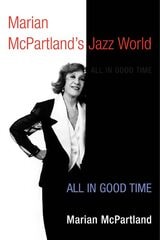
cover of Marian McPartland's Jazz World: All in Good Time

Marian McPartland's Jazz World

All in Good Time

Marian McPartland

University of Illinois Press, 1987

In this collection of musical portraits, jazz pianist and radio host Marian McPartland pays tribute to such beloved and legendary figures as Benny Goodman, Bill Evans, Joe Morello, Paul Desmond, Alec Wilder, Mary Lou Williams, and others. McPartland’s reminiscences and anecdotes about these jazz greats are informed by her encyclopedic knowledge of their music, making this richly detailed collection an important addition to the literature of jazz. 

In a preface to this edition, McPartland extends her commentary to include details of her long-running National Public Radio show “Marian McPartland’s Piano Jazz” and memories of her late husband, famed Chicago trumpeter Jimmy McPartland.
[more]
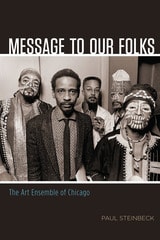
cover of Message to Our Folks: The Art Ensemble of Chicago

Message to Our Folks

The Art Ensemble of Chicago

Paul Steinbeck

University of Chicago Press, 2017

This year marks the golden anniversary of the Art Ensemble of Chicago, the flagship band of the Association for the Advancement of Creative Musicians. Formed in 1966 and flourishing until 2010, the Art Ensemble distinguished itself by its unique performance practices—members played hundreds of instruments on stage, recited poetry, performed theatrical sketches, and wore face paint, masks, lab coats, and traditional African and Asian dress. The group, which built a global audience and toured across six continents, presented their work as experimental performance art, in opposition to the jazz industry’s traditionalist aesthetics.

In Message to Our Folks, Paul Steinbeck combines musical analysis and historical inquiry to give us the definitive study of the Art Ensemble. In the book, he proposes a new theory of group improvisation that explains how the band members were able to improvise together in so many different styles while also drawing on an extensive repertoire of notated compositions. Steinbeck examines the multimedia dimensions of the Art Ensemble’s performances and the ways in which their distinctive model of social relations kept the group performing together for four decades. Message to Our Folks is a striking and valuable contribution to our understanding of one of the world’s premier musical groups.
[more]
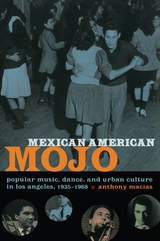
cover of Mexican American Mojo: Popular Music, Dance, and Urban Culture in Los Angeles, 1935–1968

Mexican American Mojo

Popular Music, Dance, and Urban Culture in Los Angeles, 1935–1968

Anthony Macías

Duke University Press, 2008

Stretching from the years during the Second World War when young couples jitterbugged across the dance floor at the Zenda Ballroom, through the early 1950s when honking tenor saxophones could be heard at the Angelus Hall, to the Spanish-language cosmopolitanism of the late 1950s and 1960s, Mexican American Mojo is a lively account of Mexican American urban culture in wartime and postwar Los Angeles as seen through the evolution of dance styles, nightlife, and, above all, popular music. Revealing the links between a vibrant Chicano music culture and postwar social and geographic mobility, Anthony Macías shows how by participating in jazz, the zoot suit phenomenon, car culture, rhythm and blues, rock and roll, and Latin music, Mexican Americans not only rejected second-class citizenship and demeaning stereotypes, but also transformed Los Angeles.

Macías conducted numerous interviews for Mexican American Mojo, and the voices of little-known artists and fans fill its pages. In addition, more famous musicians such as Ritchie Valens and Lalo Guerrero are considered anew in relation to their contemporaries and the city. Macías examines language, fashion, and subcultures to trace the history of hip and cool in Los Angeles as well as the Chicano influence on urban culture. He argues that a grass-roots “multicultural urban civility” that challenged the attempted containment of Mexican Americans and African Americans emerged in the neighborhoods, schools, nightclubs, dance halls, and auditoriums of mid-twentieth-century Los Angeles. So take a little trip with Macías, via streetcar or freeway, to a time when Los Angeles had advanced public high school music programs, segregated musicians’ union locals, a highbrow municipal Bureau of Music, independent R & B labels, and robust rock and roll and Latin music scenes.
[more]
cover of Microgroove: Forays into Other Music

Microgroove

Forays into Other Music

John Corbett

Duke University Press, 2015
Microgroove continues John Corbett's exploration of diverse musics, with essays, interviews, and musician profiles that focus on jazz, improvised music, contemporary classical, rock, folk, blues, post-punk, and cartoon music. Corbett's approach to writing is as polymorphous as the music, ranging from oral history and journalistic portraiture to deeply engaged cultural critique. Corbett advocates for the relevance of "little" music, which despite its smaller audience is of enormous cultural significance. He writes on musicians as varied as Sun Ra, PJ Harvey, Koko Taylor, Steve Lacy, and Helmut Lachenmann. Among other topics, he discusses recording formats; the relationship between music and visual art, dance, and poetry; and, with Terri Kapsalis, the role of female orgasm sounds in contemporary popular music. Above all, Corbett privileges the importance of improvisation; he insists on the need to pay close attention to “other” music and celebrates its ability to open up pathways to new ideas, fresh modes of expression, and unforeseen ways of knowing.
 
[more]
cover of More Important Than the Music: A History of Jazz Discography

More Important Than the Music

A History of Jazz Discography

Bruce D. Epperson

University of Chicago Press, 2013
Today, jazz is considered high art, America’s national music, and the catalog of its recordings—its discography—is often taken for granted. But behind jazz discography is a fraught and highly colorful history of research, fanaticism, and the intense desire to know who played what, where, and when. This history gets its first full-length treatment in Bruce D. Epperson’s More Important Than the Music. Following the dedicated few who sought to keep jazz’s legacy organized, Epperson tells a fascinating story of archival pursuit in the face of negligence and deception, a tale that saw curses and threats regularly employed, with fisticuffs and lawsuits only slightly rarer.

Epperson examines the documentation of recorded jazz from its casual origins as a novelty in the 1920s and ’30s, through the overwhelming deluge of 12-inch vinyl records in the middle of the twentieth century, to the use of computers by today’s discographers. Though he focuses much of his attention on comprehensive discographies, he also examines the development of a variety of related listings, such as buyer’s guides and library catalogs, and he closes with a look toward discography’s future. From the little black book to the full-featured online database, More Important Than the Music offers a history not just of jazz discography but of the profoundly human desire to preserve history itself.
[more]
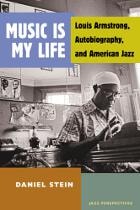
cover of Music Is My Life: Louis Armstrong, Autobiography, and American Jazz

Music Is My Life

Louis Armstrong, Autobiography, and American Jazz

Daniel Stein

University of Michigan Press, 2012

Music Is My Life is the first comprehensive analysis of Louis Armstrong's autobiographical writings (including his books, essays, and letters) and their relation to his musical and visual performances. Combining approaches from autobiography theory, literary criticism, intermedia studies, cultural history, and musicology, Daniel Stein reconstructs Armstrong's performances of his life story across various media and for different audiences, complicating the monolithic and hagiographic views of the musician.

The book will appeal to academic readers with an interest in African American studies, jazz studies, musicology, and popular culture, as well as general readers interested in Armstrong's life and music, jazz, and twentieth-century entertainment. While not a biography, it provides a key to understanding Armstrong's oeuvre as well as his complicated place in American history and twentieth-century media culture.
[more]
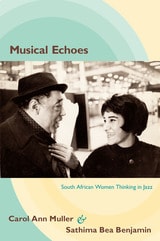
cover of Musical Echoes: South African Women Thinking in Jazz

Musical Echoes

South African Women Thinking in Jazz

Carol Ann Muller and Sathima Bea Benjamin

Duke University Press, 2011

Musical Echoes tells the life story of the South African jazz vocalist Sathima Bea Benjamin. Born in Cape Town in the 1930s, Benjamin came to know American jazz and popular music through the radio, movies, records, and live stage and dance band performances. She was especially moved by the voice of Billie Holiday. In 1962 she and Dollar Brand (Abdullah Ibrahim) left South Africa together for Europe, where they met and recorded with Duke Ellington. Benjamin and Ibrahim spent their lives on the move between Europe, the United States, and South Africa until 1977, when they left Africa for New York City and declared their support for the African National Congress. In New York, Benjamin established her own record company and recorded her music independently from Ibrahim. Musical Echoes reflects twenty years of archival research and conversation between this extraordinary jazz singer and the South African musicologist Carol Ann Muller. The narrative of Benjamin’s life and times is interspersed with Muller’s reflections on the vocalist’s story and its implications for jazz history.
[more]