Results by title
496 books match the query 'Jewish' and 41 start with m
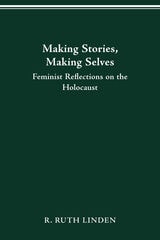
MAKING STORIES, MAKING SELVES
FEMINIST REFLECTIONS ON THE HOLOCAUSTR. Ruth Linden
The Ohio State University Press, 1995
Urged forward by these silences, Linden, a feminist and sociologist, began to interview Jewish Holocaust survivors in 1983. As Linden interprets survivors' accounts of the death camps and the resistance, she reveals complex ways in which selves are constructed through storytelling. The stories that unfold are continuously fashioned and refashioned—never stripped of context or frozen in time. What emerges is an unexpectedly elegant montage in which interviewee, interviewer, and author are intertwined.
Linden's meetings with survivors and her encounters with their stories transformed her as a feminist, a Jew, and a social scientist. Her analysis reveals the intimate connections between an ethnographer's lived experience and her interpretations of others'. Linden's reflections on the process of ethnography belie the rhetoric of positivism in the social sciences. They will inspire other scholars to break free of research and writing practices in their own disciplines that efface the ineluctable bond between knower and known. All readers will be challenged to reexamine the Holocaust in an intensely personal light and to reconsider the meanings of survival in our own time.
Cutting across the boundaries of ethnography and autobiography to create a new kind of text, Making Stories, Making Selves offers a significant contribution to interpretive social science and the literature of the Holocaust. Linden's original and courageous work is vital reading for Holocaust scholars, students of modern Jewish life, sociologists, feminist theorists, and all readers seeking to understand their own relationship to the Holocaust.
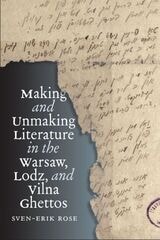
Making and Unmaking Literature in the Warsaw, Lodz, and Vilna Ghettos
Sven-Erik Rose
Brandeis University Press, 2025
A study of literature written by Jewish authors while interned in Nazi ghettos emphasizes how authors processed their horrific experiences through poetry and prose.
Published in Association with the United States Holocaust Memorial Museum
This is the first study devoted to how little known but essential authors grappled with the destitution of ghetto existence by writing within, at the limits of, and against an array of literary scenarios, tropes, plot lines, and generic conventions, including those of nature lyric, modernist interior monologue, the realist social novel, the detective story, and the gothic horror tale. Contending with starvation, disease, desperate housing conditions and the looming threat of being murdered, inhabitants of ghettos in Poland nonetheless made them sites of rich Jewish cultural production. Rose’s readings of these literary works reveal how authors asserted their humanity by insisting on writing works of literature. In such radically dehumanizing circumstances, however, their recourse to established literary genres was not naive. Rather, ghetto authors brilliantly meditated on the grotesque incongruities between established literary models and the extreme conditions of ghetto existence.
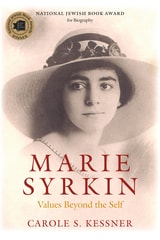
Marie Syrkin
Values Beyond the SelfCarole S. Kessner
Brandeis University Press, 2008
Marie Syrkin’s life spanned ninety years of the twentieth century, 1899–1989. As a polemical journalist, socialist Zionist, poet, educator, literary critic, translator, and idiosyncratic feminist, she was an eyewitness to and reporter on most of the major events in America, Israel, and Europe. Beautiful as well as brilliant, she had a rich personal life as a lover, wife, mother, and friend. During her lifetime Syrkin’s name was widely recognized in the world of Jewish life and letters. Yet, since Syrkin’s death, recognition of her name is no longer quite so immediate. Carole S. Kessner’s biography restores Syrkin’s fascinating life and legacy for a new generation.

Market Day
Pál Závada
Seagull Books, 2023
What could bring people to form a mob and attack others? What circumstances could provoke a thirst for blood at the market square? Who will gang up to batter their neighbor, improbably returned from deportation? How can a person be swept up among lynchers?
Pál Závada’s novel examines and analyses the anti-Semitic mass hysteria and political opportunism surrounding the pogroms in Hungary that followed World War II and the Holocaust. In May 1946, at the village market, Mária Csóka witnessed a group of women set upon and beat to death a Jewish egg seller. The wife of a schoolteacher accused of anti-Semitic incitement, and daughter of a respected shopkeeper, Mária fears for her husband’s life yet cannot ignore the victims. The murderous fury spreads through the neighborhood like wildfire, dragging out women, children, and the elderly alike. Mária’s notes from the bloody day at the village market and from the subsequent trial in Budapest testify to a state of human relations that is intimately complex and irreparably scarred.

Married to Another Man
Israel's Dilemma in PalestineGhada Karmi
Pluto Press, 2007
Two rabbis, visiting Palestine in 1897, observed that the land was like a bride, 'beautiful, but married to another man'. By which they meant that, if a place was to be found for Israel in Palestine, where would the people of Palestine go? This is a dilemma that Israel has never been able to resolve.
No conflict today is more dangerous than that between Israel and the Palestinians. The implications it has for regional and global security cannot be overstated. The peace process as we know it is dead and no solution is in sight. Nor, as this book argues, will that change until everyone involved in finding a solution accepts the real causes of conflict, and its consequences on the ground.
Leading writer Ghada Karmi explains in fascinating detail the difficulties Israel's existence created for the Arab world and why the search for a solution has been so elusive. Ultimately, she argues that the conflict will end only once the needs of both Arabs and Israelis are accommodated equally. Her startling conclusions overturn conventional thinking -- but they are hard to refute.
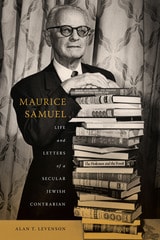
Maurice Samuel
Life and Letters of a Secular Jewish ContrarianAlan T. Levenson
University of Alabama Press, 2022
An intellectual biography that reassesses one of the premier Jewish humanists of the mid-twentieth century
In Maurice Samuel: Life and Letters of a Secular Jewish Contrarian, Alan T. Levenson captures the life, works, and milieu of the Romanian-born, English-educated, American belletrist Maurice Samuel. A diaspora intellectual—or a rooted cosmopolitan, as Levenson describes him—Samuel made an indelible mark on many features of contemporary Jewish thought and culture. A generalist in an age of experts, an independent scholar in an age of rabbis and professors, Samuel was one of the most productive and visible members of the group dubbed the “other” New York Jewish intellectuals.
His fame as a public intellectual and popular speaker were well warranted: no mere popularizer, Samuel contributed significantly to four seemingly unrelated but critical areas of modern Jewish thought. Samuel is characterized by some as principally a Zionist, by others as an accomplished translator and many Americans’ first entrée into the world of Yiddish literature, by still others as a polemicist and campaigner against anti-Semitism, and finally as a media-savvy Biblical critic, essayist, and radio personality. But he was all of these things, since Samuel succeeded in an era when it was possible to be a public intellectual without being an expert.
Drawing on Samuel’s vast literary opus, as well as previously unexplored archival material from three continents, this study writes Samuel back into the history of mid-twentieth-century American letters. Levenson argues that Samuel’s varied and substantive contributions demand reconsideration of our assumptions about the means and ends of cultural transmission, and merit him a place as one of twentieth-century American Jewry’s most significant cultural and intellectual voices.
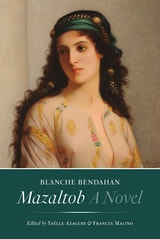
Mazaltob
A NovelBlanche Bendahan
Brandeis University Press, 2024
Raised in the Judería or Jewish quarter of Tetouan, Morocco, at the turn of the 20th-century, sixteen-year-old Mazaltob finds herself betrothed to José, an uncouth man from her own community who has returned from Argentina to take a wife. Mazaltob, however, is in love with Jean, who is French, half-Jewish, and a free spirit. In this classic of North African Jewish fiction, Blanche Bendahan evokes the two compelling forces tearing Mazaltob apart in her body and soul: her loyalty to the Judería and her powerful desire to follow her own voice and find true love. Bendahan’s nuanced and moving novel is a masterly exploration of the language, religion, and quotidian customs constraining North African Jewish women on the cusp of emancipation and decolonization. Yaëlle Azagury and Frances Malino provide the first English translation of this modern coming-of-age tale, awarded a prize by the Académie Française in 1930, and analyze the ways in which Mazaltob, with its disconcerting blend of ethnographic details and modernist experimentation, is the first of its genre—that of the feminist Sephardi novel. A historical introduction, a literary analysis, and annotations elucidate historical and cultural terms for readers, supplementing the author’s original notes.
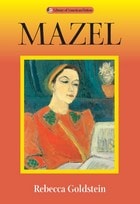
Mazel
Rebecca Goldstein
University of Wisconsin Press, 2002
Mazel means luck in Yiddish, and luck is the guiding force in this magical and mesmerizing novel that spans three generations. Sasha Saunders is the daughter of a Polish rabbi who abandons the shtetl and wins renown as a Yiddish actress in Warsaw and New York. Her daughter Chloe becomes a professor of classics at Columbia. Chloe’s daughter Phoebe grows up to become a mathematician who is drawn to traditional Judaism and the sort of domestic life her mother and grandmother rejected.
Mdeilmm
Mole SpeechHélène Cixous
Seagull Books, 2025
Weaving together history, literature, and personal experience, this recent book from a master of literature crafts a mesmerizing exploration of language, loss, and the enduring power of the spirit world.
The strange word “Mdeilmm” was reported to have been uttered by the spirit of Shakespeare when called up during a séance in 1854 at the instigation of the French poet Victor Hugo. Hugo was then living in exile on the island of Jersey where he took part in several such séances. Hélène Cixous weaves this scene into a rich tapestry that draws from many corners of her world, both real and fictional: Dostoevsky’s Idiot, Hugo’s Last Day of a Condemned Man, Poe’s story “The Gold Bug,” but also film footage of the assassination of Itzhak Rabin and many layers of memories of her Algerian childhood. Transcribed communications from spirits of the departed, her father and grandfather among them, provide a fascinating glimpse into past spiritual practices.
Cixous’s unique narrative style enhances the book’s enchanting quality, ensuring that readers are not only engaged by the content but also captivated by the beauty of the prose. Meanwhile, the reader falls under the spell of the author’s incomparable “mole speech,” the language in which poets communicate.
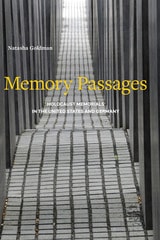
Memory Passages
Holocaust Memorials in the United States and GermanyNatasha Goldman
Temple University Press, 2020
For decades, artists and architects have struggled to relate to the Holocaust in visual form, resulting in memorials that feature a diversity of aesthetic strategies. In Memory Passages, Natasha Goldman analyzes both previously-overlooked and internationally-recognized Holocaust memorials in the United States and Germany from the postwar period to the present, drawing on many historical documents for the first time. From the perspectives of visual culture and art history, the book examines changing attitudes toward the Holocaust and the artistic choices that respond to it.
The book introduces lesser-known sculptures, such as Nathan Rapoport’s Monument to the Six Million Jewish Martyrs in Philadelphia, as well as internationally-acclaimed works, such as Peter Eisenman’s Memorial to the Murdered Jews of Europe in Berlin. Other artists examined include Will Lammert, Richard Serra, Joel Shapiro, Gerson Fehrenbach, Margit Kahl, and Andy Goldsworthy.Archival documents and interviews with commissioners, survivors, and artists reveal the conversations and decisions that have shaped Holocaust memorials.
Memory Passages suggests that memorial designers challenge visitors to navigate and activate spaces to engage with history and memory by virtue of walking or meandering. This book will be valuable for anyone teaching—or seeking to better understand—the Holocaust.
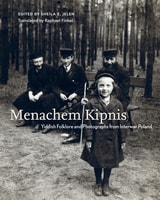
Menachem Kipnis
Yiddish Folklore and Photographs from Interwar PolandSheila E. Jelen
Rutgers University Press, 2026
Menachem Kipnis (1878–1942) was one of the early twentieth-century’s greatest Jewish eastern European ethnomusicologists, folklorists, and photographers. He had a weekly column in the Warsaw Yiddish newspaper Haynt, retelling humorous old folk stories about the fictional Polish town of Chelm, populated exclusively by fools. At the same time, his photographs of Jewish life in eastern Europe regularly appeared in the Forverts (Forward), the most popular Yiddish daily newspaper in the United States. Now, for the first time, Kipnis’s stories and photographs are published together in a single book.
Menachem Kipnis brings these photographs and stories into dialogue with one another, bridging the Jewish communities in Poland and in America during the interwar period. This dialogue, between image and text, between European metropolis and American metropolis, captures a key historical moment when American Jews sought to imagine the lives of their coreligionists in the “Old Country” and eastern European urban Jews sought to distinguish themselves from their Jewish compatriots who were still living in the shtetl. Including an introductory essay, annotations, and an epilogue by Sheila E. Jelen, Menachem Kipnis suggests new ways of understanding both visual and literary depictions of eastern European Jewish culture between the two world wars.
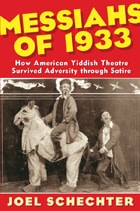
Messiahs of 1933
How American Yiddish Theatre Survived Adversity through SatireJoel Schechter
Temple University Press, 2008
Joel Schechter has rediscovered the funny and often politically-charged plays of the American Yiddish theatre of the 1930s. In Messiahs of 1933 he celebrates their satire, their radical imagination, and their commitment to social change. He introduces readers to the once-famous writers and actors—Moishe Nadir, David Pinski, Yosl Cutler, and others—who brought into artistic form their visions of peace, social justice, and satire for all.
Messiahs of 1933 greatly enlarges our understanding of Yiddish theatre and culture in the United States. It examines the innovative stage performances created by the Artef collective, the Modicut puppeteers, and the Yiddish Unit of the Federal Theatre Project. And it introduces to contemporary readers some of the most popular theatre actors of the 30s, including Leo Fuchs, Menasha Skulnik, and Yetta Zwerling. Throughout, it includes relevant photographs and contemporary comic strips, along with the first English-language publication of excerpts from the featured plays.
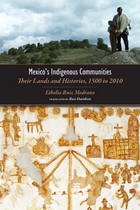
Mexico's Indigenous Communities
Their Lands and Histories, 1500-2010Ethelia Ruiz Medrano
University Press of Colorado, 2010
Ethelia Ruiz Medrano focuses on a series of individual cases, falling within successive historical epochs, that illustrate how the practice of drawing up and preserving historical documents-in particular, maps, oral accounts, and painted manuscripts-has been a determining factor in the history of Mexico's Indian communities for a variety of purposes, including the significant issue of land and its rightful ownership. Since the sixteenth century, numerous Indian pueblos have presented colonial and national courts with historical evidence that defends their landholdings.
Because of its sweeping scope, groundbreaking research, and the author's intimate knowledge of specific communities, Mexico's Indigenous Communities is a unique and exceptional contribution to Mexican history. It will appeal to students and specialists of history, indigenous studies, ethnohistory, and anthropology of Latin America and Mexico
Midrash and Theory
Ancient Jewish Exegesis and Contempory Literary StudiesDavid Stern
Northwestern University Press, 1998
As midrash--the literature of classical Jewish Scriptural interpretation--has become the focus of new interest in contemporary literary circles, it has been invoked as a precursor of post-structuralist theory and criticism. At the same time, the midrashic imagination has undergone a revival in the larger Jewish community and shown itself capable of exercising a powerful influence and hold on a new type of contemporary Jewish writing. Stern examines this resurgence of fascination with ancient Jewish interpretation from the persepctive of the cultural relevance of midrash and its connection to its original historical and literary contexts.
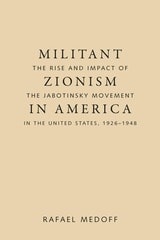
Militant Zionism in America
The Rise and Impact of the Jabotinsky Movement in the United States, 1926-1948Rafael Medoff
University of Alabama Press, 2006
This in-depth look at a controversial faction of American Zionism fills
a void in the story of American Zionism--and in the story of American Judaism.
This book recounts the fascinating and little-known story
of the militant American Zionists who lobbied Congress, rallied American
public opinion, and influenced British-American relations in their campaign
for Jewish statehood in the 1930s and 1940s. Although these activists have
been dismissed as fanatics who fragmented the American Zionist movement,
Rafael Medoff reveals that the faction--which included an Academy Award-winning
screenwriter and several future members of the Israeli parliament--was
more influential than has been previously acknowledged.
These militants stirred America's conscience by placing
controversial newspaper ads, lobbying conservative as well as liberal members
of Congress, and staging dramatic protest rallies. Through these tactics,
Medoff shows, they attracted a wave of support from an extraordinary cross-section
of leading Americans, including comedians Harpo Marx and Carl Reiner, actors
Vincent Price, Marlon Brando, and Jane Wyatt, musician Leonard Bernstein,
and rising young politicians Jacob Javits and Hubert Humphrey. Medoff also
describes the shadowy underground division that smuggled weapons to the
Holy Land in caskets, naming and interviewing for the first time members
of this gunrunning network.
Based on years of archival research and interviews and
written in a compelling style, Militant Zionism in America documents
events that reshaped the American Jewish community, influenced American
foreign policy, and contributed to one of the most extraordinary events
of modern history: the creation of the State of Israel.
Rafael Medoff is a Visiting Scholar at the State University of New York -- Purchase College.
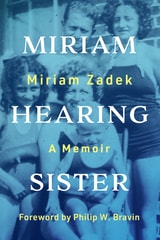
Miriam Hearing Sister
A MemoirMiriam Zadek
Gallaudet University Press, 2022
The prevailing ideological movements of the time permeate her family life. Zadek reveals the traumatic impact of eugenics and the fears surrounding the genetic transmission of deafness. She considers the effects of adhering to the oral method of communication in her home when sign language could have given her family the ability to interact with each other more fully. In this environment, Zadek became an astute communicator and learned to adapt to both the hearing and the deaf world, where she was known as “Miriam Hearing Sister.” Her memoir is an elegant literary work that offers an understanding of how biases and stigmas resonate and evolve, and it showcases her loving family of strong women who pushed against stereotypes and have thrived across generations.
Mishkan Aveilut
Where Grief ResidesRabbi Eric Weiss
Central Conference of American Rabbis, 2019
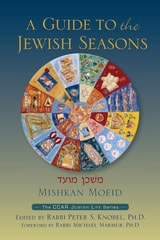
Mishkan Moeid
A Guide to the Jewish SeasonsRabbi Peter S. Knobel, PhD
Central Conference of American Rabbis, 2013

Mishkan T'filah Weekdays and Festivals Large Print
A Reform SiddurRabbi Elyse D. Frishman
Central Conference of American Rabbis, 2007
This volume is for weekdays and festivals only, and does not include Shabbat liturgy.
This Siddur includes:
- Broad selection of readings, including beloved passages from our Reform liturgical tradition and great poetic writings from throughout Jewish history
- Faithful, elegant translations
- Contemporary, gender-inclusive English
- Theological and stylistic diversity
- Full transliteration
- Extensive commentaries, source notes and usage guides
- More than 100 contemporary and traditional song texts
- Innovative design in two-page spreads
- Two-color printing to enhance usability
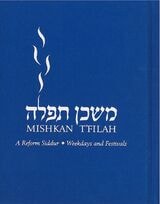
Mishkan T'filah Weekdays and Festivals, Non-transliterated
A Reform SiddurRabbi Elyse D. Frishman
Central Conference of American Rabbis, 2007
Includes services for weekdays, festivals, and other occasions of public worship. Mishkan T'filah reflects the full diversity of our Movement, including texts for more than a hundred songs.
This volume is for weekdays and festivals only. This version does not include Shabbat liturgy or transliteration.
This Siddur does include:
- Broad selection of readings, including beloved passages from our Reform liturgical tradition and great poetic writings from throughout Jewish history
- Faithful, elegant translations
- Contemporary, gender-inclusive English
- Theological and stylistic diversity
- Extensive commentaries, source notes and usage guides
- More than 100 contemporary and traditional song texts
- Innovative design in two-page spreads
- Two-color printing to enhance usability
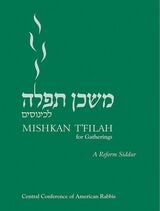
Mishkan T'filah for Gatherings
A Reform SiddurRabbi Sue Ann Wasserman
Central Conference of American Rabbis, 2009
A lightweight edition combining weekday and Shabbat services. Perfect for meetings, conferences, kallot, and retreats.
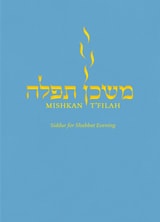
Mishkan T'filah for Shabbat Evening
Rabbi Elsye D. Frishman, Rabbi Hara E Person, Rafael Chaiken, Rabbi Annie Villarreal-Belford
Central Conference of American Rabbis, 2026
Mishkan T’filah: Siddur for Shabbat Evening is a comprehensively revised twentieth-anniversary edition of the prayer book for Friday night. Since its publication in 2007, under the leadership of Rabbi Elyse Frishman, Mishkan T’filah: A Reform Siddur has reinvigorated worship and become a beloved part of the Jewish landscape.
This new edition includes the complete Kabbalat Shabbat and Arvit services, along with the Torah service for communities that read Torah on Friday nights as well as an appendix of favorite songs. This lightweight yet durable hardcover features updated translations, full transliteration, additional liturgical texts, and a refreshed and streamlined layout. A wealth of new readings have been added to the left-hand pages, alongside indispensable classics. Gender-neutral and nonbinary options ensure that all worshipers can feel welcome. Songs that have become integral to Reform services in the past twenty years are conveniently placed next to prayers. Mishkan T’filah: Siddur for Shabbat Evening will rejuvenate your Shabbat experience.
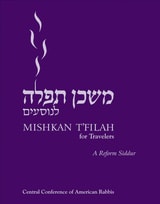
Mishkan T'filah for Travelers
A Reform SiddurRabbi Sue Ann Wasserman
Central Conference of American Rabbis, 2009
Also includes Festival liturgy.
Mishkan T'filah for the House of Mourning, Large Print
A Reform SiddurRabbi Elaine S. Zecher and Rabbi Hara E. Person
Central Conference of American Rabbis, 0
An innovative approach to services in the house of mourning. Includes thoughtful readings and commentary from traditional and contemporary sources. Easy-to-transport paperback format. Available in large print for those with vision impairments.
Mishkan T'filah for the House of Mourning
A Reform SiddurRabbi Elaine S. Zecher and Rabbi Hara E. Person
Central Conference of American Rabbis, 2010
Mishkan T'filah
A Reform Siddur, non-transliterated (Shabbat, Weekdays, Festivals): A Reform SiddurRabbi Elyse D. Frishman
Central Conference of American Rabbis, 2007
Includes services for Shabbat, weekdays, and festivals, as well as other occasions of public worship and texts for more than a hundred songs. Mishkan T'filah reflects the full diversity of our Movement.
This volume does not contain transliteration.
This Siddur includes:
- Broad selection of readings, including beloved passages from our Reform liturgical tradition and great poetic writings from throughout Jewish history
- Faithful, elegant translations
- Contemporary, gender-inclusive English
- Theological and stylistic diversity
- Extensive commentaries, source notes and usage guides
- More than 100 contemporary and traditional song texts
- Innovative design in two-page spreads (additional Shabbat services in linear style also included)
- Two-color printing to enhance usability
Mishkan T'filah
A Reform Siddur, transliterated (Shabbat, Weekdays, Festivals): A Reform SiddurRabbi Elyse D. Frishman
Central Conference of American Rabbis, 2007
Includes services for Shabbat, weekdays, and festivals, as well as other occasions of public worship and texts for more than a hundred songs. Mishkan T'filah reflects the full diversity of our Movement.
This Siddur includes:
- Broad selection of readings, including beloved passages from our Reform liturgical tradition and great poetic writings from throughout Jewish history
- Faithful, elegant translations
- Contemporary, gender-inclusive English
- Theological and stylistic diversity
- Full transliteration
- Extensive commentaries, source notes and usage guides
- More than 100 contemporary and traditional song texts
- Innovative design in two-page spreads (additional Shabbat services in linear style also included)
- Two-color printing to enhance usability
Mishkan T'filah
Journal Edition, Non-transliterated: A Reform SiddurRabbi Joel Abraham and Michelle Shapiro Abraham, RJE
Central Conference of American Rabbis, 2010
Note: Page numbers in this special edition are meant to be consistent with the page numbering of the standard, complete edition of Mishkan T'filah. However, because the Journal Edition does not contain some of the material from the complete edition, there are several jumps in page numbering in this edition.
Mishkan T'filah
Journal Edition: A Reform SiddurRabbi Joel Abraham and Michelle Shapiro Abraham
Central Conference of American Rabbis, 2010
Note: Page numbers in this special edition are meant to be consistent with the page numbering of the standard, complete edition of Mishkan T'filah. However, because the Journal Edition does not contain some of the material from the complete edition, there are several jumps in page numbering in this edition.
Mishkan T'filah
Large Print, Shabbat: A Reform SiddurRabbi Elyse D. Frishman
Central Conference of American Rabbis, 0
Including services for Shabbat and texts for more than a hundred songs, Mishkan T'filah reflects the full diversity of our Movement. Available in large print for the visually impaired.
This volume is for Shabbat only, and does not include weekday and festival liturgy.
This Siddur includes:
- Broad selection of readings, including beloved passages from our Reform liturgical tradition and great poetic writings from throughout Jewish history
- Faithful, elegant translations
- Contemporary, gender-inclusive English
- Theological and stylistic diversity
- Full transliteration
- Extensive commentaries, source notes and usage guides
- More than 100 contemporary and traditional song texts
- Innovative design in two-page spreads (additional Shabbat services in linear style also included)
- Two-color printing to enhance usability
Mishkan T'filah
Pulpit Edition: A Reform SiddurRabbi Elyse D. Frishman
Central Conference of American Rabbis, 2010
Purchase of this volume grants the buyer the right to make copies on a one-time basis for the purpose of practice or preparation only. These pages are not to be used for the creation of new services or for publication of any kind.
Each page contains a copyright notice.
Mishkan T'filah
Shabbat, non-transliterated: A Reform SiddurRabbi Elyse D. Frishman
Central Conference of American Rabbis, 0
Including services for Shabbat and texts for more than a hundred songs, Mishkan T'filah reflects the full diversity of our Movement. This volume is for Shabbat only and does not include weekday and festival liturgy.
This volume does not contain transliteration.
This Siddur includes:
- Broad selection of readings, including beloved passages from our Reform liturgical tradition and great poetic writings from throughout Jewish history
- Faithful, elegant translations
- Contemporary, gender-inclusive English
- Theological and stylistic diversity
- Extensive commentaries, source notes and usage guides
- More than 100 contemporary and traditional song texts
- Innovative design in two-page spreads (additional Shabbat services in linear style also included)
- Two-color printing to enhance usability
Mishkan T'filah
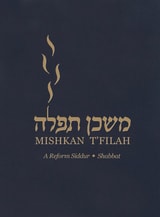
Shabbat, transliterated: A Reform SiddurRabbi Elyse D. Frishman
Central Conference of American Rabbis, 0
Including services for Shabbat and texts for more than a hundred songs, Mishkan T'filah reflects the full diversity of our Movement.
This volume is for Shabbat only and does not include weekday and festival liturgy.
This Siddur includes:
- Broad selection of readings, including beloved passages from our Reform liturgical tradition and great poetic writings from throughout Jewish history
- Faithful, elegant translations
- Contemporary, gender-inclusive English
- Theological and stylistic diversity
- Full transliteration
- Extensive commentaries, source notes and usage guides
- More than 100 contemporary and traditional song texts
- Innovative design in two-page spreads (additional Shabbat services in linear style also included)
- Two-color printing to enhance usability
Mishkan T'filah
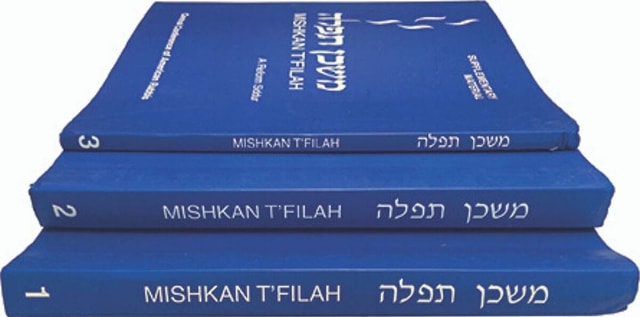
Special Large Print Edition - Three-Volume Set: A Reform SiddurRabbi Elyse D. Frishman
Central Conference of American Rabbis, 0
This Special Large Print edition is an oversize three volume set, created with the support of Women of Reform Judaism and in consultation with the Jewish Braille Institute. Each spiral bound volume uses specific layout and fonts meant to make the pages of Mishkan T'filah accessible to those with significant visual impairment.
Available only as a set of 3:
Volume 1 - Shabbat
Volume 2 - Weekdays and Festivals
Volume 3 - Supplementary Material (Blessings for the Home, Songs, Sources, Permissions)
Coil Binding
Hebrew-opening
Transliterated
Mishkan T'filah
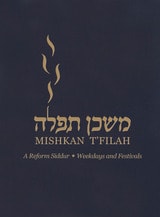
Weekdays/Festivals, transliterated: A Reform SiddurRabbi Elyse D. Frishman
Central Conference of American Rabbis, 0
Includes services for weekdays, festivals, and other occasions of public worship. Mishkan T'filah reflects the full diversity of our Movement, including texts for more than a hundred songs.
This volume is for weekdays and festivals only and does not include Shabbat liturgy.
This Siddur includes:
- Broad selection of readings, including beloved passages from our Reform liturgical tradition and great poetic writings from throughout Jewish history
- Faithful, elegant translations
- Contemporary, gender-inclusive English
- Theological and stylistic diversity
- Full transliteration
- Extensive commentaries, source notes and usage guides
- More than 100 contemporary and traditional song texts
- Innovative design in two-page spreads
- Two-color printing to enhance usability
Mishkan T'filah
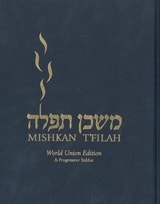
World Union Edition: A Reform SiddurRabbi Elyse D. Frishman
Central Conference of American Rabbis, 0
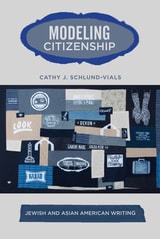
Modeling Citizenship
Jewish and Asian American WritingAuthored by Cathy Schlund-Vials
Temple University Press, 2011
Navigating deftly among historical and literary readings, Cathy Schlund-Vials examines the analogous yet divergent experiences of Asian Americans and Jewish Americans in Modeling Citizenship. She investigates how these model minority groups are shaped by the shifting terrain of naturalization law and immigration policy, using the lens of naturalization, not assimilation, to underscore questions of nation-state affiliation and sense of belonging.
Modeling Citizenship examines fiction, memoir, and drama to reflect on how the logic of naturalization has operated at discrete moments in the twentieth century. Each chapter focuses on two exemplary literary works. For example, Schlund-Vials shows how Mary Antin's Jewish-themed play The Promised Land is reworked into a more contemporary Chinese American context in Gish Jen's Mona in the Promised Land.
In her compelling analysis, Schlund-Vials amplifies the structural, cultural, and historical significance of these works and the themes they address.
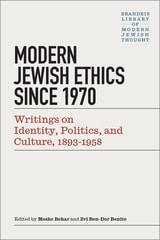
Modern Middle Eastern Jewish Thought
Writings on Identity, Politics, and Culture, 1893–1958Edited by Moshe Behar and Zvi Ben-Dor Benite
Brandeis University Press, 2013
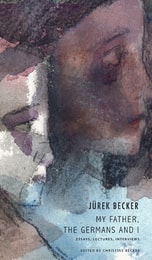
My Father, the Germans and I
Essays, Lectures, InterviewsJurek Becker
Seagull Books, 2010
Jürek Becker (1937–97) is best known for his novel Jacob the Liar, which follows the life of a man, who, like Becker, lived in the Lódz ghetto during the German occupation of Poland in World War II. Throughout his career, Becker also wrote nonfiction, and the essays, lectures, and interviews collected in My Father, the Germans and I share a common thread in that they each speak to Becker’s interactions with and opinions on the social, political, and cultural conditions of twentieth-century Germany.
Becker, who had lived in both German states and in unified Germany, was passionately and humorously active in the political debates of his time. Becker never directly aligned himself with either the political ideology of East Germany or the capitalist market forces of West Germany. The remains of fascism in postwar Germany, and the demise of Socialism, as well as racism and xenophobic violence, were topics that perpetually interested Becker. However, his writings, as evidenced in this collection, were never pedantic, but always entertaining, retaining the sense of humor that made his novels so admired.
My Father, the Germans and I gives expression to an exceptional author’s perception of himself and the world and to his tireless attempt to bring his own unique tone of linguistic brevity, irony, and balance to German relations.

My Germany
A Jewish Writer Returns to the World His Parents EscapedLev Raphael
University of Wisconsin Press, 2009
Haunted by his parents’ horrific suffering and traumatic losses under Nazi rule, Lev Raphael grew up loathing everything German. Those feelings shaped his Jewish identity, his life, and his career. While researching his mother’s war years after her death, he discovers a distant relative living in the very city where she had worked in a slave labor camp, found freedom, and met his father. Soon after, Raphael is launched on book tours in Germany and, in the process, redefines himself as someone unafraid to face the past and let it go.
Bookmarks, “Top Ten Nonfiction Titles of 2009”
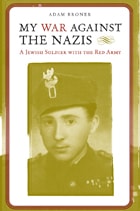
My War against the Nazis
A Jewish Soldier with the Red ArmyAdam Broner, with a foreword by Antony Polonsky
University of Alabama Press, 2007
A poignant account of the perils and fortunes of an indomitable survivor of violence in Eastern Europe during World War II.
In 1939, to escape Nazi occupation, 14-year-old Adam Broner and his older brother Sam left their home and family in Lodz, Poland, and made their way to the Soviet Union. Adam enlisted in the Red Army to join the fight against the Nazis but was sent to work in a Siberian coal mine instead when his nationality was discovered. After a bold and daring escape from Siberia, Broner reached the Soviet Polish Kosciuszko Army, joined the struggle against the Nazis, participated in the liberation of Poland, and rode victorious into Berlin in 1945. He later learned that his parents, siblings (except Sam), and all other close relatives had perished during the war.
Broner rebuilt his life, established a family, returned to Moscow for a degree in economics, and then went back to Poland, where he accepted a job in the Polish central planning agency. Eventually fed up with the growing anti-Semitism of the Communist government there, the author emigrated to the United States in 1969. He earned a doctorate from Princeton University and served as an economic adviser to New Jersey governors and the state legislature. In retirement, Broner learned portrait painting and reproduced the likenesses of his parents and siblings from memory, which are presented along with their biographies in this book.
In recounting his struggle for survival during some of the most dramatic upheavals of the 20th century— the Great Depression, Nazism, World War II, and the spread of Communism in Central Europe— Broner reveals a life dedicated to the ultimate goal of freedom, which he achieved through a combination of arduous effort and fortunate circumstance.