Results by title
56 books match the query 'Jurisprudence' and 3 start with m
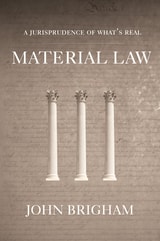
Material Law
A Jurisprudence of What's RealJohn Brigham
Temple University Press, 2009
Law is part of the process by which people construct their views of the world. In Material Law, distinguished scholar John Brigham focuses on the places where law and material life intersect, and how law creates and alters our social reality. Brigham looks at an eclectic group of bodies and things—from maps and territories and trends in courthouse architecture to a woman's womb and a judge's body— to make connections between the material and the legal.
Theoretically sophisticated, and consistently fascinating, Material Law integrates law and society, political science, and popular culture in a truly interdisciplinary fashion. Brigham examines how the meaning of law is influenced by politics, reviewing, for example, whether the authority of global law supersedes that of national law in the context of anglo-american cultural colonialism. What emerges is a well-reasoned look at how the authority of law constitutes what we see as real in our lives.

Matterphorics
On the Laws of TheoryDaniela Gandorfer
Duke University Press, 2026
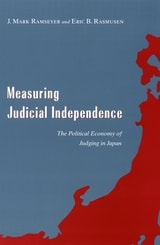
Measuring Judicial Independence
The Political Economy of Judging in JapanJ. Mark Ramseyer and Eric B. Rasmusen
University of Chicago Press, 2003
The Japanese Constitution, like many others, requires that all judges be "independent in the exercise of their conscience and bound only by this Constitution and its laws." Consistent with this requirement, Japanese courts have long enjoyed a reputation for vigilant independence—an idea challenged only occasionally, and most often anecdotally. But in this book, J. Mark Ramseyer and Eric B. Rasmusen use the latest statistical techniques to examine whether that reputation always holds up to scrutiny—whether, and to what extent, the careers of lower court judges can be manipulated to political advantage.
On the basis of careful econometric analysis of career data for hundreds of judges, Ramseyer and Rasmusen find that Japanese politics do influence judicial careers, discreetly and indirectly: judges who decide politically charged cases in ways favored by the ruling party enjoy better careers after their decisions than might otherwise be expected, while dissenting judges are more likely to find their careers hampered by assignments to less desirable positions.
Ramseyer and Rasmusen's sophisticated yet accessible analysis has much to offer anyone interested in either judicial independence or the application of econometric techniques in the social sciences.