Results by title
108 books match the query 'Knowledge and learning' and 7 start with m
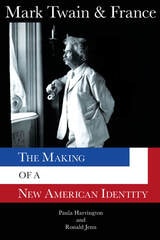
Mark Twain & France
The Making of a New American IdentityPaula Harrington and Ronald Jenn
University of Missouri Press, 2017
While critics have generally dismissed Mark Twain’s relationship with France as hostile, Harrington and Jenn see Twain’s use of the French as a foil to help construct his identity as “the representative American.” Examining new materials that detail his Montmatre study, the carte de visite album, and a chronology of his visits to France, the book offers close readings of writings that have been largely ignored, such as The Innocents Adrift manuscript and the unpublished chapters of A Tramp Abroad, combining literary analysis, socio-historical context and biographical research.

Mark Twain on the Loose
A Comic Writer and the American SelfBruce Michelson
University of Massachusetts Press, 1995
Can we rediscover the wildness in Mark Twain’s humor? Can we understand how that wildness helped make him a national legend and a key figure in the expression of an American self? In Mark Twain on the Loose, Bruce Michelson writes about Twain as a body of literature, as a public personality, and as a myth. Michelson shows that many of Twain’s most ambitious and memorable works, from the very beginning to the end of his career, express a drive for absolute liberation from every social, psychological, and artistic limit.
The outrageous and anarchic sides of Twain play a vital role in his art. But these traits are undervalued even by his admirers, who often favor clean shapes and steady affirmations in Twain’s writing —not the dangerous comic outbreak, or the deep yearning to free the self from every definition and confinement.
Reviewing works from a wide range of Twain’s writings, Michelson brings to light those wild dimensions, their literary consequences, and their cultural importance. He reveals this great author as “the best escape artist in the American canon,” a reflexive, paradoxical, rule-shattering comic genius.
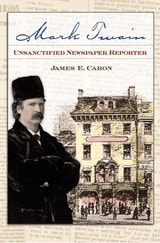
Mark Twain, Unsanctified Newspaper Reporter
James E. Caron
University of Missouri Press, 2008
Before Mark Twain became a national celebrity with his best-selling The Innocents Abroad, he was just another struggling writer perfecting his craft—but already “playin’ hell” with the world. In the first book in more than fifty years to examine the initial phase of Samuel Clemens’s writing career, James Caron draws on contemporary scholarship and his own careful readings to offer a fresh and comprehensive perspective on those early years—and to challenge many long-standing views of Mark Twain’s place in the tradition of American humor.
Tracing the arc of Clemens’s career from self-described “unsanctified newspaper reporter” to national author between 1862 and 1867, Caron reexamines the early and largely neglected writings—especially the travel letters from Hawaii and the letters chronicling Clemens’s trip from California to New York City. Caron connects those sets of letters with comic materials Clemens had already published, drawing on all known items from this first phase of his career—even the virtually forgotten pieces from the San Francisco Morning Call in 1864—to reveal how Mark Twain’s humor was shaped by the sociocultural context and how it catered to his audience’s sensibilities while unpredictably transgressing its standards.
Caron reveals how Sam Clemens’s contemporaries, notably Charles Webb, provided important comic models, and he shows how Clemens not only adjusted to but also challenged the guidelines of the newspapers and magazines for which he wrote, evolving as a comic writer who transmuted personal circumstances into literary art. Plumbing Mark Twain’s cultural significance, Caron draws on anthropological insights from Victor Turner and others to compare the performative aspects of Clemens’s early work to the role of ritual clowns in traditional societies
Brimming with fresh insights into such benchmarks as “Our Fellow Savages of the Sandwich Islands” and “Jim Smiley and His Jumping Frog,” this book is a gracefully written work that reflects both patient research and considered judgment to chart the development of an iconic American talent. Mark Twain, Unsanctified Newspaper Reporter should be required reading for all serious scholars of his work, as well as for anyone interested in the interplay between artistic creativity and the literary marketplace.
Matthew Arnold and the Classical Tradition
Warren D. Anderson
University of Michigan Press, 1988
Money and Modernity
Pound, Williams, and the Spirit of JeffersonAlec Marsh
University of Alabama Press, 1998
Movement and Modernism
Yeats, Eliot, Williams, and Early Twentieth-Century DanceTerri A. Mester
University of Arkansas Press, 1997
Mr. Jefferson and the Giant Moose
Natural History in Early AmericaLee Alan Dugatkin
University of Chicago Press, 2009
In the years after the Revolutionary War, the fledgling republic of America was viewed by many Europeans as a degenerate backwater, populated by subspecies weak and feeble. Chief among these naysayers was the French Count and world-renowned naturalist Georges-Louis Leclerc de Buffon, who wrote that the flora and fauna of America (humans included) were inferior to European specimens.
Thomas Jefferson—author of the Declaration of Independence, U.S. president, and ardent naturalist—spent years countering the French conception of American degeneracy. His Notes on Virginia systematically and scientifically dismantled Buffon’s case through a series of tables and equally compelling writing on the nature of his home state. But the book did little to counter the arrogance of the French and hardly satisfied Jefferson’s quest to demonstrate that his young nation was every bit the equal of a well-established Europe. Enter the giant moose.
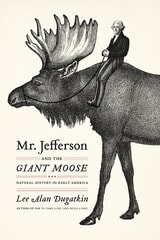
The American moose, which Jefferson claimed was so enormous a European reindeer could walk under it, became the cornerstone of his defense. Convinced that the sight of such a magnificent beast would cause Buffon to revise his claims, Jefferson had the remains of a seven-foot ungulate shipped first class from New Hampshire to Paris. Unfortunately, Buffon died before he could make any revisions to his Histoire Naturelle, but the legend of the moose makes for a fascinating tale about Jefferson’s passion to prove that American nature deserved prestige.
In Mr. Jefferson and the Giant Moose, Lee Alan Dugatkin vividly recreates the origin and evolution of the debates about natural history in America and, in so doing, returns the prize moose to its rightful place in American history.