Results by title
72 books match the query 'Korea (South)' and 7 start with m
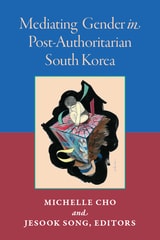
Mediating Gender in Post-Authoritarian South Korea
Michelle Cho and Jesook Song
University of Michigan Press, 2024
Mediating Gender in Post-Authoritarian South Korea maps the ways in which popular media and public discourse make the social dynamics of gender visible and open them up for debate and dismantling. In presenting innovative new research on the ways in which popular ideas about gender gain concrete form and political substance through mass mediation, the book’s contributors investigate the discursive production of gender in contemporary South Korea through trends, tropes, and thematics, as popular media become the domain in which new gendered subjectivities and relations transpire. The essays in this volume present cases and media objects that span multiple media and platforms, introducing new ways of thinking about gender as a platform and a conceptual infrastructure in the post-authoritarian era.
Mediating the South Korean Other
Representations and Discourses of Difference in the Post/Neocolonial Nation-StateDavid C. Oh, Editor
University of Michigan Press, 2022
This collection brings together leading and emerging scholars of multiculturalism in Korean media culture to examine mediated constructions of the “other,” taking into account the nation’s postcolonial and neocolonial relationships and its mediated construction of self. “Anthrocategorism ,” a more nuanced translation of injongchabyeol, is proffered as a new framework for understanding difference in ways that are locally meaningful in a society and media system in which racial or even ethnic differences are not the most salient. The collection points to the construction of racial others that elevates, tolerates, and incorporates difference; the construction of valued and devalued ethnic others, and the ambivalent construction of co-ethnic others as sympathetic victims or marginalized threats.
Memory Construction and the Politics of Time in Neoliberal South Korea
Namhee Lee
Duke University Press, 2022
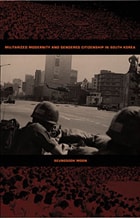
Militarized Modernity and Gendered Citizenship in South Korea
Seungsook Moon
Duke University Press, 2005
Moon situates militarized modernity in the historical context of colonialism and nationalism in the twentieth century. She follows the course of militarized modernity in South Korea from its development in the early 1960s through its peak in the 1970s and its decline after rule by military dictatorship ceased in 1987. She highlights the crucial role of the Cold War in South Korea’s militarization and the continuities in the disciplinary tactics used by the Japanese colonial rulers and the postcolonial military regimes. Moon reveals how, in the years since 1987, various social movements—particularly the women’s and labor movements—began the still-ongoing process of revitalizing South Korean civil society and forging citizenship as a new form of membership in the democratizing nation.

Movie Migrations
Transnational Genre Flows and South Korean CinemaHye Seung Chung and David Scott Diffrient
Rutgers University Press, 2015
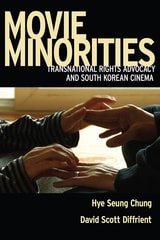
Movie Minorities
Transnational Rights Advocacy and South Korean CinemaHye Seung Chung and David Scott Diffrient
Rutgers University Press, 2021

My Life as a Night Elf Priest
An Anthropological Account of World of WarcraftBonnie A. Nardi
University of Michigan Press, 2010
"Ever since the creators of the animated television show South Park turned their lovingly sardonic gaze on the massively multiplayer online game World of Warcraft for an entire episode, WoW's status as an icon of digital culture has been secure. My Life as a Night Elf Priest digs deep beneath the surface of that icon to explore the rich particulars of the World of Warcraft player's experience."
—Julian Dibbell, Wired
"World of Warcraft is the best representative of a significant new technology, art form, and sector of society: the theme-oriented virtual world. Bonnie Nardi's pioneering transnational ethnography explores this game both sensitively and systematically using the methods of cultural anthropology and aesthetics with intensive personal experience as a guild member, media teacher, and magical quest Elf."
—Lisa Nakamura, University of Illinois
World of Warcraft rapidly became one of the most popular online world games on the planet, amassing 11.5 million subscribers—officially making it an online community of gamers that had more inhabitants than the state of Ohio and was almost twice as populous as Scotland. It's a massively multiplayer online game, or MMO in gamer jargon, where each person controls a single character inside a virtual world, interacting with other people's characters and computer-controlled monsters, quest-givers, and merchants.
In My Life as a Night Elf Priest, Bonnie Nardi, a well-known ethnographer who has published extensively on how theories of what we do intersect with how we adopt and use technology, compiles more than three years of participatory research in Warcraft play and culture in the United States and China into this field study of player behavior and activity. She introduces us to her research strategy and the history, structure, and culture of Warcraft; argues for applying activity theory and theories of aesthetic experience to the study of gaming and play; and educates us on issues of gender, culture, and addiction as part of the play experience. Nardi paints a compelling portrait of what drives online gamers both in this country and in China, where she spent a month studying players in Internet cafes.
Bonnie Nardi has given us a fresh look not only at World of Warcraft but at the field of game studies as a whole. One of the first in-depth studies of a game that has become an icon of digital culture, My Life as a Night Elf Priest will capture the interest of both the gamer and the ethnographer.
Bonnie A. Nardi is an anthropologist by training and a professor in the Department of Informatics in the Donald Bren School of Information and Computer Sciences at the University of California, Irvine. Her research focus is the social implications of digital technologies. She is the author of A Small Matter of Programming: Perspectives on End User Computing and the coauthor of Information Ecologies: Using Technology with Heart and Acting with Technology: Activity Theory and Interaction Design.
Cover art by Jessica Damsky