Results by title
118 books match the query 'Land tenure' and 5 start with m
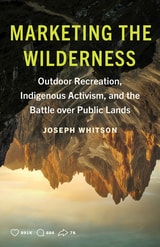
Marketing the Wilderness
Outdoor Recreation, Indigenous Activism, and the Battle over Public LandsJoseph Whitson
University of Minnesota Press, 2025
How outdoor industry marketing promotes an image of “the wilderness” as an unpeopled haven
Marketing the Wilderness analyzes the relationship between the outdoor recreation industry, public lands in the United States, and Indigenous sovereignty and representation in recreational spaces. Combining social media analysis, digital ethnography, and historical research, Joseph Whitson offers nuanced insights into more than a century of the outdoor recreation industry’s marketing strategies, unraveling its complicity in settler colonialism.
Complicating the narrative of outdoor recreation as a universal good, Whitson introduces the concept of “wildernessing” to describe the physical, legal, and rhetorical production of pristine, empty lands that undergirds the outdoor recreation industry, a process that further disenfranchises Indigenous people from whom these lands were stolen. He demonstrates how companies such as Patagonia and REI align with the mining and drilling industries in their need to remove Indigenous peoples and histories from valuable lands. And he describes the ways Indigenous and decolonial activists are subverting and resisting corporate marketing strategies to introduce new narratives of place.
Through the lens of environmental justice activism, Marketing the Wilderness reconsiders the ethics of recreational land use, advocating for engagement with issues of cultural representation and appropriation informed by Indigenous perspectives. As he discusses contemporary public land advocacy around places such as Bears Ears National Monument, Whitson focuses on the deeply fraught relationship between the outdoor recreation industry and Indigenous communities. Emphasizing the power of the corporate system and its treatment of land as a commodity under capitalism, he shows how these tensions shape the American idea of “wilderness” and what it means to fight for its preservation.
Retail e-book files for this title are screen-reader friendly with images accompanied by short alt text and/or extended descriptions.
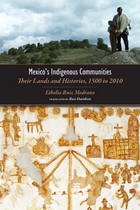
Mexico's Indigenous Communities
Their Lands and Histories, 1500-2010Ethelia Ruiz Medrano
University Press of Colorado, 2010
Ethelia Ruiz Medrano focuses on a series of individual cases, falling within successive historical epochs, that illustrate how the practice of drawing up and preserving historical documents-in particular, maps, oral accounts, and painted manuscripts-has been a determining factor in the history of Mexico's Indian communities for a variety of purposes, including the significant issue of land and its rightful ownership. Since the sixteenth century, numerous Indian pueblos have presented colonial and national courts with historical evidence that defends their landholdings.
Because of its sweeping scope, groundbreaking research, and the author's intimate knowledge of specific communities, Mexico's Indigenous Communities is a unique and exceptional contribution to Mexican history. It will appeal to students and specialists of history, indigenous studies, ethnohistory, and anthropology of Latin America and Mexico
Mimbres during the Twelfth Century
Abandonment, Continuity, and ReorganizationMargaret C. Nelson
University of Arizona Press, 1999
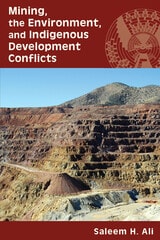
Mining, the Environment, and Indigenous Development Conflicts
Saleem H. Ali
University of Arizona Press, 2003
This book gets to the heart of resource conflicts and environmental impact assessment by asking why indigenous communities support environmental causes in some cases of mining development but not in others. Saleem Ali examines environmental conflicts between mining companies and indigenous communities and with rare objectivity offers a comparative study of the factors leading to those conflicts.
Mining, the Environment, and Indigenous Development Conflicts presents four cases from the United States and Canada: the Navajos and Hopis with Peabody Coal in Arizona; the Chippewas with the Crandon Mine proposal in Wisconsin; the Chipewyan Inuits, Déné and Cree with Cameco in Saskatchewan; and the Innu and Inuits with Inco in Labrador. These cases exemplify different historical relationships with government and industry and provide an instance of high and low levels of Native resistance in each country. Through these cases, Ali analyzes why and under what circumstances tribes agree to negotiated mining agreements on their lands, and why some negotiations are successful and others not.
Ali challenges conventional theories of conflict based on economic or environmental cost-benefit analysis, which do not fully capture the dynamics of resistance. He proposes that the underlying issue has less to do with environmental concerns than with sovereignty, which often complicates relationships between tribes and environmental organizations. Activist groups, he observes, fail to understand such tribal concerns and often have problems working with tribes on issues where they may presume a common environmental interest.
This book goes beyond popular perceptions of environmentalism to provide a detailed picture of how and when the concerns of industry, society, and tribal governments may converge and when they conflict. As demands for domestic energy exploration increase, it offers clear guidance for such endeavors when native lands are involved.
Mission of Change in Southwest Alaska
Conversations with Father René Astruc and Paul Dixon on Their Work with Yup’ik PeopleEdited by Ann Fienup-Riordan
University of Alaska Press, 2012
Mission of Change is an oral history describing various types of change—political, social, cultural, and religious—as seen through the eyes of Father Astruc and Paul Dixon, non-Natives who dedicated their lives to working with the Yup’ik people. Their stories are framed by the an analytic history of regional changes, together with current anthropological theory on the nature of cultural change and the formation of cultural identity. The book presents a subtle and emotionally moving account of the region and the roles of two men, both of whom view issues from a Catholic perspective yet are closely attuned to and involved with changes in the Yup’ik community.