Results by title
320 books match the query 'Legal status, laws, etc' and 9 start with m
MAKING MIDWIVES LEGAL
Childbirth, Medicine, and the Law, Second EditionRaymond G. DeVries
The Ohio State University Press, 1996

Mad River, Marjorie Rowland, and the Quest for LGBTQ Teachers’ Rights
Margaret A. Nash
Rutgers University Press, 2022
In the first in-depth treatment of this foundational legal case, authors Margaret A. Nash and Karen L. Graves tell the story of that case and of Marjorie Rowland, the pioneer who fought for employment rights for LGBTQ educators and who paid a heavy price for that fight. It brings the story of LGBTQ educators’ rights to the present, including commentary on Bostock v Clayton County, the 2020 Supreme Court case that struck down employment discrimination against LGBT workers.

Marriage and Divorce in the Jewish State
Israel's Civil WarSusan M. Weiss and Netty C. Gross-Horowitz
Brandeis University Press, 2012
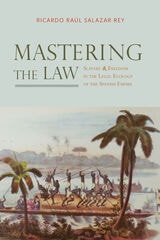
Mastering the Law
Slavery and Freedom in the Legal Ecology of the Spanish EmpireRicardo Raúl Salazar Rey
University of Alabama Press, 2020
Atlantic slavery can be overwhelming in its immensity and brutality, as it involved more than 15 million souls forcibly displaced by European imperialism and consumed in building the global economy. Mastering the Law: Slavery and Freedom in the Legal Ecology of the Spanish Empire lays out the deep history of Iberian slavery, explores its role in the Spanish Indies, and shows how Africans and their descendants used and shaped the legal system as they established their place in Iberoamerican society during the seventeenth century.
Ricardo Raúl Salazar Rey places the institution of slavery and the people involved with it at the center of the creation story of Latin America. Iberoamerican customs and laws and the institutions that enforced them provided a common language and a forum to resolve disputes for Spanish subjects, including enslaved and freedpeople. The rules through which Iberian conquerors, settlers, and administrators incorporated Africans into the expanding Empire were developed out of the need of a distant crown to find an enforceable consensus. Africans and their mestizo descendants, in turn, used and therefore molded Spanish institutions to serve their interests.Salazar Rey mined extensively the archives of secular and religious courts, which are full of complex disputes, unexpected subversions, and tactical alliances among enslaved people, freedpeople, and the crown.
The narrative unfolds around vignettes that show Afroiberians building their lives while facing exploitation and inequality enforced through violence. Salazar Rey deals mostly with cases originating from Cartagena de Indias, a major Atlantic port city that supported the conquest and rule of the Indies. His work recovers the voices and indomitable ingenuity that enslaved people and their descendants displayed when engaging with the Spanish legal ecology. The social relationships animating the case studies represent the broader African experience in the Americas during the sixteenth and seventeenth centuries.
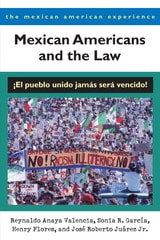
Mexican Americans and the Law
¡El pueblo unido jamás será vencido!Reynaldo Anaya Valencia, Sonia R. García, Henry Flores, and José Roberto Juárez Jr.
University of Arizona Press, 2004
Each chapter highlights historical contexts, relevant laws, and policy concerns for a specific issue and features abridged versions of significant state and federal cases involving Mexican Americans. Beginning with People v. Zammora (1940), the trial that was a precursor to the Zoot Suit Riots in Los Angeles during World War II, the authors lead students through some of the most important and precedent-setting cases in American law:
- Educational equality: from segregation concerns in Méndez v. Westminster (1946) to unequal funding in San Antonio Independent School District vs. Rodríguez (1973)
- Gender issues: reproductive rights in Madrigal v. Quilligan (1981), workplace discrimination in EEOC v. Hacienda Hotel (1989), sexual violence in Aguirre-Cervantes v. INS (2001)
- Language rights: Ýñiguez v. Arizonans for Official English (1995), García v. Gloor (1980), Serna v. Portales Municipal Schools (1974)
- Immigration-: search and seizure questions in U.S. v. Brignoni-Ponce (1975) and U.S. v. Martínez-Fuerte (1976); public benefits issues in Plyler v. Doe (1982) and League of United Latin American Citizens v. Wilson (1997)
- Voting rights: redistricting in White v. Regester (1973) and Bush v. Vera (1996)
- Affirmative action: Hopwood v. State of Texas (1996) and Coalition for Economic Equity v. Wilson (1997)
- Criminal justice issues: equal protection in Hernández v. Texas (1954); jury service in Hernández v. New York (1991); self incrimination in Miranda v. Arizona (1966); access to legal counsel in Escobedo v. Illinois (1964)
With coverage as timely as the 2003 Supreme Court decision on affirmative action, Mexican Americans and the Law offers invaluable insight into legal issues that have impacted Mexican Americans, other Latinos, other racial minorities, and all Americans. Discussion questions, suggested readings, and Internet sources help students better comprehend the intricacies of law.
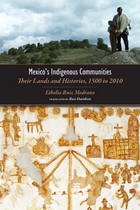
Mexico's Indigenous Communities
Their Lands and Histories, 1500-2010Ethelia Ruiz Medrano
University Press of Colorado, 2010
Ethelia Ruiz Medrano focuses on a series of individual cases, falling within successive historical epochs, that illustrate how the practice of drawing up and preserving historical documents-in particular, maps, oral accounts, and painted manuscripts-has been a determining factor in the history of Mexico's Indian communities for a variety of purposes, including the significant issue of land and its rightful ownership. Since the sixteenth century, numerous Indian pueblos have presented colonial and national courts with historical evidence that defends their landholdings.
Because of its sweeping scope, groundbreaking research, and the author's intimate knowledge of specific communities, Mexico's Indigenous Communities is a unique and exceptional contribution to Mexican history. It will appeal to students and specialists of history, indigenous studies, ethnohistory, and anthropology of Latin America and Mexico
Minorities and Law in Czechoslovakia
Jan Kuklík and René Petráš
Karolinum Press, 2017

More Than Victims
Battered Women, the Syndrome Society, and the LawDonald Alexander Downs
University of Chicago Press, 1996
"More Than Victims is a powerful step in the right direction. Women as well as men need to be protected from violence, and women, in particular, require better understanding of their sometimes oppressive situations. But they also need to be able to participate fully in the discourse of politics and citizenship. Downs offers a solution that helps to make both possible."—Teresa Godwin Phelps, Review of Politics
"Downs has written an important book on a subject that deserves more of our attention."— Susan Mezey, Law and Politics Book Review
"Comprehensive and compelling. [Downs] demonstrates a masterful grasp of the complex legal and philosophical issues implicated in domestic violence cases."—Annette DeMichele, New York Law Journal
Multiple InJustices
Indigenous Women, Law, and Political Struggle in Latin AmericaR. Aída Hernández Castillo
University of Arizona Press, 2016
Multiple InJustices synthesizes R. Aída Hernández Castillo’s twenty-four years of activism and research among indigenous women’s organizations in Latin America. As both feminist and critical anthropologist, Hernández Castillo analyzes the context of legal pluralism wherein the indigenous women of Mexico, Guatemala, and Colombia struggle for justice. Through ethnographical research in community, state, and international justice, she reflects on the possibilities and limitations of customary, national, and international law for indigenous women.
Colonialism, racism, and patriarchal violence have been fundamental elements for the reproduction of capitalism, Hernández Castillo asserts. Only a social policy that offers economic alternatives based on distribution of wealth and a real recognition of cultural and political rights of indigenous peoples can counter the damage of outside forces such as drug cartels on indigenous lands.
She concludes that the theories of indigenous women on culture, tradition, and gender equity—as expressed in political documents, event reports, public discourse, and their intellectual writings—are key factors in the decolonization of Latin American feminisms and social justice for all.