Results by title
155 books match the query 'Legislators' and 11 start with m
Mayor Harold Washington
Champion of Race and Reform in ChicagoRoger Biles
University of Illinois Press, 2020
Me, Governor?
My Life in the Rough-and-Tumble World of New Jersey PoliticsRichard J. Codey
Rutgers University Press, 2011
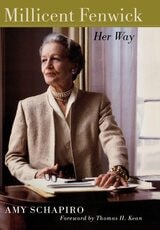
Millicent Fenwick
Her WaySchapiro, Amy
Rutgers University Press, 2003
Amy Schapiro has written the first biography of Millicent Fenwick, the popular and colorful New Jersey congresswoman. Affectionately remembered as the pipe-smoking grandmother who served as the model for Garry Trudeau’s Doonesbury character Lacey Davenport, Fenwick defied such simplistic expectations to become, in the words of Walter Cronkite, “the conscience of Congress.”
Born in 1910 into comfortable circumstances, Fenwick faced tragedy at an early age when her mother was lost in the sinking of the Lusitania. Following an upper-class childhood and a failed marriage, she began a fourteen-year career at Vogue magazine.
In the 1960s, Fenwick became involved in the civil rights movement and took part in local and state politics in New Jersey. Blessed with striking good looks and a sharp wit, she cut a glamorous figure, rising quickly through the ranks of the state Republican Party at a time when most of her peers were retiring. When this colorful, outspoken figure—one of only five New Jersey women ever elected to Congress— went to Washington in 1974 at age sixty-four, her victory was portrayed by the media as a “geriatric triumph.”
Schapiro’s extensive interviews with Fenwick’s son, Hugh, who granted her exclusive rights to Fenwick’s personal papers, oral histories, letters, and photographs, provide rare insight into the life and career of one of America’s most memorable politicians.

Misconceiving Mothers
Legislators, Prosecutors, and the Politics of Prenatal Drug ExposureLaura Gomez
Temple University Press, 1997
Misconceiving Mothers is a case study of how public policy about reproduction and crime is made. Laura E. Gomez uses secondary research and first-hand interviews with legislators and prosecutors to examine attitudes toward the criminalization and/or medicalization of drug use during pregnancy by the legislature and criminal justice systems in California. She traces how an initial tendency toward criminalization gave way to a trend toward seeing the problem of "crack babies" as an issue of social welfare and public health.
It is no surprise that in an atmosphere of mother-blaming, particularly targeted at poor women and women of color, "crack babies" so easily captured the American popular imagination in the late 1980s. What is surprising is the was prenatal drug exposure came to be institutionalized in the state apparatus. Gomez attributes this circumstance to four interrelated cause: the gendered nature of the social problem; the recasting of the problem as fundamentally "medical" rather than "criminal"; the dynamic nature of t he process of institutionalization; and the specific feature of the legal institutions -- that is, the legislature and prosecutors' offices -- the became prominent in the case.
At one level Misconceiving Mothers tells the story of a particular problem at a particular time and place -- how the California legislature and district attorneys grappled with pregnant women's drug use in the late 1980s and early 1990s. At another level, the book tells a more general story about the political nature of contemporary social problems. The story it tells is political not just because it deals with the character of political institutions but because the process itself and the nature of the claims-making concern the power to control the allocation of state resources.
A number of studies have looked at how the initial criminalization of social problems takes place. Misconceiving Mothers looks at the process by which a criminalized social problem is institutionalized through the attitudes and policies of elite decision-makers.
Mo
The Life and Times of Morris K. UdallDonald W. Carson and James W. Johnson
University of Arizona Press, 2001
Mo provides the most complete record of Udall's thirty-year congressional career ever published. It reveals how he challenged the House seniority system and turned the House Interior Committee into a powerful panel that did as much to protect the environment as any organization in the twentieth century. It shows Udall to have been a consensus builder for environmental issues who paved the way for the Alaska Lands Act of 1980, helped set aside 2.4 million acres of wilderness in Arizona, and fought for the Central Arizona Project, one of the most ambitious water projects in U.S. history. Carson and Johnson record Udall's early opposition to the Vietnam War at a time when that conflict was largely perceived as a just cause, as well as his early advocacy of campaign finance reform. They also provide a behind-the-scenes account of his run for the presidency—the first House member to seek the office in nearly a century—which gained him an intensely loyal national following.
Mo explores the paradoxes that beset Udall: He was a man able to accomplish things politically because people genuinely liked and respected him, yet he was a loner and workaholic whose focus on politics overshadowed his personal life. Carson and Johnson devote a chapter to the famous Udall sense of humor. They also look sensitively at his role as a husband and father and at his proud and stubborn bout with Parkinson's disease. Mo Udall will long be remembered for his contributions to environmental legislation, for his unflagging efforts in behalf of Arizona, and for the gentle humor with which he conducted his life. This book secures his legacy.
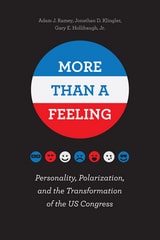
More Than a Feeling
Personality, Polarization, and the Transformation of the US CongressAdam J. Ramey, Jonathan D. Klingler, and Gary E. Hollibaugh Jr.
University of Chicago Press, 2017
With More Than a Feeling, Adam J. Ramey, Jonathan D. Klingler, and Gary E. Hollibaugh, Jr. have developed an innovative framework incorporating what are known as the Big Five dimensions of personality—openness to experience, conscientiousness, extraversion, agreeableness, and neuroticism—to improve our understanding of political behavior among members of Congress. To determine how strongly individuals display these traits, the authors identified correlates across a wealth of data, including speeches, campaign contributions and expenditures, committee involvement, willingness to filibuster, and even Twitter feeds. They then show how we might expect to see the influence of these traits across all aspects of Congress members’ political behavior—from the type and quantity of legislation they sponsor and their style of communication to whether they decide to run again or seek a higher office. They also argue convincingly that the types of personalities that have come to dominate Capitol Hill in recent years may be contributing to a lot of the gridlock and frustration plaguing the American political system.
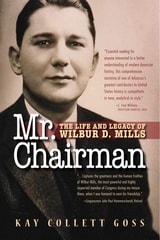
Mr. Chairman
The Life and Legacy of Wilbur D. MillsKay Collett Goss
Parkhurst Brothers, Inc., 2012
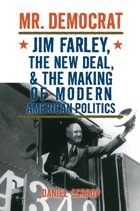
Mr. Democrat
Jim Farley, the New Deal and the Making of Modern American PoliticsDaniel Scroop
University of Michigan Press, 2006
Mr. Democrat tells the story of Jim Farley, Franklin D. Roosevelt's campaign manager. As party boss, Farley experienced unprecedented success in the New Deal years. And like his modern counterpart Karl Rove, Farley enjoyed unparalleled access and power. Unlike Rove, however, Farley was instrumental in the creation of an overwhelming new majority in American politics, as the emergence of the New Deal transformed the political landscape of its time.
Mr. Democrat is timely and indispensable not just because Farley was a fascinating and unduly neglected figure, but also because an understanding of his career advances our knowledge of how and why he revolutionized the Democratic Party and American politics in the age of the New Deal.
Daniel Scroop is Lecturer in American History, University of Liverpool School of History.
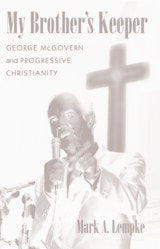
My Brother's Keeper
George McGovern and Progressive ChristianityMark A. Lempke
University of Massachusetts Press, 2017
George McGovern is chiefly remembered for his landslide loss to Richard Nixon in 1972. Yet at the time, his candidacy raised eyebrows by invoking the prophetic tradition, an element of his legacy that is little studied. In My Brother's Keeper, Mark A. Lempke explores the influence of McGovern's evangelical childhood, Social Gospel worldview, and conscientious Methodism on a campaign that brought antiwar activism into the mainstream.
McGovern's candidacy signified a passing of the torch within Christian social justice. He initially allied with the ecumenical movement and the mainline Protestant churches during a time when these institutions worked easily with liberal statesmen. But the senator also galvanized a dynamic movement of evangelicals rooted in the New Left, who would dominate subsequent progressive religious activism as the mainline entered a period of decline. My Brother's Keeper argues for the influential, and often unwitting, role McGovern played in fomenting a “Religious Left” in 1970s America, a movement that continues to this day. It joins a growing body of scholarship that complicates the dominant narrative of that era's conservative Christianity.
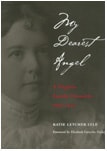
My Dearest Angel
A Virginia Family Chronicle 1895–1947Katie Letcher Lyle
Ohio University Press, 2002
She was the daughter of a circuit judge and state senator. He was the youngest son of Virginia’s Civil War governor and was a state legislator himself at the age of nineteen. Their courtship and marriage stands as a portrait of a bygone way of life unique to the American South during the first half of the twentieth century. My Dearest Angel is their story, told through their faithful correspondence over the course of their fifty years together.
Piecing together the voluminous letters, their granddaughter, noted author Katie Letcher Lyle, has succeeded in giving us an intimate panorama of the full and oftentimes wrenching lives led by Greenlee and Katie Letcher. Domestic life, family secrets, and visiting luminaries are part of their story. But the abiding appeal of My Dearest Angel is the maturation of a lifelong relationship built on the crest of a changing world.
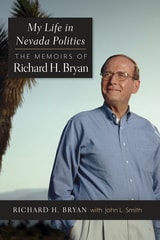
My Life in Nevada Politics
The Memoirs of Senator Richard H. BryanRichard H. Bryan
University of Nevada Press, 2024
Born in Washington, D.C. in 1937, Bryan grew up in Las Vegas. His interest in politics started early, winning school-class elections and expressing a personal goal of one day becoming Governor of Nevada. He was elected student body president at the University of Nevada.
His career in public service began as a deputy district attorney in Clark County. In 1966, he became the first county public defender in state history. Bryan served in the Nevada Legislature in both the Assembly and Senate before winning the statewide office of Attorney General in 1978. He was elected Nevada Governor in 1982, winning re-election in 1986. Bryan was elected to the U.S. Senate in 1988, reelected in 1994, and served on the committees on Commerce, Banking, Taxation, and Intelligence, and chaired the Ethics Committee. He retired from the Senate in 2001 and returned to Nevada.
Bryan’s list of accomplishments is extensive. He was largely responsible for the early call-to-arms in the fight against the Department of Energy’s attempt to create a nuclear waste repository at Yucca Mountain. As governor, he reorganized state economic development programs, improved environmental protections for Lake Tahoe and other threatened areas, and made unprecedented appointments of women. In the Senate, Bryan authored the Southern Nevada Public Lands Management Act and the National Conservation Area for the High Rock Desert country. He had a front-row seat to the historic buildup to the Iraq War and the impeachment of President Bill Clinton. In retirement, Bryan continues to serve the state through his participation on a wide range of committees.
Throughout his political career, Bryan, with wife Bonnie at his side, traversed Nevada from its tiniest hamlets to the metro areas of Reno and Las Vegas with unrivaled zeal in his efforts to represent the state’s citizens. He is famous for knowing thousands of his constituents not only by their first names, but also recalling details of their lives. The simple fact is, while in service to Nevada, Bryan was in his element in the place he loves best.