Results by title
97 books match the query 'Louisiana' and 5 start with m
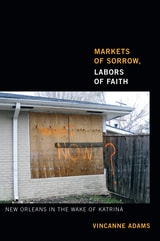
Markets of Sorrow, Labors of Faith
New Orleans in the Wake of KatrinaVincanne Adams
Duke University Press, 2013
Filled with the often desperate voices of residents who returned to New Orleans, Markets of Sorrow, Labors of Faith describes the human toll of disaster capitalism and the affect economy it has produced. While for-profit companies delayed delivery of federal resources to returning residents, faith-based and nonprofit groups stepped in to rebuild, compelled by the moral pull of charity and the emotional rewards of volunteer labor. Adams traces the success of charity efforts, even while noting an irony of neoliberalism, which encourages the very same for-profit companies to exploit these charities as another market opportunity. In so doing, the companies profit not once but twice on disaster.
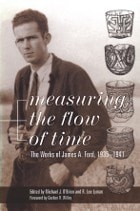
Measuring the Flow of Time
The Works of James A. Ford, 1935-1941James A. Ford, edited by R. Lee Lyman and Michael J. O'Brien
University of Alabama Press, 1999
This collection of Ford's works focuses on the development of ceramic chronology—a key tool in Americanist archaeology.
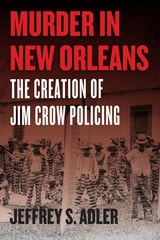
Murder in New Orleans
The Creation of Jim Crow PolicingJeffrey S. Adler
University of Chicago Press, 2019
New Orleans in the 1920s and 1930s was a deadly place. In 1925, the city’s homicide rate was six times that of New York City and twelve times that of Boston. Jeffrey S. Adler has explored every homicide recorded in New Orleans between 1925 and 1940—over two thousand in all—scouring police and autopsy reports, old interviews, and crumbling newspapers. More than simply quantifying these cases, Adler places them in larger contexts—legal, political, cultural, and demographic—and emerges with a tale of racism, urban violence, and vicious policing that has startling relevance for today.
Murder in New Orleans shows that whites were convicted of homicide at far higher rates than blacks leading up to the mid-1920s. But by the end of the following decade, this pattern had reversed completely, despite an overall drop in municipal crime rates. The injustice of this sharp rise in arrests was compounded by increasingly brutal treatment of black subjects by the New Orleans police department. Adler explores other counterintuitive trends in violence, particularly how murder soared during the flush times of the Roaring Twenties, how it plummeted during the Great Depression, and how the vicious response to African American crime occurred even as such violence plunged in frequency—revealing that the city’s cycle of racial policing and punishment was connected less to actual patterns of wrongdoing than to the national enshrinement of Jim Crow. Rather than some hyperviolent outlier, this Louisiana city was a harbinger of the endemic racism at the center of today’s criminal justice state. Murder in New Orleans lays bare how decades-old crimes, and the racially motivated cruelty of the official response, have baleful resonance in the age of Black Lives Matter.
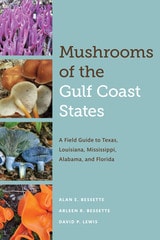
Mushrooms of the Gulf Coast States
A Field Guide to Texas, Louisiana, Mississippi, Alabama, and FloridaBy Alan E. Bessette, Arleen F. Bessette, and David P. Lewis
University of Texas Press, 2019
The weather patterns and topography of America's Gulf Coast create favorable growing conditions for thousands of species of mushrooms, but the complete region has generally gone uncharted when it comes to mycology. Mushrooms of the Gulf Coast States at last delivers an in-depth, high-quality, user-friendly field guide, featuring more than 1,000 common and lesser-known species—some of which are being illustrated in color for the first time.
Using easily identifiable characteristics and a color key, the authors enable anyone, whether amateur mushroom hunter or professional mycologist, to discern and learn about the numerous species of mushrooms encountered in Texas, Louisiana, Mississippi, Alabama, and Florida. Wild-food enthusiasts will appreciate the information on edibility or toxicity that accompanies each description, and they will also find the book’s detailed instructions for collecting, cleaning, testing, preserving, and cooking wild mushrooms to be of great interest. Providing encyclopedic knowledge in a handy format that fits in a backpack, Mushrooms of the Gulf Coast States is a must-have for any mushroom lover.
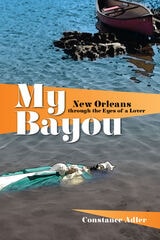
My Bayou
New Orleans through the Eyes of a LoverConstance Adler
Michigan State University Press, 2012
A vividly described and intensely personal memoir, My Bayou charts a personal and spiritual transformation along the fabled banks of Bayou Saint John in New Orleans. When Constance Adler moves to New Orleans, she begins what becomes a lasting love affair with the city, and especially the bayou—a living entity and the beating heart of local culture. Rites of passage, celebrations, mysterious accidents, and magic all take place on its banks, leading Adler to a vibrant awareness of the power of being part of a community. That faith is tested in the wake of Hurricane Katrina, and is ultimately proven right, as Bayou Saint John begins to rebuild.