Results by title
124 books match the query 'Macroeconomics' and 19 start with m

Macroeconomic Consequences of Farm Support Policies
A. B. Stoeckel, David Vincent and Sandy Cuthbertson
Duke University Press, 1989
The scholars and experts here assembled present for the first time a quantification and analysis of the impact upon the world economy of reduction or elimination of agricultural protectionism. They question why, give the magnitude of the problem, inferior policies endure despite the weight of evidence that they have failed. The answer they derive is that there is no general understanding of the true cost of the failure, and therefore it is necessary to initiate reform from outside agricultural circles.
Macroeconomic Linkage
Savings, Exchange Rates, and Capital FlowsEdited by Takatoshi Ito and Anne O. Krueger
University of Chicago Press, 1994
These fourteen papers are organized around four themes: the overall determinants of growth and trading relations in the East Asian region; monetary policies in relation to capital controls and capital accounts; the impact of exchange rate behavior on industrial structure; and the potential for greater regional integration. The contributors examine interactions among exchange rate movements, trade balances, and capital flows; how government monetary policy affects capital flows; the effect of exchange rates on industrial structure, inventories, and prices; and the extent of regional integration in East Asia.
Macroeconomic Policies and the Development of Markets in Transition Economies
Fabrizio Coricelli
Central European University Press, 1998

Macroeconomics
A Critical CompanionBen Fine and Ourania Dimakou
Pluto Press, 2016
Macroeconomics
A Neoclassical IntroductionMerton H. Miller and Charles W. Upton
University of Chicago Press, 1986
"The most innovative approach to introducing macroeconomics that I have seen. . . . A 'classic' in the sense that every serious student of macroeconomics is likely to want it in his or her library."—John P. Gould, University of Chicago
"The task the authors set out to perform is ambitious: to write a macroeconomics textbook structured around a neoclassical growth model. And in this task they have succeeded."—Clifford W. Smith, Jr., Journal of Finance
"This is a superb book. As a vehicle for teaching economics I have to place it right behind Henderson and Quant (Microeconomics) and Dorfman, Samuelson, and Solow (Linear Programming). Moreover, it is an exciting book both to read and to think about. . . . It is not just that these authors have something to say, but their way of saying it is generally superior."—F. E. Banks, Kyklos
Market-Augmenting Government
The Institutional Foundations for ProsperityOmar Azfar and Charles A. Cadwell, Editors
University of Michigan Press, 2003
The contributors, renowned experts in their fields on the complex institutional requirements for prosperity, offer arguments from economic theory, economic history, legal theory, and political science. The chapters are simultaneously of high scholarly quality and intensely applicable. Indeed many of the ideas here are being used to design reform projects in developing countries.
Market-Augmenting Government will appeal to legal theorists, economists, and political scientists, and in particular to institutional economists. Its writing is friendly to the general reader, with only a few of the chapters requiring specialized knowledge. The book will also figure importantly in policy circles as governance moves center stage in the practice of reform and development.
Omar Azfar is Research Associate, IRIS Center, University of Maryland, College Park. Charles A. Cadwell is Director and Principle Investigator, IRIS Center, University of Maryland, College Park.
Measuring Economic Sustainability and Progress
Edited by Dale W. Jorgenson, J. Steven Landefeld, and Paul Schreyer
University of Chicago Press, 2014
The latest in the NBER’s influential Studies in Income and Wealth series, which has played a key role in the development of national account statistics in the United States and other nations, this volume explores collaborative solutions between academics, policy researchers, and official statisticians to some of today’s most important economic measurement challenges. Contributors to this volume extend past research on the integration and extension of national accounts to establish an even more comprehensive understanding of the distribution of economic growth and its impact on well-being, including health, human capital, and the environment. The research contributions assess, among other topics, specific conceptual and empirical proposals for extending national accounts.
Measuring Wealth and Financial Intermediation and Their Links to the Real Economy
Edited by Charles R. Hulten and Marshall B. Reinsdorf
University of Chicago Press, 2015
Measuring Wealth and Financial Intermediation and Their Links to the Real Economy identifies measurement problems associated with the financial crisis and improvements in measurement that may prevent future crises, taking account of the dynamism of the financial marketplace in which measures that once worked well become misleading. In addition to advances in measuring financial activity, the contributors also investigate the effects of the crisis on households and nonfinancial businesses. They show that households’ experiences varied greatly and some even experienced gains in wealth, while nonfinancial businesses’ lack of access to credit in the recession may have been a more important factor than the effects of policies stimulating demand.
Measuring and Accounting for Innovation in the Twenty-First Century
Edited by Carol Corrado, Jonathan Haskel, Javier Miranda, and Daniel Sichel
University of Chicago Press, 2021
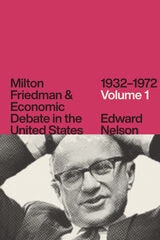
Milton Friedman and Economic Debate in the United States, 1932–1972, Volume 1
Edward Nelson
University of Chicago Press, 2020
This two-volume account provides a foundational introduction to Friedman’s role in several major economic debates that took place in the United States between 1932 and 1972. The first volume, which takes the story through 1960, covers the period in which Friedman began and developed his research on monetary policy. It traces Friedman’s thinking from his professional beginnings in the 1930s as a combative young microeconomist, to his wartime years on the staff of the US Treasury, and his emergence in the postwar period as a leading proponent of monetary policy. The second volume covers the years between 1960 and 1972— years that saw the publication of Friedman and Anna Schwartz’s Monetary History of the United States. The book also covers Friedman’s involvement in a number of debates in the 1960s and 1970s, on topics such as unemployment, inflation, consumer protection, and the environment.
As a fellow monetary economist, Nelson writes from a unique vantage point, drawing on both his own expertise in monetary analysis and his deep familiarity with Friedman’s writings. Using extensive documentation, the book weaves together Friedman’s research contributions and his engagement in public debate, providing an unparalleled analysis of Friedman’s views on the economic developments of his day.
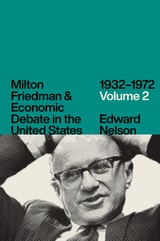
Milton Friedman and Economic Debate in the United States, 1932–1972, Volume 2
Edward Nelson
University of Chicago Press, 2020
This two-volume account provides a foundational introduction to Friedman’s role in several major economic debates that took place in the United States between 1932 and 1972. The first volume, which takes the story through 1960, covers the period in which Friedman began and developed his research on monetary policy. It traces Friedman’s thinking from his professional beginnings in the 1930s as a combative young microeconomist, to his wartime years on the staff of the US Treasury, and his emergence in the postwar period as a leading proponent of monetary policy. The second volume covers the years between 1960 and 1972— years that saw the publication of Friedman and Anna Schwartz’s Monetary History of the United States. The book also covers Friedman’s involvement in a number of debates in the 1960s and 1970s, on topics such as unemployment, inflation, consumer protection, and the environment.
As a fellow monetary economist, Nelson writes from a unique vantage point, drawing on both his own expertise in monetary analysis and his deep familiarity with Friedman’s writings. Using extensive documentation, the book weaves together Friedman’s research contributions and his engagement in public debate, providing an unparalleled analysis of Friedman’s views on the economic developments of his day.

Milton Friedman and Economic Debate in the United States, 1973–1976, Vol. 3
Edward Nelson
University of Chicago Press, 2027
The third installment in the definitive account of the famed economist's role in economic debate—and his lasting influence on economic policy.
Milton Friedman is widely recognized as one of the most significant contributors to economics in the modern age. Yet no previous study has distilled Friedman’s vast body of writings into an authoritative account of his research, his policy views, and his interventions in public debate. Through his sweeping series on the most influential economist of the second half of the twentieth century, Edward Nelson closes this gap: Milton Friedman and EconomicDebate in the United States is the defining narrative on the famed public intellectual—the first to grapple comprehensively with Friedman’s research output, economic framework, and legacy.
Volume 3 chronicles Friedman’s activities from 1973 to 1976, encompassing his final years at the University of Chicago and a period that saw his further ascension in national prominence. In the mid-1970s, economic news dominated American political discourse as the nation endured double-digit inflation and recession. It was during this time that Friedman’s views became a center of economic debate in both the research world and public debate, while his explanation for “stagflation” formed part of the critique of stabilization policy that would lead to his 1976 Nobel Prize. Nelson details the controversies that Friedman faced in the media—including his contrarian stances on inflation’s cure, the economic implications of oil price shocks, and the social responsibility of business—and how Friedman concluded that the world needed a “new Adam Smith” to press the case for free markets. Drawing upon a large body of documentary sources, interviews with dozens of the people closest to Friedman, and his own expertise in Friedman’s research area of monetary analysis, Nelson provides the definitive account of the formative (and uneven) events in Friedman’s foray into life as a public intellectual and how his research permanently shifted economic thinking.
Milton Friedman and Economic Debate in the United States, 1977–1979, Vol. 4
Edward Nelson
University of Chicago Press, 0
The fourth installment of the sweeping account of the most influential economist in modern times, focusing on his crossover into the public sphere.
Milton Friedman is widely recognized as one of the most significant contributors to economics in the modern age. Yet no previous study has distilled Friedman’s vast body of writings into an authoritative account of his research, his policy views, and his interventions in public debate. Through his sweeping series on the most influential economist of the second half of the twentieth century, Edward Nelson closes this gap: Milton Friedman and EconomicDebate in the United States is the defining narrative on the famed public intellectual—the first to grapple comprehensively with Friedman’s research output, economic framework, and legacy.
Volume 4 of Nelson’s intellectual and policy biography offers an exacting portrait of Friedman’s career following his departure from the University of Chicago. Spanning 1977 to 1979, Nelson’s narrative details Friedman’s move to California and his greater immersion in public policy, including his project with Rose Friedman and television professionals to create a TV series giving his viewpoint. Nelson details the successes and failures of Friedman’s years of extraordinary influence, including:
- His warnings about US inflation returning to double digits in 1979;
- The changes in professional thinking in the US economics profession and policymaking toward acceptance of Friedman's view that inflation is a monetary phenomenon;
- The rise of Paul Volcker to head of the Federal Reserve and his integration of monetarist ideas into US monetary policy;
- Friedman's proposal to phase in a zero-tariff arrangement in the United States;
- His role in the tax revolt of the 1970s—including his break with the emerging supply-side economics movement on the effects of tax cuts;
- The second oil-price shock and Friedman's critique of the Carter Administration's energy policy;
- The resilience after 1976 of Ronald Reagan's presidential ambitions and Friedman's 1979 endorsement of Reagan for president in the 1980 election.
Drawing upon a large body of documentary sources, interviews with dozens of the people closest to Friedman, and his own expertise in Friedman’s research area of monetary analysis, Nelson offers the definitive account of what proved to be pivotal years for Friedman and the field of economics.
Milton Friedman
Economics in Theory and PracticeAbraham Hirsch and Neil de Marchi
University of Michigan Press, 1991
Modeling the Distribution and Intergenerational Transmission of Wealth
James D. Smith
University of Chicago Press, 1980
Modern Autocracy
The Rise of Authoritarian Economies—and Why Only Some Can SucceedSimon Commander and Saul Estrin
University of Chicago Press, 2027
Strongman governments are back. What becomes of their economies?
Autocracy has once again become a rising force. Today, two thirds of the world’s population live under regimes where electoral democracy is either absent or debased. Moreover, even many functioning democracies are now facing a significant share of their citizens who favor switching to authoritarian rule. But as states return to their old authoritarian ways, what happens to their still-modernized economies?
Simon Commander and Saul Estrin examine the scale of this change—and the unevenly distributed economic consequences that will soon accompany it. Modern Autocracy reveals how authoritarian economies generally perform worse than economies in democratic states, in part because many authoritarian states are centralized around a leader whose economic stewardship facilitates political favor and cronyism. In all, these features, combined with the likelihood of repression, sap economic vitality and stymie competition, innovation, and, ultimately, growth.
The exception, the authors reveal, is that autocracies can perform better when they’re built around an institutional framework rather than simply a leader. That is because they can pursue strategic goals, including innovation; even so, their autocratic foundations open up major vulnerabilities and tensions. Brimming with political relevance, Modern Autocracy is a defining taxonomy of economies and their natures in this century.
Monetary Divergence
Domestic Policy Autonomy in the Post-Bretton Woods EraDavid H. Bearce
University of Michigan Press, 2007
"In a meticulously researched study, David Bearce demonstrates that, contrary to predictions, financial globalization has not resulted in a systematic convergence of national monetary policies. The book is a must-read for students of the political economy of international finance. Highlighting the critical role of partisan politics in determining policy outcomes, Bearce adds a new and important dimension to our understanding of the impacts of international capital mobility in the contemporary era."
—Benjamin Jerry Cohen, University of California, Santa Barbara
"Bearce offers a compelling analysis of partisan economic policy in an open economy. By analyzing both fiscal and monetary policies, Bearce extends our understanding of how the electoral imperative conditions policy behavior. His conclusions will have to be addressed in any
future debate about the topic."
—William Bernhard, University of Illinois at Urbana-Champaign
"Interest group divisions over exchange rates and macroeconomic policy have been at the center of international political economy research for about 20 years. Political scientists have studied these cleavages, focusing on the policy interests of various industry groups. On a separate but parallel track, another group of researchers explored the relationship between partisan politics and macroeconomic policy choices. In this exceptionally well researched book, Bearce integrates these two analytical traditions. Noting that industry groups are typically important organized constituents in left-wing and right-wing political parties, Bearce demonstrates how macroeconomic policy outcomes in advanced countries vary systematically with the alternation of political parties in government."
—J. Lawrence Broz, University of California, San Diego
David H. Bearce is Assistant Professor of Political Science at the University of Pittsburgh.
Monetary Interpretations of the Great Depression
Frank G. Steindl
University of Michigan Press, 1996
Money, Capital, and Fluctuations
Early EssaysF. A. Hayek
University of Chicago Press, 1984
EDITOR'S INTRODUCTION
INTRODUCTION
1. THE MONETARY POLICY OF THE UNITED STATES AFTER THE RECOVERY FROM THE 1920 CRISIS (1925)
2. SOME REMARKS ON THE PROBLEM OF IMPUTATION (1926)
3. ON THE PROBLEM OF THE THEORY OF INTEREST (1927)
4. INTERTEMPORAL PRICE EQUILIBRIUM AND MOVEMENTS IN THE VALUE OF MONEY (1928)
5. THE FATE OF THE GOLD STANDARD (1932)
6. CAPITAL CONSUMPTION (1932)
7. ON 'NEUTRAL MONEY' (1933)
8. TECHNICAL PROGRESS AND EXCESS CAPACITY (1936)
Two reviews
MARGINAL UTILITY AND ECONOMIC CALCULATION (1925)
THE EXCHANGE VALUE OF MONEY (1929)
NAME INDEX