Results by title
175 books match the query 'Marriage' and 19 start with m
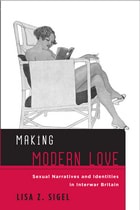
Making Modern Love
Sexual Narratives and Identities in Interwar BritainLisa Z. Sigel
Temple University Press, 2012
After the Great War, British men and women grappled with their ignorance about sexuality and desire. Seeking advice and information from doctors, magazines, and each other, they wrote tens of thousands of letters about themselves as sexual subjects. In these letters, they disclosed their uncertainties, their behaviors, and the role of sexuality in their lives. Their fascinating narratives tell how people sought to unleash their imaginations and fashion new identities.
Making Modern Love shows how readers embraced popular media—self-help books, fetish magazines, and advice columns—as a source of information about sexuality and a means for telling their own stories. From longings for transcendent marital union to fantasies of fetish-wear, cross-dressing, and whipping, men and women revealed a surprising range of desires and behaviors (queer and otherwise) that have been largely disregarded until now.
Lisa Sigel mines these provocative narratives to understand how they contributed to new subjectivities and the development of modern sexualities.
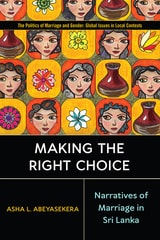
Making the Right Choice
Narratives of Marriage in Sri LankaAsha L. Abeyasekera
Rutgers University Press, 2021
Making the Right Choice unravels the entangled relationship between marriage, morality, and the desire for modernity as it plays out in the context of middle-class status concerns and aspirations for upward social mobility within the Sinhala-Buddhist community in urban Sri Lanka. By focusing on individual life-histories spanning three generations, the book illuminates how narratives about a gendered self and narratives about modernity are mutually constituted and intrinsically tied to notions of agency. The book uncovers how "becoming modern" in urban Sri Lanka, rather than causing inter-generational conflict, is a collective aspiration realized through the efforts of bringing up educated and independent women capable of making "right" choices. The consequence of this collective investment is a feminist conundrum: agency does not denote the right to choose, but the duty to make the "right" choice; hence agency is experienced not as a sense of "freedom," but rather as a burden of responsibility.
Marriage In A Culture Of Divorce
Karla B. Hackstaff
Temple University Press, 1999
Marriage in a Culture of Divorce examines the shifting meanings of divorce and gender for two generations of middle-class, married couples. Hackstaff finds that new social and economic conditions both support and undermine the efforts of spouses to redefine the meaning of marriage in a culture of divorce. The definitions of marriage, divorce, and gender have changed for all, but more for the young than the old, and more for women than for men. While some spouses in both generations believe that marriage is for life and that men should dominate in marriage, the younger generation of spouses increasingly construct marriage as contingent rather than forever.
Hackstaff presents this evidence in archival case studies of couples married in the 1950s, which she then contrasts with her own case studies of people married during the 1970s, finding evidence of a significant shift in who does the emotional work of maintaining the relationship. It is primarily the woman in the '50s couples who "monitors" the marriage, whereas in the '70s couples both husband and wife support a "marital work ethic," including couples therapy in some cases.
The words and actions of the couples Hackstaff follows in depth - the '50s Stones, Dominicks, Hamptons, and McIntyres, and the '70s Turners, Clement-Leonettis, Greens, Kason-Morrises, and Nakatos -- reveal the changes and contradictory tendencies of married life in the U.S. There are traditional relationships characterized by male dominance, there are couples striving for gender equality, there are partners pulling together, and partners pulling apart.
Those debating "family values" should not forget, Hackstaff contends, that there are costs associated with marriage culture as well as divorce culture, and they should view divorce as a transitional means for defining marriage in an egalitarian direction. She convincingly illustrates her controversial position, that although divorce has its cost to society, the divorce culture empowers wives and challenges the legacy of male dominance that previously set the conditions for marriage endurance.
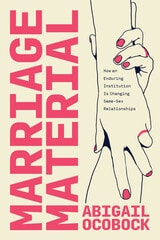
Marriage Material
How an Enduring Institution Is Changing Same-Sex RelationshipsAbigail Ocobock
University of Chicago Press, 2024
It is no secret that marriage rates in the United States are at an all-time low. Despite this significant decline, the institution of marriage endures in our society amid historic changes to its meaning and practice. How does the continuing strength of marriage impact the relationships of same-sex couples after the legalization of same-sex marriage?
Drawing on over one hundred interviews with LGBTQ+ people, Marriage Material reveals the transformative impact marriage equality has had on same-sex relationships. Sociologist Abigail Ocobock looks to same-sex couples across a wide age range to illuminate the complex ways institutional mechanisms work in tandem to govern the choices and behaviors of individuals with different marriage experiences. Ocobock examines both the influence of marriage on the dynamics of same-sex relationships and how LGBTQ+ people challenge heteronormative assumptions about marriage, highlighting the complex interplay between institutional constraint and individual agency.
Marriage Material presents a bold challenge to dominant scholarly and popular ideas about the decline of marriage, making clear that gaining access to legal marriage has transformed same-sex relationships, both for better and for worse.
Marriage and Cohabitation
Arland Thornton, William G. Axinn, and Yu Xie
University of Chicago Press, 2007
In an era when half of marriages end in divorce, cohabitation has become more commonplace and those who do get married are doing so at an older age. So why do people marry when they do? And why do some couples choose to cohabit? A team of expert family sociologists examines these timely questions in Marriage and Cohabitation, the result of their research over the last decade on the issue of union formation.
Situating their argument in the context of the Western world’s 500-year history of marriage, the authors reveal what factors encourage marriage and cohabitation in a contemporary society where the end of adolescence is no longer signaled by entry into the marital home. While some people still choose to marry young, others elect to cohabit with varying degrees of commitment or intentions of eventual marriage. The authors’ controversial findings suggest that family history, religious affiliation, values, projected education, lifetime earnings, and career aspirations all tip the scales in favor of either cohabitation or marriage. This book lends new insight into young adult relationship patterns and will be of interest to sociologists, historians, and demographers alike.
Marriage and Divorce in the Jewish State
Israel's Civil WarSusan M. Weiss and Netty C. Gross-Horowitz
Brandeis University Press, 2012
Marriage and Health
The Well-Being of Same-Sex CouplesHui Liu
Rutgers University Press, 2020
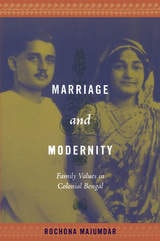
Marriage and Modernity
Family Values in Colonial BengalRochona Majumdar
Duke University Press, 2009
Majumdar examines three broad developments related to the modernity of arranged marriage: the growth of a marriage market, concomitant debates about consumption and vulgarity in the conduct of weddings, and the legal regulation of family property and marriages. Drawing on matrimonial advertisements, wedding invitations, poems, photographs, legal debates, and a vast periodical literature, she shows that the modernization of families does not necessarily imply a transition from extended kinship to nuclear family structures, or from matrimonial agreements negotiated between families to marriage contracts between individuals. Colonial Bengal tells a very different story.
Marriage in Past, Present and Future Tense
Edited by Janet Carsten, Hsiao-Chiao Chiu, Siobhan Magee, Eirini Papadaki, and Koreen M. Reece
University College London, 2021
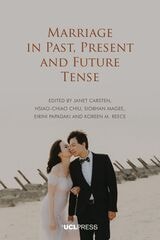
A series of global case studies, Marriage in Past, Present and Future Tense unravels the ever-changing intimate and institutional questions united by marriage. Traversing politics, economics, and religion, the authors explore how marital practices both react to and produce broader social transformation. In particular, the authors contend that contexts marked by violent sociopolitical ruptures such as civil war or colonization illuminate the links between the personal and political. What emerges is a complex portrait of marriage as a site of cultural memory, embodied experience, and active imagination.
Marriage on Trial
Ludwig Schmugge
Catholic University of America Press, 2012

Marriage to the Sea
Linked NovellasSarah Stone
Four Way Books, 2026
Marriage, Class and Colour in Nineteenth-Century Cuba
A Study of Racial Attitudes and Sexual Values in a Slave SocietyVerena Martinez-Alier
University of Michigan Press, 1989
Marriage, Divorce, and Distress in Northeast Brazil
Black Women's Perspectives on Love, Respect, and KinshipMedeiros, Melanie A.
Rutgers University Press, 2018
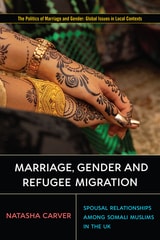
Marriage, Gender and Refugee Migration
Spousal Relationships among Somali Muslims in the United KingdomNatasha Carver
Rutgers University Press, 2021
This ethical and poetic ethnography analyses the upheavals to gender roles and marital relationships brought about by Somali refugee migration to the UK. Unmoored from the socio-cultural norms that made them men and women, being a refugee is described as making "everything" feel "different, mixed up, upside down." Marriage, Gender and Refugee Migration details how Somali gendered identities are contested, negotiated, and (re)produced within a framework of religious and politico-national discourses, finding that the most significant catalysts for challenging and changing harmful gender practices are a combination of the welfare system and Islamic praxis. Described as “an important and urgent monograph," this book will be a key text relevant to scholars of migration, transnational families, personal life, and gender. Written in a beautiful and accessible style, the book voices the participants with respect and compassion, and is also recommended for scholars of qualitative social research methods.
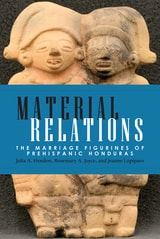
Material Relations
The Marriage Figurines of Prehispanic HondurasJulia A. Hendon
University Press of Colorado, 2014
They examine the production, use, and disposal of marriage figurines from six sites—Campo Dos, Cerro Palenque, Copán, Currusté, Tenampua, and Travesia—and explore their role in rituals and ceremonies, as well as in the forming of social bonds and the celebration of relationships among communities. They find evidence of historical traditions reproduced over generations through material media in social relations among individuals, families, and communities, as well as social differences within this network of connected yet independent settlements.
Material Relations provides a new and dynamic understanding of how social houses functioned via networks of production and reciprocal exchange of material objects and will be of interest to Mesoamerican archaeologists, anthropologists, and art historians.
Mediating the Uprising
Narratives of Gender and Marriage in Syrian Television DramaRebecca Joubin
Rutgers University Press, 2020
While for some screenwriters a return to pre-2011 life would be welcome after so much bloodshed, others advocated profound cultural and social transformation, instead. They employed marriage and gender metaphors in the stories they wrote to engage in political critique, even at the risk of creating marketing difficulties for the shows or they created escapist stories such as transnational adaptations and Old Damascus tales. Serving as heritage preservation, Mediating the Uprising underscores that television drama creators in Syria have many ways of engaging in protest, with gender and marriage at the heart of the polemic.
Money, Marriage, and Madness
The Life of Anna OttKim E. Nielsen
University of Illinois Press, 2020
Kim E. Nielsen explores a life at once irregular and unexceptional. Historical and institutional structures, like her whiteness and laws that liberalized divorce and women's ability to control their property, opened up uncommon possibilities for Ott. Other structures, from domestic violence in the home to rampant sexism and ableism outside of it, remained a part of even affluent women's lives. Money, Marriage, and Madness tells a forgotten story of how the legal and medical cultures of the time shaped one woman—and what her life tells us about power and society in nineteenth century America.
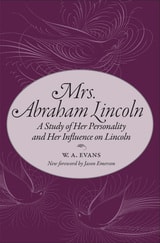
Mrs. Abraham Lincoln
A Study of Her Personality and Her Influence on LincolnW.A. Evans, Foreword by Jason Emerson
Southern Illinois University Press, 1932
First published in 1932, this was the first thoroughly researched biography of Mary Lincoln ever written, and it remains the most balanced and complete work on this controversial First Lady. Author W. A. Evans challenges the disparaging views of Mary Lincoln that were generally accepted at the time, offering a comprehensive and informed look at a woman whose physical and mental health problems have often been misconstrued or overlooked by other biographers. Evans conducted extensive research, interviewing Mrs. Lincoln’s family members, seeking advice and assistance from numerous Lincoln scholars and historians, scouring thousands of pages of contemporary newspapers and primary resources, reviewing correspondence Mary wrote during her stay at Bellevue Place sanitarium, and consulting with several medical experts. The result of all this research is an objective and detailed portrait of Mrs. Lincoln and her influence on her husband that still has a great deal of historical value for readers today.
A new foreword by Jason Emerson, author of The Madness of Mary Lincoln, provides biographical information on Evans and background on the origins of the book and its reception and influence. Finally back in print, this classic biography is essential reading for all with an interest in the Lincoln family.
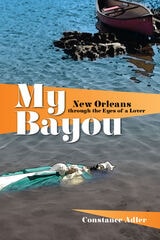
My Bayou
New Orleans through the Eyes of a LoverConstance Adler
Michigan State University Press, 2012
A vividly described and intensely personal memoir, My Bayou charts a personal and spiritual transformation along the fabled banks of Bayou Saint John in New Orleans. When Constance Adler moves to New Orleans, she begins what becomes a lasting love affair with the city, and especially the bayou—a living entity and the beating heart of local culture. Rites of passage, celebrations, mysterious accidents, and magic all take place on its banks, leading Adler to a vibrant awareness of the power of being part of a community. That faith is tested in the wake of Hurricane Katrina, and is ultimately proven right, as Bayou Saint John begins to rebuild.