Results by title
66 books match the query 'Masculinity in literature' and 9 start with m
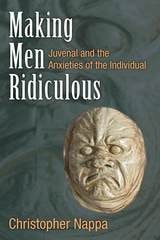
Making Men Ridiculous
Juvenal and the Anxieties of the IndividualChristopher Nappa
University of Michigan Press, 2018
In his sixteen verse satires, Juvenal presents speakers who decry the breakdown in traditional Roman values and the status of Roman men as they are confronted by upstart foreigners, devious and deviant women, class traitors, the power of the imperial household, and even the body itself. The satirist castigates vice and immorality even as he revels in describing them. This book locates Juvenal’s targets among the matrices of birth, wealth, class, gender, and ethnicity and walks carefully through a number of his most arresting vignettes in order to show not only what, but how, he satirizes. Moreover, the analysis shows that Juvenal’s portraits sometimes escape his grasp, and, as often as not, he ends up undermining the voice with which he speaks and the values he claims to hold dear. Individual chapters look at the satirist himself, rebellious bodies, disgraced aristocrats, uppity (even murderous) wives, and the necessary but corrupting power of money. The conclusion considers the endurance of both the targets and the rhetoric behind them in the modern world.
Making Men Ridiculous will interest scholars and advanced students of ancient satire, later European satire, imperial Roman culture and literature, and class, gender, and sexuality in the ancient world.
Making Men
Gender, Literary Authority, and Women’s Writing in Caribbean NarrativeBelinda Edmondson
Duke University Press, 1998
Discussing the canonical Caribbean narrative as it reflects national identity under the domination of English cultural authority, Belinda Edmondson focuses particularly on the pervasive influence of Victorian sensibilities in the structuring of twentieth-century national identity. She shows that issues of race and English constructions of masculinity not only are central to West Indian identity but also connect Caribbean authorship to the English literary tradition. This perspective on the origins of West Indian literary nationalism then informs Edmondson’s search for female subjectivity in current literature by West Indian women immigrants in America. Making Men compares the intellectual exile of men with the economic migration of women, linking the canonical male tradition to the writing of modern West Indian women and exploring how the latter write within and against the historical male paradigm in the continuing process of national definition.
With theoretical claims that invite new discourse on English, Caribbean, and American ideas of exile, migration, race, gender identity, and literary authority, Making Men will be informative reading for those involved with postcolonial theory, African American and women’s studies, and Caribbean literature.
Male Call
Becoming Jack LondonJonathan Auerbach
Duke University Press, 1996
Jonathan Auerbach shows that London’s personal identity was not a basis of his literary success, but rather a consequence of it. Unlike previous studies of London that are driven by the author’s biography, Male Call examines how London carefully invented a trademark “self” in order to gain access to a rapidly expanding popular magazine and book market that craved authenticity, celebrity, power, and personality. Auerbach demonstrates that only one fact of London’s life truly shaped his art: his passionate desire to become a successful author. Whether imagining himself in stories and novels as a white man on trail in the Yukon, a sled dog, a tramp, or a professor; or engaging questions of manhood and mastery in terms of work, race, politics, class, or sexuality, London created a public persona for the purpose of exploiting the conventions of the publishing world and marketplace.
Revising critical commonplaces about both Jack London’s work and the meaning of “nature” within literary naturalism and turn-of-the-century ideologies of masculinity, Auerbach’s analysis intriguingly complicates our view of London and sheds light on our own postmodern preoccupation with celebrity. Male Call will attract readers with an interest in American studies, American literature, gender studies, and cultural studies.
Masculinist Impulses
Toomer, Hurston, Black Writing, and ModernityNathan Grant
University of Missouri Press, 2004
Grant’s book provides close readings of Jean Toomer (Cane and Natalie Mann) and Zora Neale Hurston (Moses, Man of the Mountain, Seraph of the Suwanee, and Their Eyes Were Watching God), for whom the American South was a crucial locus of the African American experience. Toomer and Hurston were virtually alone among the Harlem Renaissance writers of prose who returned to the South for their literary materials. That return, however, allowed their rediscovery of key black masculine values and charted the northern route of those values in the twentieth century to their compromise and destruction.
Grant then moves on to three more recent writers—John Edgar Wideman, Gloria Naylor, and Toni Morrison—who expanded upon and transformed the themes of Toomer and Hurston. Like Toomer and Hurston, these later authors recognized the need for the political union of black men and women in the effort to realize the goals of equity and justice.
Masculinist Impulses discusses nineteenth- and twentieth-century black masculinity as both a feature and a casualty of modernism. Scholars and students of African American literature will find Grant’s nuanced and creative readings of these key literary texts invaluable.
Masculinity Besieged?
Issues of Modernity and Male Subjectivity in Chinese Literature of the Late Twentieth CenturyXueping Zhong
Duke University Press, 2000
Before the 1990s onslaught of popular culture decentered the role of intellectuals within the nation, they had come to embody Chinese masculinity during the previous decade. The focus on masculinity in literature had become unprecedented in scale and the desire for “real men” began to permeate Chinese popular culture, making icons out of Rambo and Takakura Ken. Stories by Zhang Xianliang and Liu Heng portraying male anxiety about masculine sexuality are employed by Zhong to show how “marginal” males negotiate their sexual identities in relation to both women and the state. Looking at writers popular among not only the well-educated but also the working and middle classes, she discusses works by Han Shaogong, Yu Hua, and Wang Shuo and examines instances of self-loathing male voices, particularly as they are articulated in Mo Yan’s well-known work Red Sorghum. In her last chapter Zhong examines “roots literature,” which speaks of the desire to create strong men as a part of the effort to create a geopolitically strong Chinese nation. In an afterword, Zhong situates her study in the context of the 1990s.
This book will be welcomed by scholars of Chinese cultural studies, as well as in literary and gender studies.
Men without Women
Masculinity and Revolution in Russian Fiction, 1917–1929Eliot Borenstein
Duke University Press, 2001
In such works as Red Cavalry by Isaac Babel, Envy by Yuri Olesha, and Chevengur by Andrei Platonov women are either absent or transformed into bodiless abstractions. Their absence, claims Borenstein, reflects the masculine values that are hallmarks of the post-revolutionary era: production rather than reproduction, participation in history rather than domestic ahistoricity, heavy industry, construction, and struggle. He identifies in this literature groups of “men without women” replacing the family, even while the metaphor of family is used as an organizing feature of their recurring revolutionary missions. With the passage of time, these characters’ relationships—just as those in the Soviet culture of the time—begin to resemble the family structure that was originally rejected and destroyed, with one important exception: the new “families” had no place for women. According to Borenstein, this masculinist myth found its most congenial audience during the early period of communism, but its hostility to women and family ties could not survive into the Stalinist era when women, home, and family were no longer seen as antithetical to socialism.
Drawing on the theory and writings of Levi-Strauss, Girard, Sedgwick, and others, Men Without Women will be of interest to students and scholars of Slavic literature and history as well as specialists in literary theory and gender studies.
Mexican Masculinities
Robert McKee Irwin
University of Minnesota Press, 2003
A fascinating examination of masculinity in nineteenth- and twentieth-century Mexico
The first of its kind and a powerful challenge to customary views of gender and sexuality in the life and literature of Mexico, this book traces literary representations of masculinity in Mexico from independence in 1810 to the 1960s, and shows how these intersect with the constructions of nation and nationality.
The rhetoric of “Mexicanness” makes constant use of images of masculinity, though it does so in shifting and often contradictory ways. Robert McKee Irwin’s work follows these shifts from the male homosocial bonding that was central to notions of national integration in the nineteenth century, to questioning of gender norms stirred by science and scandals at the turn of the century, to the virulent reaction against gender chaos after the Mexican revolution, to the association of Mexicanness with machismo and homophobia in the literature of the 1940s and 1950s—even as male homosexuality was established as an integral part of national culture.As the first historical study of how masculinity and, particularly, homosexuality were understood in Mexico in the national era, this book not only provides “queer readings” of most major canonical texts of the period in question, but also uncovers a variety of unknown texts from queer Mexican history, including the 1906 novel Los 41, which reenacts the scandal of a turn-of-the-century transvestite ball that launched modern discussion of homosexuality in Mexico. It is a radical undermining of the simple hetero/homosexual and masculine/feminine oppositions that have for so long informed views of the country’s national character.
Monumental Anxieties
Homoerotic Desire and Feminine Influence in 19-th Century U.S. LiteratureDerrick, Scott S
Rutgers University Press, 1997
Scott Derrick has written an original book that contributes significantly to current revisions of the nineteenth-century American literary tradition's representation of gender and sexuality. His interpretation of feminist, lesbian-feminist, and gay issues in nineteenth-century American literature as complementary enlarges our historical understanding and helps build the coalition politics needed in these areas."-John Carlos Rowe, University of California, Irvine
Recent gender-based scholarship on nineteenth-century American literature has established male authors' crucial awareness of the competition from popular women writers. And critical work in gay studies and queer theory has stressed the importance in canonical American literature of homoerotic relations between men, even before "homosexuality" became codified at the end of the century. Scott Derrick draws on these insights to explore the ways in which male authors struggle to refigure literature-historically devalued as feminine-as a masculine and heterosexual enterprise. Derrick focuses on scenes of compositional crisis that reveal how male identity itself is at risk in the perils and possibilities of being a male author in a feminized literary marketplace.
He suggests that traditionally valued texts by Hawthorne, Poe, James, Sinclair, and Crane have at their core combustible four-sided conflicts between feminine identifications and masculine distancings, homoerotic longings and homophobic dreads, conflicts which are largely determined by domestic ideals of male and female roles within the nineteenth-century family. The negotiation of such conflicts is controlled by the nature of fiction writing, which both frees the imagination to explore forbidden fantasies and harnesses the imagination to public understandings of the proper form and content of fiction. Thus Monumental Anxieties also contributes to recent debates about the social shaping of contemporary homosexuality and to the history of American masculinity.
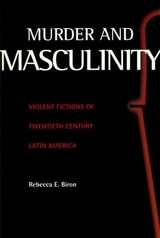
Murder and Masculinity
Violent Fictions of Twentieth-Century Latin AmericaRebecca E. Biron
Vanderbilt University Press, 2000
The introduction to this study deftly situates Biron's work in relation to previous theoretical arguments on the social and political dimensions of Latin American writing. The five subsequent chapters offer superb analyses of the individual texts. Like their male protagonists who experiment with the psychological and legal extremes of gender division, these narratives risk nonconformity to the laws of genre in their quest for liberation from violent social and literary conventions. In combining elements of detective stories, crime narratives, psychological case studies, and magical or grotesque realism, they offer metafictional commentary on a network of discourses that confuses images of masculinity, national identity, and political autonomy in postcolonial Latin America.