58 books match the query 'Media & Internet' and 3 start with m
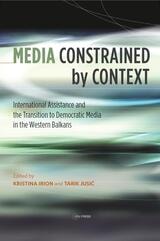
cover of Media Constrained by Context: International Assistance and Democratic Media Transition in the Western Balkans

Media Constrained by Context

International Assistance and Democratic Media Transition in the Western Balkans

Kristina Irion

Central European University Press, 2018
This books draws a comparative balance of twenty years' international media assistance in the five countries of the Western Balkans. The central question was what happens to imported models when they are transposed onto the newly evolving media systems of transitional societies. Albania, Bosnia-Herzegovina, Kosovo, Macedonia and Serbia undertook a range of media reforms to conform with accession requirements of the European Union and the standards of the Council of Europe, among others. The essays explore the nexus between the democratic transformation of the media and international media assistance. The cross-national analysis concludes that the effects of international assistance are highly constrained by the local context. From today's vantage point it becomes obvious, that scaling media assistance does not necessarily improve outcomes. The experiences in the region suggest that imported solutions have not been very cognitive in all aspects of local conditions but international strategies tent to be rather schematic and lacked strategic approaches to promote media policy stability, credible media reform and implementation. The book offers valuable insights into the nature and effects of media assistance and the strategies deployed by international aid agencies, local political forces, media professionals, civil society organizations and other actors.
[more]
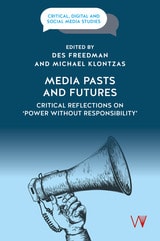
cover of Media Pasts and Futures: Critical Reflections on 'Power Without Responsibility'

Media Pasts and Futures

Critical Reflections on 'Power Without Responsibility'

Edited by Des Freedman and Michael Klontzas

University of Westminster Press, 2025
This collection of short essays from leading media scholars reflects on critical issues of media history, power, ownership, influence and impact. The book uses the acclaimed media title Power Without Responsibility (PWR) as a calling card, a cue to reflect on the limitations of the media in different countries and to advocate solutions aimed at stimulating more democratic forms of communications.Organised in five sections, contributions in this book identify the relevance of PWR and then pick out and develop its core themes. The first section provides both a reminder of PWR’s significance to media history and analysis and then explores its conclusions in relation to media systems in places including Europe, South and East Asia, Africa and Latin America. The second section takes up the argument that ‘market censorship’ impoverishes the media while the third explores the book’s lessons for contemporary media reform. The fourth section explores the contribution of public service broadcasting and its relevance for future communications systems. The fifth section considers PWR’s analysis of radical journalism in relation to both historical and contemporary initiatives while the concluding section features two original essays by the authors of PWR, James Curran and Jean Seaton, reflecting on their book 43 years and nine editions after it was first published.
[more]
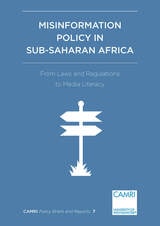
cover of Misinformation Policy in Sub-Saharan Africa: From Laws and Regulations to Media Literacy

Misinformation Policy in Sub-Saharan Africa

From Laws and Regulations to Media Literacy

Peter Cunliffe-Jones, Assane Diagne, Alan Finlay, Sahite Gaye, Wallace Gichunge, Chido Onumah, Cornia Pretorius and Anya Schiffrin

University of Westminster Press, 2021

Misinformation Policy in Sub-Saharan Africa is a single volume containing two research reports by eight authors examining policy towards misinformation in Sub-Saharan Africa.

The volume first examines the teaching of ‘media literacy’ in state-run schools in seven Sub-Saharan African countries as of mid-2020, as relates to misinformation. It explains the limited elements of media and information literacy (MIL) that are included in the curricula in the seven countries studied and the elements of media literacy related to misinformation taught in schools in one province of South Africa since January 2020. The authors propose six fields of knowledge and skills specific to misinformation that are required in order to reduce students’ susceptibility to false and misleading claims. Identifying obstacles to the introduction and effective teaching of misinformation literacy, the authors make five recommendations for the promotion of misinformation literacy in schools, to reduce the harm misinformation causes.

The second report in the volume examines changes made to laws and regulations related to ‘false information’ in eleven countries across Sub-Saharan Africa 2016-2020 from Ethiopia to South Africa. By examining the terms of such laws against what is known of misinformation types, drivers and effects, it assesses the likely effects of punitive policies and those of more positive approaches that provide accountability in political debate by promoting access to accurate information and corrective speech. In contrast to the effects described for most recent regulations relating to misinformation, the report identifies ways in which legal and regulatory frameworks can be used to promote a healthier information environment.

[more]