Results by title
80 books match the query 'Medical (incl. Patients)' and 9 start with m
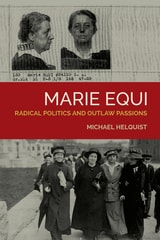
Marie Equi
Radical Politics and Outlaw PassionsMichael Helquist
Oregon State University Press, 2015
Equi self-studied her way into a San Francisco medical school and then obtained her license in Portland to become one of the first practicing woman physicians in the Pacific Northwest. From Pendleton, Portland, Seattle and beyond to Boston and San Francisco, she leveraged her professional status to fight for woman suffrage, labor rights, and reproductive freedom. She mounted soapboxes, fought with police, and spent a night in jail with birth control advocate Margaret Sanger. Equi marched so often with unemployed men that the media referred to them as her army. She battled for economic justice at every turn and protested the U.S. entry into World War I, leading to a conviction for sedition and a three-year sentence in San Quentin. Breaking boundaries in all facets of life, she became the first well-known lesbian in Oregon, and her same-sex affairs figured prominently in two U.S. Supreme Court cases.
Marie Equi is a finely written, rigorously researched account of a woman of consequence, who one fellow-activist considered “the most interesting woman that ever lived in this state, certainly the most fascinating, colorful, and flamboyant.” This much anticipated biography will engage anyone interested in Pacific Northwest history, women’s studies, the history of lesbian and gay rights, and the personal demands of political activism. It is the inspiring story of a singular woman who was not afraid to take risks, who refused to compromise her principles in the face of enormous opposition and adversity, and who paid a steep personal price for living by her convictions.
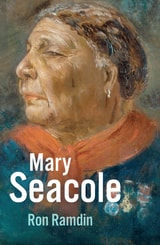
Mary Seacole
Ron Ramdin
Haus Publishing, 2020
Mary Seacole’s remarkable life began in Jamaica, where she was born a free person, the daughter of a black mother and white Scottish army officer. Ron Ramdin—who, like Seacole, was born in the Caribbean and emigrated to the United Kingdom—tells the remarkable story of this woman, celebrated today as a pioneering nurse.
Refused permission to serve as an army nurse, Seacole took the remarkable step of funding her own journey to the Crimean battlefront, and there, in the face of sometimes harsh opposition, she established a hotel for wounded British soldiers. Unlike Florence Nightingale—whose exploits saw her venerated as the “lady with the lamp” for generations afterward—Seacole cared for soldiers perilously close to the fighting. As Ramdin shows in this biography, Seacole’s time in Crimea, for which she is best known, was only the pinnacle of a life of adventure and travel.
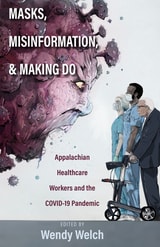
Masks, Misinformation, and Making Do
Appalachian Health-Care Workers and the COVID-19 PandemicWendy Welch
Ohio University Press, 2023
Medal Winners
How the Vietnam War Launched Nobel CareersBy Raymond S. Greenberg
University of Texas Press, 2020
As the ground war in Vietnam escalated in the late 1960s, the US government leveraged the so-called doctor draft to secure adequate numbers of medical personnel in the armed forces. Among newly minted physicians’ few alternatives to military service was the Clinical Associate Training Program at the National Institutes of Health. Though only a small percentage of applicants were accepted, the elite program launched an unprecedented number of remarkable scientific careers that would revolutionize medicine at the end of the twentieth century.
Medal Winners recounts this overlooked chapter and unforeseen byproduct of the Vietnam War through the lives of four former NIH clinical associates who would go on to become Nobel laureates. Raymond S. Greenberg traces their stories from their pre-NIH years and apprenticeships through their subsequent Nobel Prize–winning work, which transformed treatment of heart disease, cancer, and other diseases. Greenberg shows how the Vietnam draft unintentionally ushered in a golden era of research by bringing talented young physicians under the tutelage of leading scientists and offers a lesson in what it may take to replicate such a towering center of scientific innovation as the NIH in the 1960s and 1970s.
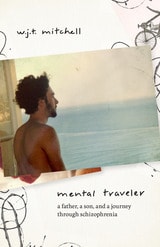
Mental Traveler
A Father, a Son, and a Journey through SchizophreniaW. J. T. Mitchell
University of Chicago Press, 2020
Gabriel Mitchell was diagnosed with schizophrenia at age twenty-one and died by suicide eighteen years later. He left behind a remarkable archive of creative work and a father determined to honor his son’s attempts to conquer his own illness. Before his death, Gabe had been working on a film that would show madness from inside and out, as media stereotype and spectacle, symptom and stigma, malady and minority status, disability and gateway to insight. He was convinced that madness is an extreme form of subjective experience that we all endure at some point in our lives, whether in moments of ecstasy or melancholy, or in the enduring trauma of a broken heart. Gabe’s declared ambition was to transform schizophrenia from a death sentence to a learning experience, and madness from a curse to a critical perspective.
Shot through with love and pain, Mental Traveler shows how Gabe drew his father into his quest for enlightenment within madness. It is a book that will touch anyone struggling to cope with mental illness, and especially for parents and caregivers of those caught in its grasp.
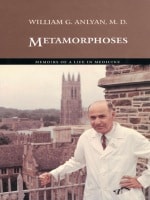
Metamorphoses
Memoirs of a Life in MedicineWilliam G. Anlyan, M. D.
Duke University Press, 2004
Born in Alexandria, Egypt, in 1925, and schooled in the British tradition, Anlyan attended Yale University as an undergraduate and medical student before coming to the relatively unknown medical school at Duke University in 1949 for an internship in general and thoracic surgery. He stayed on, first as a resident, then as a staff surgeon. By 1961, he was a full professor of surgery. In 1964, Anlyan was named dean of the medical school, the first in a series of administrative posts at the medical school and hospital. Anlyan’s role in the transformation of the Duke University Medical Center into an internationally renowned health system is manifest: he restructured the medical school and hospital and supervised the addition of almost four million square feet of new or renovated space. He hired outstanding administrators and directed a staff that instituted innovative programs and groundbreaking research centers, such as the Cancer Center and the Physician’s Assistant Program.
Anlyan describes a series of metamorphoses in his own life, in the world of medicine, in Durham, and at Duke. At the time of his prep school upbringing in Egypt, medicine was a matter of controlling infectious diseases like tuberculosis and polio. As he became an immigrant medical student and then a young surgeon, he observed vast advances in medical practice and changes in the financing of medical care. During his tenure at Duke, Durham was transformed from a sleepy mill and tobacco town into the “City of Medicine,” a place where patients routinely travel for open-heart surgery and cutting-edge treatments for cancer and other diseases.
Anyone interested in health care, medical education, and the history of Duke University will find Anlyan’s memoir of interest.
More than "First, Do No Harm"
Academic Global HealthTimothy R. B. Johnson
Michigan Publishing Services, 2023
Using personal experience and narrative, as well as the voices of students, trainees, and academic colleagues, this book illustrates how an initiative beginning over thirty years ago to train obstetrician-gynecologists in Ghana can serve as a model for global engagement by universities and learners at many levels. In addition to detailing a proven sustainable model for global health programs, this book highlights the ethical and moral imperatives participants should expect and demand of truly engaged academic global health.
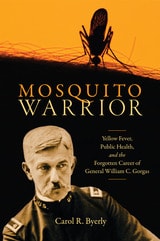
Mosquito Warrior
Yellow Fever, Public Health, and the Forgotten Career of General William C. GorgasCarol R. Byerly
University of Alabama Press, 2024
A compelling biography of General William C. Gorgas, the US Army doctor's campaign against mosquito-borne disease reshaped public health, military medicine, and U. S. power on the world stage.
Mosquito Warrior tells the engrossing story of General William C. Gorgas (1854–1920), the once-renowned pioneer in tropical disease research and public health. His fascinating life illuminates vast transformations in the United States, including the end of the Civil War and the industrialization of the US military and economy, the emergence of germ theory and the modernization of the public health system, and the rise of the United States as a world power.
A scion of Confederate elites, Gorgas came of age amidst war and disease and the politics of racial segregation. He followed his father into military service as an army medical officer, treating troops on America’s western frontier posts. During the US occupation of Cuba, Gorgas applied Walter Reed’s research on the theory of mosquito-borne disease transmission, ending centuries of yellow fever in Havana through the eradication of the deadly Aedes aegypti mosquito. Applying similar strategies on the isthmus of Panama against yellow fever and malaria, Gorgas enabled the completion of the Panama Canal, then the largest engineering project in the world. Hailed a hero, he pursued his fight against mosquito-borne disease throughout the tropics, expanding American interests as he went. Appointed as US Army surgeon general on the eve of World War I, Gorgas resumed work modernizing the army health care system, strengthening US medical and military authority on the world stage.
Celebrated in life, Gorgas’s reputation fell victim to competing political interests and jealousies after his death, a cautionary tale about historical memory and the politics of science and personality. Carol R. Byerly’s balanced and contemporary examination of Gorgas illuminates his complex legacy in medicine and public health, military history, and American ambitions at the dawn of US global ascendency.
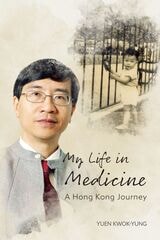
My Life in Medicine
A Hong Kong JourneyKwok-Yung Yuen
Hong Kong University Press, 2024
From humble beginnings in Hong Kong, Yuen Kwok-Yung rose to international prominence as a doctor, surgeon, academic, and microbiologist. As an advisor to governments, he and colleagues made discoveries that helped the world cope with unprecedented threats to public health, including the COVID-19 pandemic. In this compelling memoir, Dr. Yuen weaves personal stories with those from his extraordinary medical career to take readers on an inspiring journey about perseverance, courage, faith, and the ongoing peril of infectious diseases.