Results by title
63 books match the query 'Medical policy' and 6 start with m
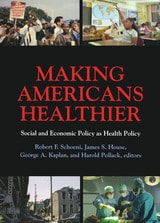
Making Americans Healthier
Social and Economic Policy as Health PolicyRobert F. Schoeni
Russell Sage Foundation, 2008
The United States spends billions of dollars annually on social and economic policies aimed at improving the lives of its citizens, but the health consequences associated with these policies are rarely considered. In Making Americans Healthier, a group of multidisciplinary experts shows how social and economic policies seemingly unrelated to medical well-being have dramatic consequences for the health of the American people. Most previous research concerning problems with health and healthcare in the United States has focused narrowly on issues of medical care and insurance coverage, but Making Americans Healthier demonstrates the important health consequences that policymakers overlook in traditional cost-benefit evaluations of social policy. The contributors examine six critical policy areas: civil rights, education, income support, employment, welfare, and neighborhood and housing. Among the important findings in this book, David Cutler and Adriana Lleras-Muney document the robust relationship between educational attainment and health, and estimate that the health benefits of education may exceed even the well-documented financial returns of education. Pamela Herd, James House, and Robert Schoeni discover notable health benefits associated with the Supplemental Security Income Program, which provides financial support for elderly and disabled Americans. George Kaplan, Nalini Ranjit, and Sarah Burgard document a large and unanticipated improvement in the health of African-American women following the enactment of civil rights legislation in the 1960s. Making Americans Healthier presents ground-breaking evidence that the health impact of many social policies is substantial. The important findings in this book pave the way for promising new avenues for intervention and convincingly demonstrate that ultimately social and economic policy is health policy. A Volume in the National Poverty Center Series on Poverty and Public Policy
[more]
Mama Might Be Better Off Dead
The Failure of Health Care in Urban AmericaLaurie Kaye Abraham
University of Chicago Press, 1994
North Lawndale, a neighborhood that lies in the shadows of Chicago’s Loop, is surrounded by some of the city’s finest medical facilities, Yet, it is one of the sickest, most medically underserved communities in the country.
Mama Might Be Better Off Dead immerses readers in the lives of four generations of a poor, African-American family in the neighborhood, who are beset with the devastating illnesses that are all too common in America’s inner-cities. Headed by Jackie Banes, who oversees the care of a diabetic grandmother, a husband on kidney dialysis, an ailing father, and three children, the Banes family contends with countless medical crises. From visits to emergency rooms and dialysis units, to trials with home care, to struggles for Medicaid eligibility, Laurie Kaye Abraham chronicles their access—or more often, lack thereof—to medical care. Told sympathetically but without sentimentality, their story reveals an inadequate health care system that is further undermined by the direct and indirect effects of poverty.
Both disturbing and illuminating, Mama Might Be Better Off Dead is an unsettling, profound look at the human face of health care in America. Published to great acclaim in 1993, the book in this new edition includes an incisive foreword by David Ansell, a physician who worked at Mt. Sinai Hospital, where much of the Banes family’s narrative unfolds.
[more]
Markets and Medicine
The Politics of Health Care Reform in Britain, Germany, and the United StatesSusan Giaimo
University of Michigan Press, 2002
Are advanced industrialized countries converging on a market response to reform their systems of social protection? By comparing the health care reform experiences of Britain, Germany, and the United States in the 1990s, Susan Giaimo explores how countries pursue diverse policy responses and how such variations reflect distinctive institutions, actors, and reform politics in each country.
In Britain, the Thatcher government's plan to inject a market into the state-administered national health service resulted in a circumscribed experiment orchestrated from above. In Germany, the Kohl government sought to repair defects in the corporatist arrangement with doctors and insurers, thus limiting the market experiment and designing it to enhance the solidarity of the national health insurance system. In the United States, private market actors foiled Clinton's bid to expand the federal government's role in the private health care system through managed competition and national insurance. But market reform continued, albeit led by private employers and with government officials playing a reactive role. Actors and institutions surrounding the existing health care settlement in each country created particular reform politics that either militated against or fostered the deployment of competition.
The finding that major transformations are occurring in private as well as public systems of social protection suggests that studies of social policy change expand their focus beyond statutory welfare state programs. The book will interest political scientists and policymakers concerned with welfare state reform in advanced industrial societies; social scientists interested in the changing balance among state, market, and societal interests in governance; and health policy researchers, health policymakers, and health care professionals.
Susan Giaimo is an independent scholar. She completed her Ph.D. in Political Science at the University of Wisconsin-Madison. She also earned an MSc in Politics from the London School of Economics and Political Science, with the Politics and Government of Western Europe as the branch of study. After completing her doctorate, she was a postdoctoral fellow in the Robert Wood Johnson Foundation Scholars in Health Policy Research Program, University of California at Berkeley, and the Robert Bosch Foundation Scholars Program in Comparative Public Policy and Comparative Institutions, American Institute for Contemporary German Studies, Johns Hopkins University. She taught in the Political Science Department at Massachusetts Institute of Technology for five years. During that period she won the Society for the Advancement of Socio-Economics Founder's Prize for "Adapting the Welfare State: The Case of Health Care Reform in Britain, Germany, and the United States," a paper she coauthored with Philip Manow. She has also worked for health maintenance organizations (HMOs) and medical practices in the United States.
[more]

Medical Professionalism in the New Information Age
Edited and with an Introduction by David J. Rothman and David Blumenthal
Rutgers University Press, 2011
With computerized health information receiving unprecedented government support, a group of health policy scholars analyze the intricate legal, social, and professional implications of the new technology. These essays explore how Health Information Technology (HIT) may alter relationships between physicians and patients, physicians and other providers, and physicians and their home institutions. Patient use of web-based information may undermine the traditional information monopoly that physicians have long enjoyed. New IT systems may increase physicians' legal liability and heighten expectations about transparency. Case studies on kidney transplants and maternity practices reveal the unanticipated effects, positive and negative, of patient uses of the new technology. An independent HIT profession may emerge, bringing another organized interest into the medical arena. Taken together, these investigations cast new light on the challenges and opportunities presented by HIT.
[more]
Medicine and Health in Africa
Multidisciplinary PerspectivesPaula Viterbo
Michigan State University Press, 2011
Over the last two decades, the implosion of economies under the burden of debt, the negative repercussions of structural adjustment programs, the crisis of legitimacy, civil wars, and the collapse of some states have resulted in serious health issues across the African continent. Newly emerging diseases, such as Ebola virus and HIV/AIDS have killed and disabled millions. Some “old diseases,” such as yellow fever, tuberculosis, and polio have reappeared. Malaria, cholera, and meningitis continue to kill thousands. In many countries, the medical infrastructure has collapsed, while an increasing number of physicians and nurses have migrated to more hospitable places. Stigmatization of the affected people has exacerbated social and racial discrimination and has affected the implementation of national and international public health programs. The complexity of the situation requires an interdisciplinary approach. This collection, including contributions by historians, sociologists, anthropologists, and biologists, emphasizes the social and cultural contexts of African health, paying particular attention to the history of the colonial public health system and its legacy.
[more]

Medicine, Law, and the State in Imperial Russia
Elisa M. Becker
Central European University Press, 2011
Examines the theoretical and practical outlook of forensic physicians in Imperial Russia, from the 18th to the early 20th centuries, arguing that the interaction between state and these professionals shaped processes of reform in contemporary Russia. It demonstrates the ways in which the professional evolution of forensic psychiatry in Russia took a different turn from Western models, and how the process of professionalization in late imperial Russia became associated with liberal legal reform and led to the transformation of the autocratic state system.
[more]