Results by title
100 books match the query 'Microeconomics' and 6 start with m
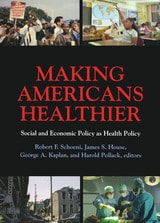
Making Americans Healthier
Social and Economic Policy as Health PolicyRobert F. Schoeni
Russell Sage Foundation, 2008
The United States spends billions of dollars annually on social and economic policies aimed at improving the lives of its citizens, but the health consequences associated with these policies are rarely considered. In Making Americans Healthier, a group of multidisciplinary experts shows how social and economic policies seemingly unrelated to medical well-being have dramatic consequences for the health of the American people. Most previous research concerning problems with health and healthcare in the United States has focused narrowly on issues of medical care and insurance coverage, but Making Americans Healthier demonstrates the important health consequences that policymakers overlook in traditional cost-benefit evaluations of social policy. The contributors examine six critical policy areas: civil rights, education, income support, employment, welfare, and neighborhood and housing. Among the important findings in this book, David Cutler and Adriana Lleras-Muney document the robust relationship between educational attainment and health, and estimate that the health benefits of education may exceed even the well-documented financial returns of education. Pamela Herd, James House, and Robert Schoeni discover notable health benefits associated with the Supplemental Security Income Program, which provides financial support for elderly and disabled Americans. George Kaplan, Nalini Ranjit, and Sarah Burgard document a large and unanticipated improvement in the health of African-American women following the enactment of civil rights legislation in the 1960s. Making Americans Healthier presents ground-breaking evidence that the health impact of many social policies is substantial. The important findings in this book pave the way for promising new avenues for intervention and convincingly demonstrate that ultimately social and economic policy is health policy. A Volume in the National Poverty Center Series on Poverty and Public Policy
[more]
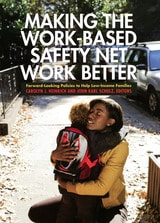
Making the Work-Based Safety Net Work Better
Forward-Looking Policies to Help Low-Income FamiliesCarolyn J. Heinrich
Russell Sage Foundation, 2009
Work first. That is the core idea behind the 1996 welfare reform legislation. It sounds appealing, but according to Making the Work-Based Safety Net Work Better, it collides with an exceptionally difficult reality. The degree to which work provides a way out of poverty depends greatly on the ability of low-skilled people to maintain stable employment and make progress toward an income that provides an adequate standard of living. This forward-looking volume examines eight areas of the safety net where families are falling through and describes how current policies and institutions could evolve to enhance the self-sufficiency of low-income families. David Neumark analyzes a range of labor market policies and finds overwhelming evidence that the minimum wage is ineffective in promoting self-sufficiency. Neumark suggests the Earned Income Tax Credit is a much more promising policy to boost employment among single mothers and family incomes. Greg Duncan, Lisa Gennetian, and Pamela Morris find no evidence that encouraging parents to work leads to better parenting, improved psychological health, or more positive role models for children. Instead, the connection between parental work and child achievement is linked to parents' improved access to quality child care. Rebecca Blank and Brian Kovak document an alarming increase in the number of single mothers who receive neither wages nor public assistance and who are significantly more likely to suffer from medical problems of their own or of a child. Time caps and work hour requirements embedded in benefits policies leave some mothers unable to work and ineligible for cash benefits. Marcia Meyers and Janet Gornick identify another gap: low-income families tend to lose financial support and health coverage long before they earn enough to access employer-based benefits and tax provisions. They propose building "institutional bridges" that minimize discontinuities associated with changes in employment, earnings, or family structure. Steven Raphael addresses a particularly troubling weakness of the work-based safety net—its inadequate provision for the large number of individuals who are or were incarcerated in the United States. He offers tractable suggestions for policy changes that could ease their transition back into non-institutionalized society and the labor market. Making the Work-Based Safety Net Work Better shows that the "work first" approach alone isn't working and suggests specific ways the social welfare system might be modified to produce greater gains for vulnerable families.
[more]
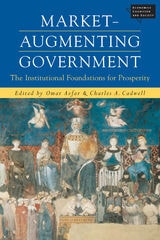
Market-Augmenting Government
The Institutional Foundations for ProsperityOmar Azfar and Charles A. Cadwell, Editors
University of Michigan Press, 2003
As recently as 1990 policymakers and academics believed widely that all that was needed for dramatic increases in prosperity in transitional economies was to roll back the state. The arguments in this book present an articulate antidote to that assertion: While the state must withdraw from many activities involving direct production and exchange, it must provide good laws and enforce them for economies to prosper. In one chapter, Robert Summers brilliantly exposes the complexity of this requirement, listing eighteen minimum conditions for the creation of the rule of law. Other chapters describe the benefits of good commercial law on economic growth, the political foundations of American commercial law, how poor governance led to the Asian financial crisis, the institutional requirements for environmental markets, and constitutional structures that lead to efficient government.
The contributors, renowned experts in their fields on the complex institutional requirements for prosperity, offer arguments from economic theory, economic history, legal theory, and political science. The chapters are simultaneously of high scholarly quality and intensely applicable. Indeed many of the ideas here are being used to design reform projects in developing countries.
Market-Augmenting Government will appeal to legal theorists, economists, and political scientists, and in particular to institutional economists. Its writing is friendly to the general reader, with only a few of the chapters requiring specialized knowledge. The book will also figure importantly in policy circles as governance moves center stage in the practice of reform and development.
Omar Azfar is Research Associate, IRIS Center, University of Maryland, College Park. Charles A. Cadwell is Director and Principle Investigator, IRIS Center, University of Maryland, College Park.
[more]

Microeconomics
A Critical CompanionBen Fine
Pluto Press, 2016
The culmination of forty years of teaching, researching, and advising on political economy, Ben Fine’s Microeconomics offers a clear and concise exposition of mainstream microeconomics from a heterodox perspective. Covering topics from consumer and producer theory to general equilibrium to perfect competition, it sets the emergence and evolution of microeconomics in both its historical and interdisciplinary context. Fine critically exposes the methodological and conceptual content of dominant microeconomic models without sacrificing the technical detail required for those completing a first degree in economics or entering postgraduate study. The result is a book which is sure to establish a strong presence on undergraduate reading lists and in comparative literature on the subject.
[more]

Models of Strategic Choice in Politics
Peter C. Ordeshook, Editor
University of Michigan Press, 1989
Discusses the sophisticated application of game theory to the development of contemporary political theory
[more]
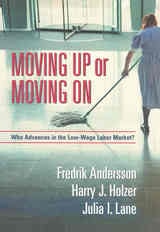
Moving Up or Moving On
Who Gets Ahead in the Low-Wage Labor Market?Fredrik Andersson
Russell Sage Foundation, 2005
For over a decade, policy makers have emphasized work as the best means to escape poverty. However, millions of working Americans still fall below the poverty line. Though many of these "working poor" remain mired in poverty for long periods, some eventually climb their way up the earnings ladder. These success stories show that the low wage labor market is not necessarily a dead end, but little research to date has focused on how these upwardly mobile workers get ahead. In Moving Up or Moving On, Fredrik Andersson, Harry Holzer, and Julia Lane examine the characteristics of both employees and employers that lead to positive outcomes for workers. Using new Census data, Moving Up or Moving On follows a group of low earners over a nine-year period to analyze the behaviors and characteristics of individuals and employers that lead workers to successful career outcomes. The authors find that, in general, workers who "moved on" to different employers fared better than those who tried to "move up" within the same firm. While changing employers meant losing valuable job tenure and spending more time out of work than those who stayed put, workers who left their jobs in search of better opportunity elsewhere ended up with significantly higher earnings in the long term—in large part because they were able to find employers that paid better wages and offered more possibilities for promotion. Yet moving on to better jobs is difficult for many of the working poor because they lack access to good-paying firms. Andersson, Holzer, and Lane demonstrate that low-wage workers tend to live far from good paying employers, making an improved transportation infrastructure a vital component of any public policy to improve job prospects for the poor. Labor market intermediaries can also help improve access to good employers. The authors find that one such intermediary, temporary help agencies, improved long-term outcomes for low-wage earners by giving them exposure to better-paying firms and therefore the opportunity to obtain better jobs. Taken together, these findings suggest that public policy can best serve the working poor by expanding their access to good employers, assisting them with job training and placement, and helping them to prepare for careers that combine both mobility and job retention strategies. Moving Up or Moving On offers a compelling argument about how low-wage workers can achieve upward mobility, and how public policy can facilitate the process. Clearly written and based on an abundance of new data, this book provides concrete, practical answers to the large questions surrounding the low-wage labor market.
[more]