Results by title
89 books match the query 'Mind & Body' and 6 start with m
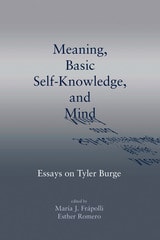
Meaning, Basic Self-Knowledge, and Mind
Essays on Tyler BurgeEdited by María Frápolli and Esther Romero
CSLI, 2003
This volume comprises a lively and thorough discussion between philosophers and Tyler Burge about Burge's recent, and already widely accepted, position in the theory of meaning, mind, and knowledge. This position is embodied by an externalist theory of meaning and an anti-individualist theory of mind and approach to self-knowledge.
The authors of the eleven papers here expound their versions of this position and go on to critique Burge's version. Together with Burge's replies, this volume offers a major contribution to contemporary philosophy.
The authors of the eleven papers here expound their versions of this position and go on to critique Burge's version. Together with Burge's replies, this volume offers a major contribution to contemporary philosophy.
[more]
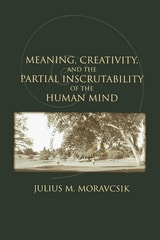
Meaning, Creativity, and the Partial Inscrutability of the Human Mind
Julius M. Moravcsik
CSLI, 1998
In this book, Julius M. Moravcsik disputes that a natural language is not and should not be represented as a formal language. The book criticizes current philosophy of language as having an altered focus without adjusting the needed conceptual tools. It develops a new theory of lexical meaning, a new conception of cognition-humans not as information processing creatures but as primarily explanation and understanding seeking creatures-with information processing as a secondary, derivative activity. In conclusion, based on the theories of lexical meaning and cognition, this work sketches an argument showing that the human understanding of human understanding must always remain just partial.
[more]
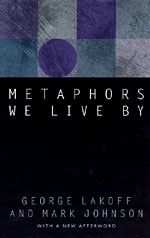
Metaphors We Live By
George Lakoff and Mark Johnson
University of Chicago Press, 1981
The now-classic Metaphors We Live By changed our understanding of metaphor and its role in language and the mind. Metaphor, the authors explain, is a fundamental mechanism of mind, one that allows us to use what we know about our physical and social experience to provide understanding of countless other subjects. Because such metaphors structure our most basic understandings of our experience, they are "metaphors we live by"—metaphors that can shape our perceptions and actions without our ever noticing them.
In this updated edition of Lakoff and Johnson's influential book, the authors supply an afterword surveying how their theory of metaphor has developed within the cognitive sciences to become central to the contemporary understanding of how we think and how we express our thoughts in language.
In this updated edition of Lakoff and Johnson's influential book, the authors supply an afterword surveying how their theory of metaphor has developed within the cognitive sciences to become central to the contemporary understanding of how we think and how we express our thoughts in language.
[more]
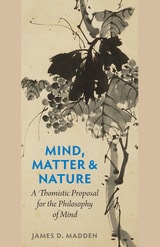
Mind, Matter, and Nature
James D. Madden
Catholic University of America Press, 2013
Written for students, Mind, Matter, and Nature presumes no prior philosophical training on the part of the reader. The book nevertheless holds the arguments discussed to rigorous standards and is conversant with recent literature, thus making it useful as well to more advanced students and professionals interested in a resource on Thomistic hylomorphism in the philosophy of mind.
[more]
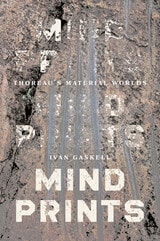
Mindprints
Thoreau's Material WorldsIvan Gaskell
University of Chicago Press, 2024
A rediscovery of Thoreau’s interactions with everyday objects and how they shaped his thought.
Though we may associate Henry David Thoreau with ascetic renunciation, he accumulated a variety of tools, art, and natural specimens throughout his life as a homebuilder, surveyor, and collector. In some of these objects, particularly Indigenous artifacts, Thoreau perceived the presence of their original makers, and he called such objects “mindprints.” Thoreau believed that these collections could teach him how his experience, his world, fit into the wider, more diverse (even incoherent) assemblage of other worlds created and re-created by other beings every day. In this book, Ivan Gaskell explores how a profound environmental aesthetics developed from this insight and shaped Thoreau’s broader thought.
Though we may associate Henry David Thoreau with ascetic renunciation, he accumulated a variety of tools, art, and natural specimens throughout his life as a homebuilder, surveyor, and collector. In some of these objects, particularly Indigenous artifacts, Thoreau perceived the presence of their original makers, and he called such objects “mindprints.” Thoreau believed that these collections could teach him how his experience, his world, fit into the wider, more diverse (even incoherent) assemblage of other worlds created and re-created by other beings every day. In this book, Ivan Gaskell explores how a profound environmental aesthetics developed from this insight and shaped Thoreau’s broader thought.
[more]
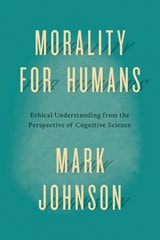
Morality for Humans
Ethical Understanding from the Perspective of Cognitive ScienceMark Johnson
University of Chicago Press, 2014
What is the difference between right and wrong? This is no easy question to answer, yet we constantly try to make it so, frequently appealing to some hidden cache of cut-and-dried absolutes, whether drawn from God, universal reason, or societal authority. Combining cognitive science with a pragmatist philosophical framework in Morality for Humans: Ethical Understanding from the Perspective of Cognitive Science, Mark Johnson argues that appealing solely to absolute principles and values is not only scientifically unsound but even morally suspect. He shows that the standards for the kinds of people we should be and how we should treat one another—which we often think of as universal—are in fact frequently subject to change. And we should be okay with that. Taking context into consideration, he offers a remarkably nuanced, naturalistic view of ethics that sees us creatively adapt our standards according to given needs, emerging problems, and social interactions.
Ethical naturalism is not just a revamped form of relativism. Indeed, Johnson attempts to overcome the absolutist-versus-relativist impasse that has been one of the most intractable problems in the history of philosophy. He does so through a careful and inclusive look at the many ways we reason about right and wrong. Much of our moral thought, he shows, is automatic and intuitive, gut feelings that we follow up and attempt to justify with rational analysis and argument. However, good moral deliberation is not limited merely to intuitive judgments supported after the fact by reasoning. Johnson points out a crucial third element: we imagine how our decisions will play out, how we or the world would change with each action we might take. Plumbing this imaginative dimension of moral reasoning, he provides a psychologically sophisticated view of moral problem solving, one perfectly suited for the embodied, culturally embedded, and ever-developing human creatures that we are.
Ethical naturalism is not just a revamped form of relativism. Indeed, Johnson attempts to overcome the absolutist-versus-relativist impasse that has been one of the most intractable problems in the history of philosophy. He does so through a careful and inclusive look at the many ways we reason about right and wrong. Much of our moral thought, he shows, is automatic and intuitive, gut feelings that we follow up and attempt to justify with rational analysis and argument. However, good moral deliberation is not limited merely to intuitive judgments supported after the fact by reasoning. Johnson points out a crucial third element: we imagine how our decisions will play out, how we or the world would change with each action we might take. Plumbing this imaginative dimension of moral reasoning, he provides a psychologically sophisticated view of moral problem solving, one perfectly suited for the embodied, culturally embedded, and ever-developing human creatures that we are.
[more]