Results by title
54 books match the query 'Money & Monetary Policy' and 17 start with m
Managing Currency Crises in Emerging Markets
Edited by Michael P. Dooley and Jeffrey A. Frankel
University of Chicago Press, 2003
The contributions here explore the management process from the beginning of a crisis to the long-term effects of the techniques used to minimize it. The first three chapters focus on the earliest responses and the immediate defense of a currency under attack, exploring whether unnecessary damage to economies can be avoided by adopting the right response within the first few days of a financial crisis. Next, contributors examine the adjustment programs that follow, considering how to design these programs so that they shorten the recovery phase, encourage economic growth, and minimize the probability of future difficulties. Finally, the last four papers analyze the actual effects of adjustment programs, asking whether they accomplish what they are designed to do-and whether, as many critics assert, they impose disproportionate costs on the poorest members of society.
Recent high-profile currency crises have proven not only how harmful they can be to neighboring economies and trading partners, but also how important policy responses can be in determining their duration and severity. Economists and policymakers will welcome the insightful evaluations in this important volume, and those of its companion, Sebastian Edwards and Jeffrey A. Frankel's Preventing Currency Crises in Emerging Markets.
Marginal Gains
Monetary Transactions in Atlantic AfricaJane I. Guyer
University of Chicago Press, 2004
The answer is a rich diversity of economic practices responsive to both local and global circumstances. In Marginal Gains, Jane I. Guyer explores and explains these often bewildering practices, including trade with coastal capitalism and across indigenous currency zones, and within the modern popular economy. Drawing on a wide range of evidence, Guyer demonstrates that the region shares a coherent, if loosely knit, commercial culture. She shows how that culture actually works in daily practice, addressing both its differing scales of value and the many settings in which it operates, from crisis conditions to ordinary household budgets. The result is a landmark study that reveals not just how popular economic systems work in Africa, but possibly elsewhere in the Third World.
Milton Friedman and Economic Debate in the United States, 1932–1972, Volume 1
Edward Nelson
University of Chicago Press, 2020
This two-volume account provides a foundational introduction to Friedman’s role in several major economic debates that took place in the United States between 1932 and 1972. The first volume, which takes the story through 1960, covers the period in which Friedman began and developed his research on monetary policy. It traces Friedman’s thinking from his professional beginnings in the 1930s as a combative young microeconomist, to his wartime years on the staff of the US Treasury, and his emergence in the postwar period as a leading proponent of monetary policy. The second volume covers the years between 1960 and 1972— years that saw the publication of Friedman and Anna Schwartz’s Monetary History of the United States. The book also covers Friedman’s involvement in a number of debates in the 1960s and 1970s, on topics such as unemployment, inflation, consumer protection, and the environment.
As a fellow monetary economist, Nelson writes from a unique vantage point, drawing on both his own expertise in monetary analysis and his deep familiarity with Friedman’s writings. Using extensive documentation, the book weaves together Friedman’s research contributions and his engagement in public debate, providing an unparalleled analysis of Friedman’s views on the economic developments of his day.
Milton Friedman and Economic Debate in the United States, 1932–1972, Volume 2
Edward Nelson
University of Chicago Press, 2020
This two-volume account provides a foundational introduction to Friedman’s role in several major economic debates that took place in the United States between 1932 and 1972. The first volume, which takes the story through 1960, covers the period in which Friedman began and developed his research on monetary policy. It traces Friedman’s thinking from his professional beginnings in the 1930s as a combative young microeconomist, to his wartime years on the staff of the US Treasury, and his emergence in the postwar period as a leading proponent of monetary policy. The second volume covers the years between 1960 and 1972— years that saw the publication of Friedman and Anna Schwartz’s Monetary History of the United States. The book also covers Friedman’s involvement in a number of debates in the 1960s and 1970s, on topics such as unemployment, inflation, consumer protection, and the environment.
As a fellow monetary economist, Nelson writes from a unique vantage point, drawing on both his own expertise in monetary analysis and his deep familiarity with Friedman’s writings. Using extensive documentation, the book weaves together Friedman’s research contributions and his engagement in public debate, providing an unparalleled analysis of Friedman’s views on the economic developments of his day.

Milton Friedman and Economic Debate in the United States, 1973–1976, Vol. 3
Edward Nelson
University of Chicago Press, 2027
The third installment in the definitive account of the famed economist's role in economic debate—and his lasting influence on economic policy.
Milton Friedman is widely recognized as one of the most significant contributors to economics in the modern age. Yet no previous study has distilled Friedman’s vast body of writings into an authoritative account of his research, his policy views, and his interventions in public debate. Through his sweeping series on the most influential economist of the second half of the twentieth century, Edward Nelson closes this gap: Milton Friedman and EconomicDebate in the United States is the defining narrative on the famed public intellectual—the first to grapple comprehensively with Friedman’s research output, economic framework, and legacy.
Volume 3 chronicles Friedman’s activities from 1973 to 1976, encompassing his final years at the University of Chicago and a period that saw his further ascension in national prominence. In the mid-1970s, economic news dominated American political discourse as the nation endured double-digit inflation and recession. It was during this time that Friedman’s views became a center of economic debate in both the research world and public debate, while his explanation for “stagflation” formed part of the critique of stabilization policy that would lead to his 1976 Nobel Prize. Nelson details the controversies that Friedman faced in the media—including his contrarian stances on inflation’s cure, the economic implications of oil price shocks, and the social responsibility of business—and how Friedman concluded that the world needed a “new Adam Smith” to press the case for free markets. Drawing upon a large body of documentary sources, interviews with dozens of the people closest to Friedman, and his own expertise in Friedman’s research area of monetary analysis, Nelson provides the definitive account of the formative (and uneven) events in Friedman’s foray into life as a public intellectual and how his research permanently shifted economic thinking.
Milton Friedman and Economic Debate in the United States, 1977–1979, Vol. 4
Edward Nelson
University of Chicago Press, 0
The fourth installment of the sweeping account of the most influential economist in modern times, focusing on his crossover into the public sphere.
Milton Friedman is widely recognized as one of the most significant contributors to economics in the modern age. Yet no previous study has distilled Friedman’s vast body of writings into an authoritative account of his research, his policy views, and his interventions in public debate. Through his sweeping series on the most influential economist of the second half of the twentieth century, Edward Nelson closes this gap: Milton Friedman and EconomicDebate in the United States is the defining narrative on the famed public intellectual—the first to grapple comprehensively with Friedman’s research output, economic framework, and legacy.
Volume 4 of Nelson’s intellectual and policy biography offers an exacting portrait of Friedman’s career following his departure from the University of Chicago. Spanning 1977 to 1979, Nelson’s narrative details Friedman’s move to California and his greater immersion in public policy, including his project with Rose Friedman and television professionals to create a TV series giving his viewpoint. Nelson details the successes and failures of Friedman’s years of extraordinary influence, including:
- His warnings about US inflation returning to double digits in 1979;
- The changes in professional thinking in the US economics profession and policymaking toward acceptance of Friedman's view that inflation is a monetary phenomenon;
- The rise of Paul Volcker to head of the Federal Reserve and his integration of monetarist ideas into US monetary policy;
- Friedman's proposal to phase in a zero-tariff arrangement in the United States;
- His role in the tax revolt of the 1970s—including his break with the emerging supply-side economics movement on the effects of tax cuts;
- The second oil-price shock and Friedman's critique of the Carter Administration's energy policy;
- The resilience after 1976 of Ronald Reagan's presidential ambitions and Friedman's 1979 endorsement of Reagan for president in the 1980 election.
Drawing upon a large body of documentary sources, interviews with dozens of the people closest to Friedman, and his own expertise in Friedman’s research area of monetary analysis, Nelson offers the definitive account of what proved to be pivotal years for Friedman and the field of economics.
Milton Friedman's Monetary Framework
A Debate with His CriticsEdited by Robert J. Gordon, with essays by Milton Friedman, Karl Brunner and All
University of Chicago Press, 1975
Because his statement was important and controversial both as a commentary on the history of economic thought and as a theoretical contribution in its own right, the Journal of Political Economy in 1972 presented critical reviews from noted monetary theorists, including Karl Brunner and Allan H. Meltzer, James Tobin, Paul Davidson, and Don Patinkin. Their studies, which are printed in the present volume, focus on substantive issues, covering a variety of topics. All of their major points are discussed in Friedman's reply, which clarifies and expands upon his original themes and introduces interesting new material. Thus the synthesis of his two articles, the critical comments, and his response, together with an introduction by Robert J. Gordon, are combined in one volume for the convenience of scholars and students.
Monetary Divergence
Domestic Policy Autonomy in the Post-Bretton Woods EraDavid H. Bearce
University of Michigan Press, 2007
"In a meticulously researched study, David Bearce demonstrates that, contrary to predictions, financial globalization has not resulted in a systematic convergence of national monetary policies. The book is a must-read for students of the political economy of international finance. Highlighting the critical role of partisan politics in determining policy outcomes, Bearce adds a new and important dimension to our understanding of the impacts of international capital mobility in the contemporary era."
—Benjamin Jerry Cohen, University of California, Santa Barbara
"Bearce offers a compelling analysis of partisan economic policy in an open economy. By analyzing both fiscal and monetary policies, Bearce extends our understanding of how the electoral imperative conditions policy behavior. His conclusions will have to be addressed in any
future debate about the topic."
—William Bernhard, University of Illinois at Urbana-Champaign
"Interest group divisions over exchange rates and macroeconomic policy have been at the center of international political economy research for about 20 years. Political scientists have studied these cleavages, focusing on the policy interests of various industry groups. On a separate but parallel track, another group of researchers explored the relationship between partisan politics and macroeconomic policy choices. In this exceptionally well researched book, Bearce integrates these two analytical traditions. Noting that industry groups are typically important organized constituents in left-wing and right-wing political parties, Bearce demonstrates how macroeconomic policy outcomes in advanced countries vary systematically with the alternation of political parties in government."
—J. Lawrence Broz, University of California, San Diego
David H. Bearce is Assistant Professor of Political Science at the University of Pittsburgh.
Monetary Policy
Edited by N. Gregory Mankiw
University of Chicago Press, 1994
Some of the papers in this volume evaluate a variety of policy rules based on monetary aggregates, nominal income, commodity prices, and other economic variables. Others analyze price behavior and inflation, particularly the short-run behavior of prices. Still others examine the monetary transmission mechanism—the channel through which the central bank's actions affect spending on goods and services—with a special focus on the reduction in bank lending that must accompany a reduction in reserves.
This new research will be of special interest to central bankers and academic economists.
Monetary Policy Rules
Edited by John B. Taylor
University of Chicago Press, 1999
Monetary Policy Rules illustrates that simple policy rules are more robust and more efficient than complex rules with multiple variables. A state-of-the-art appraisal of the fundamental issues facing the Federal Reserve Board and other central banks, Monetary Policy Rules is essential reading for economic analysts and policymakers alike.
Monetary Policy in the United States
An Intellectual and Institutional HistoryRichard H. Timberlake
University of Chicago Press, 1993
After describing the constitutional principles that the Founding Fathers laid down to prevent state and federal governments from printing money. Timberlake shows how the First and Second Banks of the United States gradually assumed the central banking powers that were originally denied them. Drawing on congressional debates, government documents, and other primary sources, he analyses the origins and constitutionality of the greenbacks and examines the evolution of clearinghouse associations as private lenders of last resort. He completes this history with a study of the legislation that fundamentally changed the power and scope of the Federal Reserve System—the Banking Act of 1935 and the Monetary Control Act of 1980.
Writing in nontechnical language, Timberlake demystifies two centuries of monetary policy. He concludes that central banking has been largely a series of politically inspired government-serving actions that have burdened the private economy.
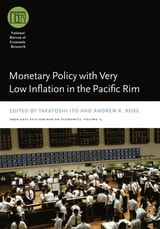
Monetary Policy with Very Low Inflation in the Pacific Rim
Edited by Takatoshi Ito and Andrew K. Rose
University of Chicago Press, 2006
The editors of this volume attribute low inflation and deflation in the region to a number of recent phenomena. Some of these episodes, they argue, may be linked to rapid growth on the supply side of economies. Here, inadequate demand policy can produce what is referred to as a "liquidity trap" in which the expectation of falling prices encourages agents to defer costly purchases, thereby discouraging growth. Low inflation rates can also be traced to the presence of a "zero-lower bound" on interest rates, as well as the inflation-targeting phenomenon. Targets have been set so low, the editors argue, that in some cases a few bad shocks lead to deflation.
Monetary Trends in the United States and the United Kingdom
Their Relations to Income, Prices, and Interest RatesMilton Friedman and Anna J. Schwartz
University of Chicago Press, 1982
Money and Society
A Critical CompanionAxel T. Paul
Pluto Press, 2021
Money in Historical Perspective
Anna J. Schwartz
University of Chicago Press, 1987
In the papers in part I, dating from 1947 to the present, Dr. Schwartz examines money and banking in the United States and the United Kingdom from a historical perspective. Her investigation of the historical evidence linking economic instability to erratic monetary behavior—this behavior itself a product of discretionary monetary policy—has led her to argue for the importance of stable money, and her writings on these issues over the last two decades form part II. The volume concludes with four recent articles on international monetary arrangements, including Dr. Schwartz's well-known work on the gold standard.
This volume of classic essays by Anna Schwartz will be a useful addition to the libraries of scholars and students for its exemplary historical research and commentary on monetary systems.
Money, History, and International Finance
Essays in Honor of Anna J. SchwartzEdited by Michael D. Bordo
University of Chicago Press, 1989
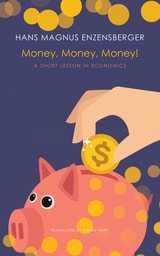
Money, Money, Money!
A Short Lesson in EconomicsHans Magnus Enzensberger
Seagull Books, 2020
The Federmanns live a pleasant but painfully normal life in the Munich suburbs. All that the three children really know about money is that there’s never enough of it in their family.
Every so often, their impish Great-Aunt Fé descends on the city. After repeated cycles of boom and bust, profligacy and poverty, the grand old lady has become enormously wealthy and lives alone in a villa on the shore of Lake Geneva. But what does Great-Aunt Fé want from the Federmanns, her only surviving relatives? This time, she invites the children to tea at her luxury hotel where she spoils, flummoxes, and inspires them. Dismayed at their ignorance of the financial ways of the world, she gives them a crash course in economics that piques their curiosity, unsettles their parents, and throws open a whole new world. The young Federmanns are for once taken seriously and together they try to answer burning questions: Where does money come from? Why are millionaires and billionaires never satisfied? And why are those with the most always showered with more?
In this rich volume, the renowned poet, translator, and essayist Hans Magnus Enzensberger turns his gimlet eye on the mechanisms and machinations of banks and politicians—the human greed, envy, and fear that fuels the global economy. A modern, but moral-less fable, Money, Money, Money! is shot through with Enzensberger’s trademark erudition, wit, and humanist desire to cut through jargon and forearm his readers against obscurantism.