Results by title
111 books match the query 'Museum Studies' and 9 start with m
Memories before the State
Postwar Peru and the Place of Memory, Tolerance, and Social InclusionJoseph P. Feldman
Rutgers University Press, 2021
Memories before the State examines the discussions and debates surrounding the creation of the Place of Memory, Tolerance, and Social Inclusion (LUM), a national museum in Peru that memorializes the country’s internal armed conflict of the 1980s and 1990s. Emerging from a German donation that the Peruvian government initially rejected, the Lima-based museum project experienced delays, leadership changes, and limited institutional support as planners and staff devised strategies that aligned the LUM with a new class of globalized memorial museums and responded to political realities of the country’s postwar landscape. The book analyzes forms of authority that emerge as an official institution seeks to incorporate and manage diverse perspectives on recent violence.
Methods and Methodologies in Heritage Studies
Edited by Rachel King and Trinidad Rico
University College London, 2024
Methods and Methodologies in Heritage Studies offers succinct and accessible analyses of the current debates, intellectual legacies, and practical innovations on heritage value today. Using archaeology, anthropology, history, and geography, this multidisciplinary textbook is designed to support students, researchers, and practitioners, inviting them to review discussions of key problems and argumentative interventions in heritage studies.
Mining in the Museum
Mineral Technology on Display in American HistoryEric C. Nystrom
University of Massachusetts Press, 2027
Examining 150 years of mining and mineral technology exhibits at the Smithsonian
Buried deep underground or cut into remote landscapes, mines are often dirty, dark, and dangerous places, located far from the everyday urban spaces that most Americans call home. Yet mining is foundational to the making of the United States, supplying the raw materials that built its infrastructure, powered its industries, and shaped its scientific institutions, even as the work itself has remained physically removed, technically complex, and culturally overlooked. Mining in the Museum reveals how Americans have encountered this vital industry not at the distant mine face, but in museum galleries. Tracing more than 150 years of mining and mineral technology exhibits at the Smithsonian Institution in Washington, DC, Eric C. Nystrom shows how curators transformed ore, instruments, models, and machinery into stories about progress, innovation, and national development, and how those interpretive choices shaped what the nation remembers—and forgets—about mining.
Using mining collections as a lens into institutional change, Nystrom offers a new history of the Smithsonian and its United States National Museum, examining how curators, administrators, and policymakers debated what museums were for, which kinds of knowledge they should produce, and what objects deserved display. He follows the shifting fortunes of mineral and mining exhibits across world’s fairs, scientific surveys, and changing exhibition philosophies, showing how display strategies evolved alongside professional science and public education. As mining’s place in the national imagination changed, so too did its presence in the federal museum, moving from a central scientific and technological showcase to a subject increasingly preserved by regional and local institutions closer to mining communities themselves. Grounded in extensive archival research, Mining in the Museum illuminates the evolving relationship among technology, public history, and the politics of display, demonstrating how museums help define which industries, and which kinds of work, become part of the American story.
Mobile Museums
Collections in CirculationEdited by Felix Driver, Mark Nesbitt, and Caroline Cornish
University College London, 2021
How did the process of the circulation re-examine, inform, and unsettle common assumptions about the way museum collections have evolved over time and space? Mobile Museums presents an argument for the importance of circulation in the study of museum collections, both past and present. It brings together a diverse array of international scholars and curators from a variety of disciplines to consider the mobility of collections, especially in the context of Indigenous community engagement. By foregrounding the question of circulation, the book represents a paradigm shift in the understanding of the history and future uses of museum collections. Taking on a global perspective and addressing a variety of types of collection, including the botanical, ethnographic, economic, and archaeological, the book helps us to understand why the mobility of museum collections was a fundamental aspect of their history—and why it continues to matter today.
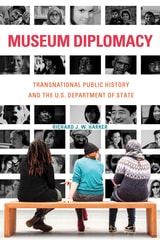
Museum Diplomacy
Transnational Public History and the U.S. Department of StateRichard J. W. Harker
University of Massachusetts Press, 2020
As more historic sites and museums seek to surmount social, cultural, and economic barriers between themselves and their communities in their exhibitions and programming, the Museums Connect program provides important lessons on how to overcome entrenched hierarchies of power in public history.
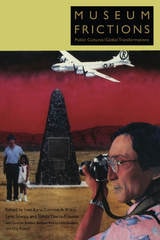
Museum Frictions
Public Cultures/Global TransformationsIvan Karp, Corinne A. Kratz, Lynn Szwaja, and Tomás Ybarra-Frausto With Gustavo Buntinx, Barbara Kirshenblatt-Gimblett, and Ciraj Rassool, eds.
Duke University Press, 2006
Whether contrasting the transformation of Africa’s oldest museum, the South Africa Museum, with one of its newest, the Lwandle Migrant Labor Museum; offering an interpretation of the audio guide at the Guggenheim Bilbao; reflecting on the relative paucity of art museums in Peru and Cambodia; considering representations of slavery in the United States and Ghana; or meditating on the ramifications of an exhibition of Australian aboriginal art at the Asia Society in New York City, the contributors highlight the frictions, contradictions, and collaborations emerging in museums and heritage sites around the world. The volume opens with an extensive introductory essay by Ivan Karp and Corinne A. Kratz, leading scholars in museum and heritage studies.
Contributors. Tony Bennett, David Bunn, Gustavo Buntinx, Cuauhtémoc Camarena, Andrea Fraser, Martin Hall, Ivan Karp, Barbara Kirshenblatt-Gimblett, Corinne A. Kratz, Christine Mullen Kreamer, Joseph Masco, Teresa Morales, Howard Morphy, Ingrid Muan, Fred Myers, Ciraj Rassool, Vicente Razo, Fath Davis Ruffins, Lynn Szwaja, Krista A. Thompson, Leslie Witz, Tomás Ybarra-Frausto
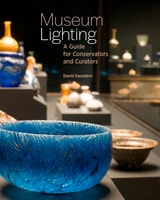
Museum Lighting
A Guide for Conservators and CuratorsDavid Saunders
J. Paul Getty Trust, The, 2020
Author David Saunders, former keeper of conservation and scientific research at the British Museum, explores how to balance the conflicting goals of visibility and preservation under a variety of conditions. Beginning with the science of how light, color, and vision function and interact, he proceeds to offer detailed studies of the impact of light on a wide range of objects, including paintings, manuscripts, textiles, bone, leather, and plastics.
With analyses of the effects of light on visibility and deterioration, Museum Lighting provides practical information to assist curators, conservators, and other museum professionals in making critical decisions about the display and preservation of objects in their collections.

Museum Pieces
Collectors and CollectionNeil Harris
University of Chicago Press, 0
An eminent historian assembles a career-long group of essays about art collecting and the leadership, strategies, and shifting cultural power of American art museums as they have emerged over the past 150 years.
Museums and their cultural power, and the vagaries of collecting in the United States have fascinated University of Chicago historian Neil Harris for more than sixty years. In this collection of eighteen lively essays from across his distinguished career, Harris addresses period rooms, visitor research, museum education, museum branding and merchandising, and the persistent influence of individual collectors and patrons such as J. Pierpont Morgan, among other important topics. Harris’s geographical range is broad, too, with considerations of museums in Boston, New York, Washington, D.C., Toledo, Chicago, Denver, and elsewhere.
Harris remains one of a very small number of art-minded scholars whose work on museums, taste, and collecting not only can be read by other historians of the United States but can be read with real profit. In a rich and reflective introduction, Harris connects his deep interest in recurring subjects to both his own intellectual biography and broader trends in American scholarship.
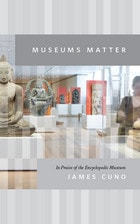
Museums Matter
In Praise of the Encyclopedic MuseumJames Cuno
University of Chicago Press, 2011
The concept of an encyclopedic museum was born of the Enlightenment, a manifestation of society’s growing belief that the spread of knowledge and the promotion of intellectual inquiry were crucial to human development and the future of a rational society. But in recent years, museums have been under attack, with critics arguing that they are little more than relics and promoters of imperialism. Could it be that the encyclopedic museum has outlived its usefulness?
With Museums Matter, James Cuno, president and director of the Art Institute of Chicago, replies with a resounding “No!” He takes us on a brief tour of the modern museum, from the creation of the British Museum—the archetypal encyclopedic collection—to the present, when major museums host millions of visitors annually and play a major role in the cultural lives of their cities. Along the way, Cuno acknowledges the legitimate questions about the role of museums in nation-building and imperialism, but he argues strenuously that even a truly national museum like the Louvre can’t help but open visitors’ eyes and minds to the wide diversity of world cultures and the stunning art that is our common heritage. Engaging with thinkers such as Edward Said and Martha Nussbaum, and drawing on examples from the politics of India to the destruction of the Bramiyan Buddhas to the history of trade and travel, Cuno makes a case for the encyclopedic museum as a truly cosmopolitan institution, promoting tolerance, understanding, and a shared sense of history—values that are essential in our ever more globalized age.
Powerful, passionate, and to the point, Museums Matter is the product of a lifetime of working in and thinking about museums; no museumgoer should miss it.