Results by title
72 books match the query 'Museums' and 11 start with m
Made in Newark
Cultivating Industrial Arts and Civic Identity in the Progressive EraShales, Ezra
Rutgers University Press, 2010
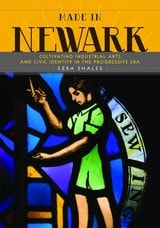
This is the story of experimental exhibitions in the library and the founding of the Newark Museum Associationùa project in which cultural literacy was intertwined with civics and consumption. Local artisans demonstrated crafts, connecting the cultural institution to the department store, school, and factory, all of which invoked the ideal of municipal patriotism. Today, as cultural institutions reappraise their relevance, Made in Newark explores precedents for contemporary debates over the ways the library and museum engage communities, define heritage in a multicultural era, and add value to the economy.
Massachusetts Treasures
A Guide to Marvelous, Must-See MuseumsChuck D'Imperio
University of Massachusetts Press, 2018
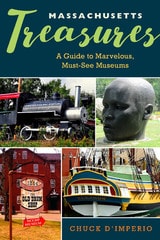
Well known for its world-renowned art museums—from the Clark Art Institute in Williamstown to the Museum of Fine Arts in Boston—Massachusetts is also home to numerous institutions with more eclectic collections and, oftentimes, lower profiles. These include Mansfield's National Black Doll Museum of History and Culture, Watertown's Plumbing Museum, and Granville's Noble and Cooley Center for Historic Preservation.
In Massachusetts Treasures, Chuck D'Imperio explores more than forty museums scattered throughout the Bay State, from Cape Cod to the Berkshires. Many—but not all—might be considered “offbeat,” and each and every one is enchanting. Through personal visits and interviews with founders and directors, D'Imperio offers an inside glimpse into some of the Commonwealth's most unique museums, providing a valuable guide for road warriors and history buffs discovering Massachusetts either for the first or the tenth time.
Mediating Knowledges
Origins of a Zuni Tribal MuseumGwyneira Isaac
University of Arizona Press, 2007
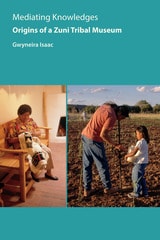
These personal narratives provide insight into the diversity of perspectives found within the community, as well as tracing the ongoing negotiation of the relationship between Zuni and Anglo-American cultures. In particular, Isaac examines how Zunis, who transmit knowledge about their history through oral tradition and initiation into religious societies, must navigate the challenge of utilizing Anglo-American museum practices, which privilege technology that aids the circulation of knowledge beyond its original narrators.
This book provides a much-needed contemporary ethnography of a Pueblo community recognized for its restrictive approach to outside observers. The complex interactions between Zunis and anthropologists explored here, however, reveal not only Puebloan but also Anglo-American attitudes toward secrecy and the control of knowledge.
Museum Diplomacy
Transnational Public History and the U.S. Department of StateRichard J. W. Harker
University of Massachusetts Press, 2020
As more historic sites and museums seek to surmount social, cultural, and economic barriers between themselves and their communities in their exhibitions and programming, the Museums Connect program provides important lessons on how to overcome entrenched hierarchies of power in public history.
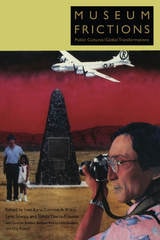
Museum Frictions
Public Cultures/Global TransformationsIvan Karp, Corinne A. Kratz, Lynn Szwaja, and Tomás Ybarra-Frausto With Gustavo Buntinx, Barbara Kirshenblatt-Gimblett, and Ciraj Rassool, eds.
Duke University Press, 2006
Whether contrasting the transformation of Africa’s oldest museum, the South Africa Museum, with one of its newest, the Lwandle Migrant Labor Museum; offering an interpretation of the audio guide at the Guggenheim Bilbao; reflecting on the relative paucity of art museums in Peru and Cambodia; considering representations of slavery in the United States and Ghana; or meditating on the ramifications of an exhibition of Australian aboriginal art at the Asia Society in New York City, the contributors highlight the frictions, contradictions, and collaborations emerging in museums and heritage sites around the world. The volume opens with an extensive introductory essay by Ivan Karp and Corinne A. Kratz, leading scholars in museum and heritage studies.
Contributors. Tony Bennett, David Bunn, Gustavo Buntinx, Cuauhtémoc Camarena, Andrea Fraser, Martin Hall, Ivan Karp, Barbara Kirshenblatt-Gimblett, Corinne A. Kratz, Christine Mullen Kreamer, Joseph Masco, Teresa Morales, Howard Morphy, Ingrid Muan, Fred Myers, Ciraj Rassool, Vicente Razo, Fath Davis Ruffins, Lynn Szwaja, Krista A. Thompson, Leslie Witz, Tomás Ybarra-Frausto
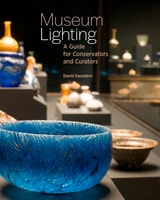
Museum Lighting
A Guide for Conservators and CuratorsDavid Saunders
J. Paul Getty Trust, The, 2020
Author David Saunders, former keeper of conservation and scientific research at the British Museum, explores how to balance the conflicting goals of visibility and preservation under a variety of conditions. Beginning with the science of how light, color, and vision function and interact, he proceeds to offer detailed studies of the impact of light on a wide range of objects, including paintings, manuscripts, textiles, bone, leather, and plastics.
With analyses of the effects of light on visibility and deterioration, Museum Lighting provides practical information to assist curators, conservators, and other museum professionals in making critical decisions about the display and preservation of objects in their collections.
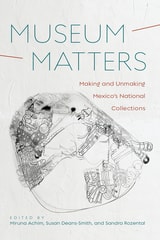
Museum Matters
Making and Unmaking Mexico’s National CollectionsEdited by Miruna Achim, Susan Deans-Smith, Sandra Rozental
University of Arizona Press, 2021
Museum Matters traces the emergence, consolidation, and dispersal of this national museum complex by telling the stories of its objects. Objects that have been separated over time are brought back together in this book in order to shed light on the interactions and processes that have forged things into symbols of science, aesthetics, and politics. The contributors to this volume illuminate how collections came into being or ceased to exist over time, or how objects moved in and out of collections and museum spaces. They explore what it means to move things physically and spatially, as well as conceptually and symbolically.
Museum Matters unravels the concept of the national museum. By unmaking the spaces, frameworks, and structures that form the complicated landscape of national museums, this volume brings a new way to understand the storage, displays, and claims about the Mexican nation’s collections today.
Contributors
Miruna Achim, Christina Bueno, Laura Cházaro, Susan Deans-Smith, Frida Gorbach, Haydeé López Hernández, Carlos Mondragón, Bertina Olmedo Vera, Sandra Rozental, Mario Rufer
Museum Politics
Power Plays At The ExhibitionTimothy W. Luke
University of Minnesota Press, 2002
The first sustained critique of the ways museum exhibits shape cultural assumptions and political values
Each year the more than seven thousand museums in the United States attract more attendees than either movies or sports. Yet until recently, museums have escaped serious political analysis. The past decade, however, has witnessed a series of unusually acrimonious debates about the social, political, and moral implications of museum exhibitions as varied as the Enola Gay display at the Smithsonian’s Air and Space Museum and the Sensation exhibit at the Brooklyn Museum of Art.
In this important volume, Timothy W. Luke explores museums’s power to shape collective values and social understandings, and argues persuasively that museum exhibitions have a profound effect on the body politic. Through discussions of topics ranging from how the National Holocaust Museum and the Museum of Tolerance in Los Angeles have interpreted the Holocaust to the ways in which the American Museum of Natural History, the Missouri Botanical Gardens, and Tucson’s Arizona-Sonora Desert Museum have depicted the natural world, Luke exposes the processes through which museums challenge but more often affirm key cultural and social realities.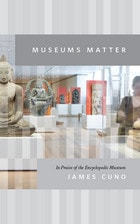
Museums Matter
In Praise of the Encyclopedic MuseumJames Cuno
University of Chicago Press, 2011
The concept of an encyclopedic museum was born of the Enlightenment, a manifestation of society’s growing belief that the spread of knowledge and the promotion of intellectual inquiry were crucial to human development and the future of a rational society. But in recent years, museums have been under attack, with critics arguing that they are little more than relics and promoters of imperialism. Could it be that the encyclopedic museum has outlived its usefulness?
With Museums Matter, James Cuno, president and director of the Art Institute of Chicago, replies with a resounding “No!” He takes us on a brief tour of the modern museum, from the creation of the British Museum—the archetypal encyclopedic collection—to the present, when major museums host millions of visitors annually and play a major role in the cultural lives of their cities. Along the way, Cuno acknowledges the legitimate questions about the role of museums in nation-building and imperialism, but he argues strenuously that even a truly national museum like the Louvre can’t help but open visitors’ eyes and minds to the wide diversity of world cultures and the stunning art that is our common heritage. Engaging with thinkers such as Edward Said and Martha Nussbaum, and drawing on examples from the politics of India to the destruction of the Bramiyan Buddhas to the history of trade and travel, Cuno makes a case for the encyclopedic museum as a truly cosmopolitan institution, promoting tolerance, understanding, and a shared sense of history—values that are essential in our ever more globalized age.
Powerful, passionate, and to the point, Museums Matter is the product of a lifetime of working in and thinking about museums; no museumgoer should miss it.
Museums and American Intellectual Life, 1876-1926
Steven Conn
University of Chicago Press, 1998
"Conn is an enthusiastic advocate for his subject, an appealing thinker, an imaginative researcher, a scholar at ease with theory and with empirical evidence." —Ann Fabian, Reviews in American History
"Steven Conn's masterly study of late-nineteenth century American museums transports the reader to a strange and wonderful intellectual universe. . . . At the end of the day, Conn reminds us, objects still have the power to fascinate, attract, evoke, and, in the right context, explain." —Christopher Clarke-Hazlett, Journal of American History
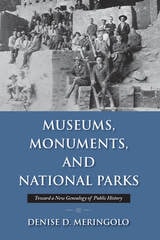
Museums, Monuments, and National Parks
Toward a New Genealogy of Public HistoryDenise D. Meringolo
University of Massachusetts Press, 2012
All of these developments included interpretive activities that shaped public understanding of the past. Yet it was not until the emergence of the education-oriented National Park Service history program in the 1920s and 1930s that public history found an institutional home that grounded professional practice simultaneously in the values of the emerging discipline and in government service. Even thereafter, tensions between administrators in Washington and practitioners on the ground at National Parks, monuments, and museums continued to define and redefine the scope and substance of the field. The process of definition persists to this day, according to Meringolo, as public historians establish a growing presence in major universities throughout the United States and abroad.