Results by title
57 books match the query 'National characteristics, American' and 4 start with m
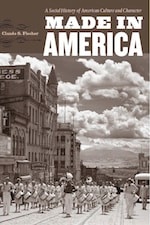
Made in America
A Social History of American Culture and CharacterClaude S. Fischer
University of Chicago Press, 2010
Our nation began with the simple phrase, “We the People.” But who were and are “We”? Who were we in 1776, in 1865, or 1968, and is there any continuity in character between the we of those years and the nearly 300 million people living in the radically different America of today?
With Made in America, Claude S. Fischer draws on decades of historical, psychological, and social research to answer that question by tracking the evolution of American character and culture over three centuries. He explodes myths—such as that contemporary Americans are more mobile and less religious than their ancestors, or that they are more focused on money and consumption—and reveals instead how greater security and wealth have only reinforced the independence, egalitarianism, and commitment to community that characterized our people from the earliest years. Skillfully drawing on personal stories of representative Americans, Fischer shows that affluence and social progress have allowed more people to participate fully in cultural and political life, thus broadening the category of “American” —yet at the same time what it means to be an American has retained surprising continuity with much earlier notions of American character.
Firmly in the vein of such classics as The Lonely Crowd and Habits of the Heart—yet challenging many of their conclusions—Made in America takes readers beyond the simplicity of headlines and the actions of elites to show us the lives, aspirations, and emotions of ordinary Americans, from the settling of the colonies to the settling of the suburbs.

Mencken’s America
H. L. MenckenS. T. Joshi
Ohio University Press, 2004
Long famous as a political, social, and cultural gadfly, journalist and essayist H. L. Mencken was unafraid to speak his mind on controversial topics and to express his views in a deliberately provocative manner.
Mencken was prolific; much of his best work lies buried in the newspapers and magazines in which it originally appeared. Mencken’s America is a sampling of this uncollected work, arranged to present the wide-ranging treatise on American culture that Mencken himself never wrote.
The core of the book is a series of six articles on “The American” published in the Smart Set in 1913-14. Never before reprinted, they embody the essence of Mencken’s views on the deficiencies of his countrymen.
What was the problem with America? For Mencken, it could be summed up in one word: Puritanism. Puritanism accounted for much that was wrong with American culture: the prevalence of “militant morality” represented by Prohibition, by campaigns against prostitution, and by religious fundamentalism. American hostility toward the fine arts led to furious attempts to suppress any work of art that was thought to contravene conventional morality-attempts that Mencken chronicles with impressive scholarship in the essay “Puritanism as a Literary Force.”
Mencken reserved his greatest scorn for American political institutions. Opposed to the very principle of democracy and universal suffrage, he maintained that, in the absence of an educated electorate, all politicians are compelled to become demagogues.
Bracing, infuriating, and pungent, H. L. Mencken’s writings retain their relevance even after the passage of nearly a hundred years, cogently discussing issues with which Americans of the twenty-first century are still wrestling. Sagaciously edited by S. T. Joshi, one of the country’s foremost Mencken scholars, Mencken’s America is a superb example of America’s turning the looking glass on itself.
Mexican Americans and Language
Del dicho al hechoGlenn A. Martínez
University of Arizona Press, 2006
This book offers an overview of some of the central issues in the Mexican American language experience, describing it in terms of both bilingualism and minority status. It is the first book to focus on the historical, social, political, and structural aspects of multiple languages in the Mexican American experience and to address the principles and methods of applied sociolinguistic research in the Mexican American community. Spanish and non-Spanish speakers in the Mexican American community share a common set of social and ethnic bonds. They also share a common experience of bilingualism.
As Martínez observes, the ideas that have been constructed around bilingualism are as important to understanding the Mexican American language experience as bilingualism itself. Mexican Americans and Language gives students the background they need to respond to the multiple social problems that can result from the language differences that exist in the Mexican American community. By showing students how to go from word to deed (del dicho al hecho), it reinforces the importance of language for their community, and for their own lives and futures.
Myths America Lives By
White Supremacy and the Stories That Give Us MeaningRichard T. Hughes
University of Illinois Press, 2018