Results by title
405 books match the query 'Natural history' and 13 start with m
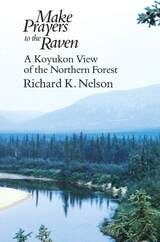
Make Prayers to the Raven
A Koyukon View of the Northern ForestRichard K. Nelson
University of Chicago Press, 1986
A powerful account of the deep connection between the Koyukon people of western Alaska and the natural world that sustains them
A blending of ethnography, personal reflections, and natural history, Make Prayers to the Raven is a moving account of the Koyukon people of western Alaska, who follow a traditional lifeway of hunting, trapping, and fishing in remote villages scattered across the boreal forest. Intimacy with nature is the foundation of their existence, and they have accumulated a masterly knowledge of their environment. The Koyukon hunter moves through a watchful forest, kills with humility and respect, and treats his catch as a being filled with power.
In Make Prayers to the Raven, Nelson describes, from a Koyukon point of view, , elements of the earth, sky, and atmosphere of the boreal forest, as well as the significant plants and animals. He retells their origins in the dreamlike Distant Time, their spirit powers, their behavior and personality, and the rules dictating their proper treatment by men and women. Make Prayers to the Raven leads the reader to an appreciation of the power and substantiality of Koyukon beliefs, and it serves the Koyukon people themselves by educating others about their way of life and by providing the Koyukon with a means of passing on traditional knowledge to their children.
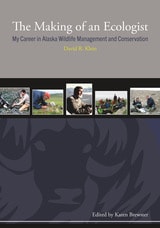
Making of an Ecologist
My Career in Alaska Wildlife Management and ConservationDavid R. Klein
University of Alaska Press, 2019
The first portion of the book is comprised of stories from Klein’s life collected during oral history interviews, while the latter section contains essays written by Klein about philosophical topics of importance to him, such as eco-philosophy, the definition of wilderness, and the morality of hunting.
Many of Klein’s graduate students have gone on to become successful wildlife managers themselves, in Alaska and around the globe. Through The Making of an Ecologist, Klein’s outlook, philosophy, and approach toward sustainability, wildlife management, and conservation can now inspire even more readers to ensure the survival of our fragile planet in an ever-changing global society.
Malibu Diary
Notes From An Urban RefugeePenelope O'Malley
University of Nevada Press, 2004
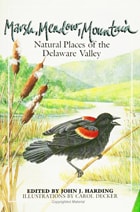
Marsh Meadow Mountain
edited by John J. Harding, illustrated by Carol Decker
Temple University Press, 1986
Stretching from the craggy reaches of the Pocono Mountains to the rolling farmlands of Lancaster County, Pennsylvania, sprawling east across the Delaware River basin and New Jersey’s coastal plain Atlantic beaches—here is a land of rich historical, cultural, and environmental diversity. Few other locales in the United States have as many varied habitats, each with its own distinctive vegetation and wildlife. The nature lover in the Delaware Valley can travel from ocean, across barrier-beaches, salt-water and fresh-water marshes, pine barrens, deciduous woodlands and fields, to mountains, all in a few hours.
Marsh, Meadow, Mountain, a combination tour guide and ecological primer, is written for the thousands of people in the area with an interest in natural history or for those seeking alternative recreational activities. Each chapter, written by an experienced naturalist intimately familiar with one of the seven major ecosystems, introduces the reader to the dynamic interrelationships in nature, the interactions between a particular habitat and its inhabitants, and its plants and wildlife. Over 135 locations are described including the Pocono Mountains, the Pine Barrens, Stone Harbor, Delaware Water Gap National Recreation Area, Ridley Creek State Park, Tyler Arboretum, and Tinicum National Environmental Center, which in any season can provide fascinating viewing opportunities depending upon your interests. Each site also includes addresses, directions, trail maps, artistic drawings, and a suggested reading list.
Marsh, Meadow, Mountain conveys both a sense of fun and learning and, ultimately, will instill in the reader a special intimacy with the Delaware Valley’s precious wild places.
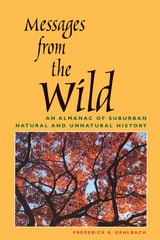
Messages from the Wild
An Almanac of Suburban Natural and Unnatural HistoryBy Frederick R. Gehlbach
University of Texas Press, 2002
Seeking a closer connection with nature than the manicured lawns of suburbia, naturalist Fred Gehlbach and his family built a house on the edge of a wooded ravine in Central Texas in the mid-1960s. On daily walks over the hills, creek hollows, and fields of the ravine, Gehlbach has observed the cycles of weather and seasons, the annual migrations of birds, and the life cycles of animals and plants that also live in the ravine.
In this book, Gehlbach draws on thirty-five years of journal entries to present a composite, day-by-day almanac of the life cycles of this semiwild natural island in the midst of urban Texas. Recording such events as the hatching of Eastern screech owl chicks, the emergence of June bugs, and the first freeze of November, he reminds us of nature's daily, monthly, and annual cycles, from which humans are becoming ever more detached in our unnatural urban environments. The long span of the almanac also allows Gehlbach to track how local and even global developments have affected the ravine, from scars left by sewer construction to an increase in frost-free days probably linked to global warming.
This long-term record of natural cycles provides one of only two such baseline data sets for North America. At the same time, the book is an eloquent account of one keen observer's daily interactions with his wild and human neighbors and of the lessons in connectedness and the "play of life" that they teach.
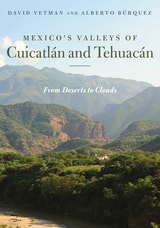
Mexico’s Valleys of Cuicatlán and Tehuacán
From Deserts to CloudsDavid Yetman and Alberto Búrquez
University of Arizona Press, 2023
Through firsthand experience and engaging prose, the authors provide a synthesis of the geology, ecology, history, and cultures of the valleys, showing their importance and influence as Mesoamerican arteries for environmental and cultural interchange through Mexico. It also reveals the extraordinary plant life that draws from habitats ranging from deserts to tropical forests.
The authors, both experts in their respective fields, begin with a general description of the geography of the valleys, followed by an introduction to climate and hydrology, a look at the valleys’ often bewildering geology. The book delves into cultural and linguistic backgrounds of the valleys and discusses archaeological sites that that encapsulate the valleys’ fascinating history prior to the arrival of Europeans. The book concludes by describing the flora that makes the region so singular.

Missionary Scientists
Jesuit Science in Spanish South America, 1570-1810Andres I. Prieto
Vanderbilt University Press, 2011
What becomes clear throughout Missionary Scientists is that early missionaries were adept in adapting to local practices, in order to both understand the scientific foundations of these techniques and ingratiate themselves to the native communities.
Spanning the disciplines of history, religion, and Latin American studies, Missionary Scientists reshapes our understanding of the importance of the Jesuit missions in establishing early scientific traditions in the New World.
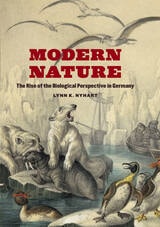
Modern Nature
The Rise of the Biological Perspective in GermanyLynn K. Nyhart
University of Chicago Press, 2009
In Modern Nature,Lynn K. Nyhart traces the emergence of a “biological perspective” in late nineteenth-century Germany that emphasized the dynamic relationships among organisms, and between organisms and their environment. Examining this approach to nature in light of Germany’s fraught urbanization and industrialization, as well the opportunities presented by new and reforming institutions, she argues that rapid social change drew attention to the role of social relationships and physical environments in rendering a society—and nature—whole, functional, and healthy.
This quintessentially modern view of nature, Nyhart shows, stood in stark contrast to the standard naturalist’s orientation toward classification. While this new biological perspective would eventually grow into the academic discipline of ecology, Modern Nature locates its roots outside the universities, in a vibrant realm of populist natural history inhabited by taxidermists and zookeepers, schoolteachers and museum reformers, amateur enthusiasts and nature protectionists.
Probing the populist beginnings of animal ecology in Germany, Nyhart unites the history of popular natural history with that of elite science in a new way. In doing so, she brings to light a major orientation in late nineteenth-century biology that has long been eclipsed by Darwinism.

Modern Oceans, Ancient Sites
Archaeology and Marine Conservation on San Miguel Island, CaliforniaTodd J Braje
University of Utah Press, 2010
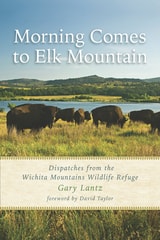
Morning Comes to Elk Mountain
Dispatches from the Wichita Mountains Wildlife RefugeGary Lantz
University of North Texas Press, 2013
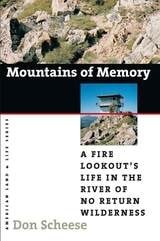
Mountains Of Memory
A Fire Lookout'S LifeDon Scheese
University of Iowa Press, 2001
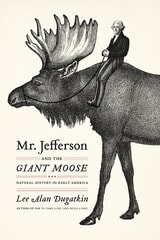
Mr. Jefferson and the Giant Moose
Natural History in Early AmericaLee Alan Dugatkin
University of Chicago Press, 2009
In the years after the Revolutionary War, the fledgling republic of America was viewed by many Europeans as a degenerate backwater, populated by subspecies weak and feeble. Chief among these naysayers was the French Count and world-renowned naturalist Georges-Louis Leclerc de Buffon, who wrote that the flora and fauna of America (humans included) were inferior to European specimens.
Thomas Jefferson—author of the Declaration of Independence, U.S. president, and ardent naturalist—spent years countering the French conception of American degeneracy. His Notes on Virginia systematically and scientifically dismantled Buffon’s case through a series of tables and equally compelling writing on the nature of his home state. But the book did little to counter the arrogance of the French and hardly satisfied Jefferson’s quest to demonstrate that his young nation was every bit the equal of a well-established Europe. Enter the giant moose.
The American moose, which Jefferson claimed was so enormous a European reindeer could walk under it, became the cornerstone of his defense. Convinced that the sight of such a magnificent beast would cause Buffon to revise his claims, Jefferson had the remains of a seven-foot ungulate shipped first class from New Hampshire to Paris. Unfortunately, Buffon died before he could make any revisions to his Histoire Naturelle, but the legend of the moose makes for a fascinating tale about Jefferson’s passion to prove that American nature deserved prestige.
In Mr. Jefferson and the Giant Moose, Lee Alan Dugatkin vividly recreates the origin and evolution of the debates about natural history in America and, in so doing, returns the prize moose to its rightful place in American history.
My Wrangell Mountains
Ruedi Homberger, Jon and Jona Van Zyle
University of Alaska Press, 2011