Results by title
129 books match the query 'Natural resources' and 5 start with m
Man Who Thought He Owned Water
On the Brink with American Farms, Cities, and FoodTershia d'Elgin
University Press of Colorado, 2016
When her father bought his farm—Big Bend Station—he also bought the ample water rights associated with the land and the South Platte River, confident that he had secured the necessary resources for a successful endeavor. Yet water immediately proved fickle, hard to defend, and sometimes dangerous. Eventually those rights were curtailed without compensation. Through her family’s story, d’Elgin dramatically frames the personal-scale implications of water competition, revealing how water deals, infrastructure, transport, and management create economic growth but also sever human connections to Earth’s most vital resource. She shows how water flows to cities at the expense of American-grown food, as rural land turns to desert, wildlife starves, the environment degrades, and climate change intensifies.
Depicting deep love, obsession, and breathtaking landscape, The Man Who Thought He Owned Water is an impassioned call to rebalance our relationship with water. It will be of great interest to anyone seeking to understand the complex forces affecting water resources, food supply, food security, and biodiversity in America.
Managing the Environmental Crisis
Incorporating Competing Values in Natural Resource AdministrationWilliam R. Mangun and Daniel H. Henning
Duke University Press, 1999
With a new foreword by Lynton Keith Caldwell
In Managing the Environmental Crisis William R. Mangun and Daniel H. Henning provide a balanced and comprehensive guide to the management of complex environmental and natural resource policy issues. Taking into account new developments, trends, and issues that have arisen in recent years, the authors begin with the recognition, often overlooked, that it is not the environment that needs to be managed but human action relating to the environment.
The authors review issues associated with a range of environmental policy concerns, including energy considerations, renewable and non renewable resource management, pollution control, wilderness management, and urban and regional policy. The history of these issues, recent actions pertaining to their management, difficulties associated with their continued presence, and the consequences of a failure to address these concerns are explored. Though focused on specific political issues, Mangun and Henning direct their attention to two large-scale trends—globalization and the political polarization of the environmental movement. At the level of the decision-making process, the incorporation of values—specifically addressed from multicultural and cross-disciplinary perspectives—is also discussed. International in scope, the book provides descriptions of the roles of both governmental and nongovernmental organizations in the formulations and implementation of national and global environmental policy.
This thoroughly revised second edition discusses various successes in the arenas of environmental cooperation and management strategy while pointing to the new challenges that have emerged in the last decade.
Mapping Abundance for a Planetary Future
Kanaka Maoli and Critical Settler Cartographies in Hawai'iCandace Fujikane
Duke University Press, 2021
Measuring and Accounting for Environmental Public Goods
A National Accounts PerspectiveEdited by Nicholas Z. Muller, Eli P. Fenichel, and Mary Bohman
University of Chicago Press, 2025
Provides strategies and approaches for integrating natural capital into environmental statistics.
While the importance of natural resources and the contributions of the environment to welfare are apparent, traditional national income and wealth accounting practices do not measure or value environmental public goods. This volume examines the conceptual and empirical basis for integrating natural capital—forests, oceans, and air—into the economic and environmental statistics that inform public policy. It offers innovative approaches to valuing nonmarket environmental goods and services, including strategies for capturing heterogeneity in measurement across types of capital, geography, and individuals.
The chapters focus on measuring productivity with adjustments for pollution damage, developing a microdata infrastructure to advance our understanding of the distribution of environmental amenities and hazards, and estimating long-run sustainable development indicators. Case studies consider coastal assets, forests, and marine ecosystems, and develop strategies for implementing specific environmental-economic accounts such as environmental activity accounts and natural capital accounts for forests and the marine economy. As national income accounting standards are updated to incorporate expanded guidance on issues related to natural capital, this timely book will help inform decisions on the measurement and treatment of climate, air, water, and other public goods.
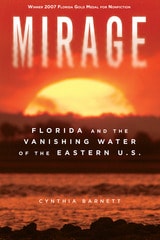
Mirage
Florida and the Vanishing Water of the Eastern U.S.Cynthia Barnett
University of Michigan Press, 2007
“Never before has the case been more compellingly made that America’s dependence on a free and abundant water supply has become an illusion. Cynthia Barnett does it by telling us the stories of the amazing personalities behind our water wars, the stunning contradictions that allow the wettest state to have the most watered lawns, and the thorough research that makes her conclusions inescapable. Barnett has established herself as one of Florida’s best journalists and Mirage is a must-read for anyone who cares about the future of the state.”
—Mary Ellen Klas, Capital Bureau Chief, Miami Herald
“Mirage is the finest general study to date of the freshwater-supply crisis in Florida. Well-meaning villains abound in Cynthia Barnett’s story, but so too do heroes, such as Arthur R. Marshall Jr., Nathaniel Reed, and Marjorie Harris Carr. The author’s research is as thorough as her prose is graceful. Drinking water is the new oil. Get used to it.”
—Michael Gannon, Distinguished Professor of history, University of Florida, and author of Florida: A Short History
“With lively prose and a journalist’s eye for a good story, Cynthia Barnett offers a sobering account of water scarcity problems facing Florida—one of our wettest states—and the rest of the East Coast. Drawing on lessons learned from the American West, Mirage uses the lens of cultural attitudes about water use and misuse to plead for reform. Sure to engage and fascinate as it informs.”
—Robert Glennon, Morris K. Udall Professor of Law and Public Policy, University of Arizona, and author of Water Follies: Groundwater Pumping and the Fate of America’s Fresh Waters
Part investigative journalism, part environmental history, Mirage reveals how the eastern half of the nation—historically so wet that early settlers predicted it would never even need irrigation—has squandered so much of its abundant freshwater that it now faces shortages and conflicts once unique to the arid West.
Florida’s parched swamps and supersized residential developments set the stage in the first book to call attention to the steady disappearance of freshwater in the American East, from water-diversion threats in the Great Lakes to tapped-out freshwater aquifers along the Atlantic seaboard.
Told through a colorful cast of characters including Walt Disney, Jeb Bush and Texas oilman Boone Pickens, Mirage ferries the reader through the key water-supply issues facing America and the globe: water wars, the politics of development, inequities in the price of water, the bottled-water industry, privatization, and new-water-supply schemes.
From its calamitous opening scene of a sinkhole swallowing a house in Florida to its concluding meditation on the relationship between water and the American character, Mirage is a compelling and timely portrait of the use and abuse of freshwater in an era of rapidly vanishing natural resources.