Results by title
121 books match the query 'Neoliberalism' and 5 start with m
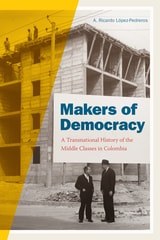
Makers of Democracy
A Transnational History of the Middle Classes in ColombiaA. Ricardo López-Pedreros
Duke University Press, 2019

Markets
Armin Beverungen
University of Minnesota Press, 2018
A media theory of markets
Markets abound in media—but a media theory of markets is still emerging. Anthropology offers media archaeologies of markets, and the sociology of markets and finance unravels how contemporary financial markets have witnessed a media technological arms race. Building on such work, this volume brings together key thinkers of economic studies with German media theory, describes the central role of the media specificity of markets in new detail and inflects them in three distinct ways. Nik-Khah and Mirowski show how the denigration of human cognition and the concomitant faith in computation prevalent in contemporary market-design practices rely on neoliberal conceptions of information in markets. Schröter confronts the asymmetries and abstractions that characterize money as a medium and explores the absence of money in media. Beverungen situates these inflections and gathers further elements for a politically and historically attuned media theory of markets concerned with contemporary phenomena such as high-frequency trading and cryptocurrencies.
Meaningless Citizenship
Iraqi Refugees and the Welfare StateSally Wesley Bonet
University of Minnesota Press, 2022
A searing critique of the “freedom” that America offers to the victims of its imperialist machinations of war and occupation
Meaningless Citizenship traces the costs of America’s long-term military involvement around the world by following the forced displacement of Iraqi families, unveiling how Iraqis are doubly displaced: first by the machinery of American imperialism in their native countries and then through a more pernicious war occurring on U.S. soil—the dismantling of the welfare state.
Revealing the everyday struggles and barriers that texture the lives of Iraqi families recently resettled to the United States, Sally Wesley Bonet draws from four years of deep involvement in the refugee community of Philadelphia. An education scholar, Bonet’s analysis moves beyond the prevalent tendency to collapse schooling into education. Focusing beyond the public school to other critical institutions, such as public assistance, resettlement programs, and healthcare, she shows how encounters with institutions of the state are an inherently educative process for both refugee youths and adults, teaching about the types of citizenship they are expected to enact and embody while simultaneously shaping them into laboring subjects in service of capitalism.
An intimate, in-depth ethnography, Meaningless Citizenship exposes how the veneer of American values—freedom, democracy, human rights—exported to countries like Iraq, disintegrates to uncover what is really beneath: a nation-state that prioritizes the needs of capitalism above the survival and wellbeing of its citizens.
Millennial Capitalism and the Culture of Neoliberalism
Jean Comaroff and John L. Comaroff, eds.
Duke University Press, 2001
In exploring the material and cultural dimensions of the Age of Millennial Capitalism, the contributors interrogate the so-called crisis of the nation-state, how the triumph of the free market obscures rising tides of violence and cultures of exclusion, and the growth of new forms of identity politics. The collection also investigates the tendency of neoliberal capitalism to produce a world of increasing differences in wealth, environmental catastrophes, heightened flows of people and value across space and time, moral panics and social impossibilities, bitter generational antagonisms and gender conflicts, invisible class distinction, and “pariah” forms of economic activity. In the process, the volume opens up an empirically grounded, conceptual discussion about the world-at-large at a particularly momentous historical time—when the social sciences and humanities are in danger of ceding intellectual initiative to the masters of the market and the media.
In addition to its crossdisciplinary essays, Millennial Capitalism and the Culture of Neoliberalism—originally the third installment of the journal Public Culture’s “Millennial Quartet”—features several photographic essays. The book will interest anthropologists, political geographers, economists, sociologists, and political theorists.
Contributors. Scott Bradwell, Jean Comaroff, John L. Comaroff, Fernando Coronil, Peter Geschiere, David Harvey, Luiz Paulo Lima, Caitrin Lynch, Rosalind C. Morris, David G. Nicholls, Francis Nyamnjoh, Elizabeth A. Povinelli, Paul Ryer, Allan Sekula, Irene Stengs, Michael Storper, Seamus Walsh, Robert P. Weller, Hylton White, Melissa W. Wright, Jeffrey A. Zimmerman
Mothering for Capital
Labor, Race, and Child "Value" in NeoliberalismMaria Kromidas
Vanderbilt University Press, 2026
Mothering for Capital offers a bold new interpretation about the crisis of motherhood in neoliberalism. It documents how the drive of capital stealthily subsumes mothering, tethering women’s work, care, and socialization of children, as well as their wishes, fears, and understandings of themselves as mothers, to the imperatives of value accumulation. Through the framework of “good” parenting that maximizes the odds of a child’s “success” in a precarious future, capital orients mothers to cultivate a set of specific cognitive, social, emotional, and psychological traits that shape children as future labor power, the ideal manageable yet self-managed subject. The child is the site of capital’s most audacious aspirations—to flatten and empty human life of all that is superfluous or dangerous to capital. What is ultimately at stake, Kromidas argues, is the subordination or emancipation of the human subject, and Mothering for Capital tracks this hidden terrain of struggle.