Results by title
65 books match the query 'Netherlands' and 2 start with m
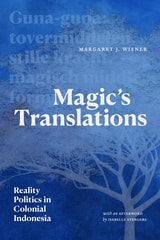
Magic’s Translations
Reality Politics in Colonial IndonesiaMargaret J. Wiener
Duke University Press, 2025
“Do you believe in magic?” This familiar question suggests magic is easily recognized but unreal. In Magic’s Translations, Margaret J. Wiener argues that such views are shaped by historical power struggles, especially in Europe’s relations with the wider world. Focusing on nineteenth- and twentieth-century Dutch interactions with Indonesians, Wiener reveals how colonial agents framed unfamiliar practices, practitioners, and objects as “magic,” rendering distinct phenomena fundamentally alike and advancing colonizing projects that deemed magic antithetical to reason and reality. While colonial authorities, including ethnologists, mobilized the concept of magic to differentiate Europeans from Indonesians, nature from culture, reason from superstition, and fact from fetish, their efforts produced unexpected outcomes: Some Indonesian artifacts and acts not only retained their power but invaded European experiences. As anthropologists were among the key translators of magic throughout the world, Wiener intersperses accounts of magic’s translations in the Indies with reflections on anthropology’s ongoing engagement with the concept. She demonstrates that magic became an object of expert knowledge, political control, and popular fascination, rather than a self-evident category or relic of naïve belief.
[more]
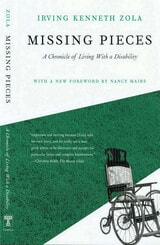
Missing Pieces
A Chronicle Of Living With A DisabilityKenneth Zola
Temple University Press, 2003
The personal odyssey of a man with a disability, this passionate book tries to tell as well as analyze what it is like to have a disability in a world that values vigor and health. Zola writes, "Missing Pieces is an unraveling of a social problem in the manner of Black Like Me. Like its author, I, too, am a trained social observer, but for me 'passing' was not an issue. For I already have the stigmata of the disabled—the braces, the limp, the cane—though I have spent much of my life denying their existence." The author started out in the role of a social scientist on a seven-day excursion to acquaint himself with an extraordinary experiment in living—Het Dorp, one of the few places in the world designed to promote "the optimum happiness" of those with severe physical disabilities. Neither a medial center nor a nursing home, Het Dorp is a village in the western-most part of the Netherlands. What began as a sociological attempt to describe this unusual setting became, through the author's growing awareness, what can only be called a socio-autobiography. Resuming his prior dependence on a wheelchair, the author experienced his own transformation from someone who is "normal" and "valid" to someone who is "invalid." The routine of Het Dorp became his: he lived in an architecturally modified home, visited the workshops, and shared meals, social events, conversation, and perceptions with the remarkably diverse residents. The author confronts some rarely discussed issues—the self-image of a person with a chronic disability, how one fills one's time, how one deals with authority and dependence, and love and sex. Missing Pieces offers striking insights into an aspect of the human condition shared by nearly 30 million Americans. It is must-read for the general reader, as well as for the rehabilitation counselor, social worker, or social scientist.
[more]