Results by title
176 books match the query 'New Testament' and 8 start with m
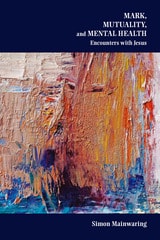
Mark, Mutuality, and Mental Health
Encounters with JesusSimon Mainwaring
SBL Press, 2014
An incitement to re-assess how society relates to persons with poor mental health
Mainwaring explores the societal contexts of those who suffer poor mental health, and in particular the relational dynamics of how identity, agency, and dialogue are negotiated in personal encounters. This work seeks to serve as an experiment, such that interested readers might better understand the dynamics of relational power that pervade encounters with persons with poor mental health.
Features:
- Foucauldian analysis of the relational dynamics of poor mental health used to re-imagine hegemonic relational dynamics
- Close readings of encounters between individual characters to evaluate how mutuality operates in those encounters
- Study of mutuality as it has emerged in mental health literature, feminist theologies, and theologies of disability
Matthew 16
21–28:20: Introduction and CommentaryWarren Carter
SBL Press, 2025
Matthew 1
1–16:20: Introduction and CommentaryWarren Carter
SBL Press, 2025
Matthew within Judaism
Israel and the Nations in the First GospelAnders Runesson
SBL Press, 2020
In this collection of essays, leading New Testament scholars reassess the reciprocal relationship between Matthew and Second Temple Judaism. Some contributions focus on the relationship of the Matthean Jesus to torah, temple, and synagogue, while others explore theological issues of Jewish and gentile ethnicity and universalism within and behind the text.
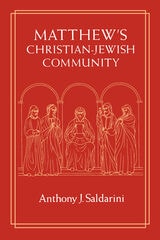
Matthew's Christian-Jewish Community
Anthony J. Saldarini
University of Chicago Press, 1994
Recent research reveals that among both Jews and Christians of the first century many groups believed in Jesus while remaining close to Judaism. Saldarini argues that the author of the Gospel of Matthew belonged to such a group, supporting his claim with an informed reading of Matthew's text and historical context. Matthew emerges as a Jewish teacher competing for the commitment of his people after the catastrophic loss of the Temple in 70 C.E., his polemics aimed not at all Jews but at those who oppose him. Saldarini shows that Matthew's teaching about Jesus fits into first-century Jewish thought, with its tradition of God-sent leaders and heavenly mediators.
In Saldarini's account, Matthew's Christian-Jewish community is a Jewish group, albeit one that deviated from the larger Jewish community. Contributing to both New Testament and Judaic studies, this book advances our understanding of how religious groups are formed.
Matthew’s Parable of the Royal Wedding Feast
A Sociorhetorical InterpretationRuth Christa Mathieson
SBL Press, 2023
Ruth Christa Mathieson’s unique reading of Matthew’s parable of the royal wedding feast (Matt 22:1–14), which concludes with the king’s demand that one of the guests be bound and cast out into the outer darkness, focuses on the means of the underdressed guest’s expulsion. Using sociorhetorical interpretation, Mathieson draws the parable into conversation with early Jewish narratives of the angel Raphael binding hands and feet (1 Enoch; Tobit) and the protocol for expelling individuals from the community in Matt 18. She asserts that readers are invited to consider if the person who is bound and cast out is a danger to the little ones of the community of faith unless removed and restrained.
Metaphor, Morality, and the Spirit in Romans 8
1-17William E. W. Robinson
SBL Press, 2016
Engage compelling arguments that challenge prominent positions in Pauline studies
In this innovative book, William E. W. Robinson takes the reader on a journey through Romans 8:1–17 using Conceptual Metaphor Theory and Conceptual Integration Theory. Robinson delineates the underlying cognitive metaphors, their structure, their function, what they mean, and how Paul’s audiences then and now are able to comprehend their meaning. He examines each metaphor in the light of relevant aspects of the Greco-Roman world and Paul’s Jewish background. Robinson contends that Paul portrays the Spirit as the principal agent in the religious-ethical life of believers. At the same time, his analysis demonstrates that the conceptual metaphors in Romans 8:1–17 convey the integral role of believers in ethical conduct. In the process, he addresses thorny theological issues such as whether Spirit and flesh signal an internal battle within believers or two conflicting ways of life. Finally, Robinson shows how this study is relevant to related Pauline passages and challenges scholars to incorporate these methods into their own investigation of biblical texts.
Features:
- Sustained argument that sheds new light on how Paul communicates with his audiences
- Substantial contribution to current debates about central theological concepts
- Conceptual Metaphor Theory and Conceptual Integration Theory applied to the metaphors in Romans 8:1-17
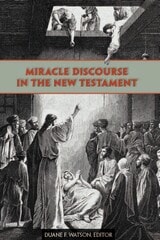
Miracle Discourse in the New Testament
Duane F. Watson
SBL Press, 2012