Results by title
78 books match the query 'North' and 5 start with m
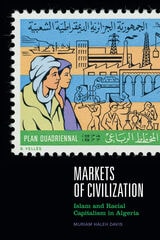
Markets of Civilization
Islam and Racial Capitalism in AlgeriaMuriam Haleh Davis
Duke University Press, 2022
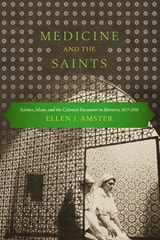
Medicine and the Saints
Science, Islam, and the Colonial Encounter in Morocco, 1877-1956By Ellen J. Amster
University of Texas Press, 2013
The colonial encounter between France and Morocco took place not only in the political realm but also in the realm of medicine. Because the body politic and the physical body are intimately linked, French efforts to colonize Morocco took place in and through the body. Starting from this original premise, Medicine and the Saints traces a history of colonial embodiment in Morocco through a series of medical encounters between the Islamic sultanate of Morocco and the Republic of France from 1877 to 1956.
Drawing on a wealth of primary sources in both French and Arabic, Ellen Amster investigates the positivist ambitions of French colonial doctors, sociologists, philologists, and historians; the social history of the encounters and transformations occasioned by French medical interventions; and the ways in which Moroccan nationalists ultimately appropriated a French model of modernity to invent the independent nation-state. Each chapter of the book addresses a different problem in the history of medicine: international espionage and a doctor’s murder; disease and revolt in Moroccan cities; a battle for authority between doctors and Muslim midwives; and the search for national identity in the welfare state. This research reveals how Moroccans ingested and digested French science and used it to create a nationalist movement and Islamist politics, and to understand disease and health. In the colonial encounter, the Muslim body became a seat of subjectivity, the place from which individuals contested and redefined the political.
Moroccan Islam
Tradition and Society in a Pilgrimage CenterBy Dale F. Eickelman
University of Texas Press, 1976
This book is one of the first comprehensive studies of Islam as locally understood in the Middle East. Specifically, it is concerned with the prevalent North African belief that certain men, called marabouts, have a special relation to God that enables them to serve as intermediaries and to influence the well-being of their clients and kin. Dale F. Eickelman examines the Moroccan pilgrimage center of Boujad and unpublished Moroccan and French archival materials related to it to show how popular Islam has been modified by its adherents to accommodate new social and economic realities. In the course of his analysis he demonstrates the necessary interrelationship between social history and the anthropological study of symbolism.
Eickelman begins with an outline of the early development of Islam in Morocco, emphasizing the "maraboutic crisis" of the fourteenth through sixteenth centuries. He also examines the history and social characteristics of the Sherqawi religious lodge, on which the study focuses, in preprotectorate Morocco. In the central portion of the book, he analyzes the economic activities and social institutions of Boujad and its rural hinterland, as well as some basic assumptions the townspeople and tribesmen make about the social order. Finally, there is an intensive discussion of maraboutism as a phenomenon and the changing local character of Islam in Morocco.
In focusing on the "folk" level of Islam, rather than on "high culture" tradition, the author has made possible a more general interpretation of Moroccan society that is in contrast with earlier accounts that postulated a marked discontinuity between tribe and town, past and present.
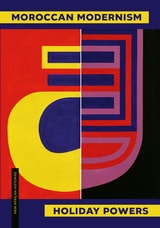
Moroccan Modernism
Holiday Powers
Ohio University Press, 2024
In the years after independence, new art forms and practices flourished at the Casablanca École des beaux-arts, transforming the colonial relic into a wellspring of Moroccan modernism. Casablanca School artists, including Farid Belkahia, Mohammed Chebaa, and Mohammed Melehi, defined the modernist movement in Morocco. Their visual arts activism was displayed at their iconic outdoor exhibition in the Djemaa al-Fna plaza in Marrakech, in their collaborations with the cultural and political journal Souffles, through their radical anticolonial pedagogy, and through their use of abstraction to expand the horizons of postcolonial national culture.
In Moroccan Modernism, Holiday Powers argues that the pedagogy and transnational solidarities of this generation of artists were intrinsic to their broader artistic projects. She advances a novel reading of Moroccan modernism that is rooted in its cosmopolitan national context and in Pan-Africanism and Pan-Arabism, the transnational anticolonial intellectual movements that defined the era.
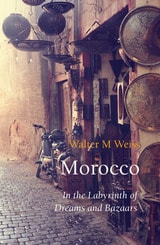
Morocco
In the Labyrinth of Dreams and BazaarsWalter M. Weiss
Haus Publishing, 2016
In Morocco, Walter M. Weiss brings extensive knowledge of the region to bear as he travels the breadth and depth of the country’s social and geographical contrasts. Berber villagers of the mountains are for the most part still illiterate and consider their king to be divinely chosen, while businessmen in Casablanca’s towering offices dream of closer ties to the European Union. Weiss visits the settings of modern legends, such as Tangier, as well as the two medieval centres Fès and Meknès, and sees earthen kasbahs and Marrakech’s bazaar. On the way, he meets acrobats, Sufi musicians, pilgrims, craftsmen, beatniks, rabbis, and Berber farmers—a kaleidoscope of variety and cultural influence.