Results by title
93 books match the query 'Paris' and 5 start with m
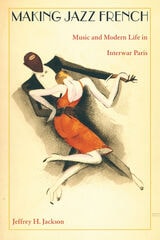
Making Jazz French
Music and Modern Life in Interwar ParisJeffrey H. Jackson
Duke University Press, 2003
Drawing on memoirs, press accounts, and cultural criticism, Jackson uses the history of jazz in Paris to illuminate the challenges confounding French national identity during the interwar years. As he explains, many French people initially regarded jazz as alien because of its associations with America and Africa. Some reveled in its explosive energy and the exoticism of its racial connotations, while others saw it as a dangerous reversal of France’s most cherished notions of "civilization." At the same time, many French musicians, though not threatened by jazz as a musical style, feared their jobs would vanish with the arrival of American performers. By the 1930s, however, a core group of French fans, critics, and musicians had incorporated jazz into the French entertainment tradition. Today it is an integral part of Parisian musical performance. In showing how jazz became French, Jackson reveals some of the ways a musical form created in the United States became an international phenomenon and acquired new meanings unique to the places where it was heard and performed.

May '68 and Its Afterlives
Kristin Ross
University of Chicago Press, 2002
Kristin Ross shows how the current official memory of May '68 came to serve a political agenda antithetical to the movement's aspirations. She examines the roles played by sociologists, repentant ex-student leaders, and the mainstream media in giving what was a political event a predominantly cultural and ethical meaning. Recovering the political language of May '68 through the tracts, pamphlets, and documentary film footage of the era, Ross reveals how the original movement, concerned above all with the question of equality, gained a new and counterfeit history, one that erased police violence and the deaths of participants, removed workers from the picture, and eliminated all traces of anti-Americanism, anti-imperialism, and the influences of Algeria and Vietnam. May '68 and Its Afterlives is especially timely given the rise of a new mass political movement opposing global capitalism, from labor strikes and anti-McDonald's protests in France to the demonstrations against the World Trade Organization in Seattle.
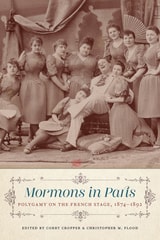
Mormons in Paris
Polygamy on the French Stage, 1874-1892Corry Cropper
Bucknell University Press, 2021
In the late nineteenth century, numerous French plays, novels, cartoons, and works of art focused on Mormons. Unlike American authors who portrayed Mormons as malevolent “others,” however, French dramatists used Mormonism to point out hypocrisy in their own culture. Aren't Mormon women, because of their numbers in a household, more liberated than French women who can't divorce? What is polygamy but another name for multiple mistresses? This new critical edition presents translations of four musical comedies staged or published in France in the late 1800s: Mormons in Paris (1874), Berthelier Meets the Mormons (1875), Japheth’s Twelve Wives (1890), and Stephana’s Jewel (1892). Each is accompanied by a short contextualizing introduction with details about the music, playwrights, and staging. Humorous and largely unknown, these plays use Mormonism to explore and mock changing French mentalities during the Third Republic, lampooning shifting attitudes and evolving laws about marriage, divorce, and gender roles.
Published by Bucknell University Press. Distributed worldwide by Rutgers University Press.
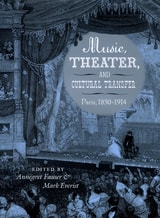
Music, Theater, and Cultural Transfer
Paris, 1830-1914Edited by Annegret Fauser and Mark Everist
University of Chicago Press, 2009
Opera and musical theater dominated French culture in the 1800s, and the influential stage music that emerged from this period helped make Paris, as Walter Benjamin put it, the “capital of the nineteenth century.” The fullest account available of this artistic ferment and its international impact, Music, Theater, and Cultural Transfer explores the diverse institutions that shaped Parisian music and extended its influence across Europe, the Americas, and Australia.
The contributors to this volume, who work in fields ranging from literature to theater to musicology, focus on the city’s musical theater scene as a whole rather than on individual theaters or repertories. Their broad range enables their collective examination of the ways in which all aspects of performance and reception were affected by the transfer of works, performers, and management models from one environment to another. By focusing on this interplay between institutions and individuals, the authors illuminate the tension between institutional conventions and artistic creation during the heady period when Parisian stage music reached its zenith.
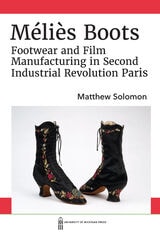
Méliès Boots
Footwear and Film Manufacturing in Second Industrial Revolution ParisMatthew Solomon
University of Michigan Press, 2022
Winner of the 2024 Society for Cinema and Media Studies Katherine Singer Kovacs Book Award
Before he became an influential cinematic innovator, Georges Méliès (1861–1938) was a maker of deluxe French footwear, an illusionist, and a caricaturist. Proceeding from these beginnings, Méliès Boots traces how the full trajectory of Georges Méliès’ career during the late-nineteenth and early-twentieth centuries, along with the larger cultural and historical contexts in which Méliès operated, shaped his cinematic oeuvre. Solomon examines Méliès’ unpublished drawings and published caricatures, the role of laughter in his magic theater productions, and the constituent elements of what Méliès called "the new profession of the cinéaste." The book also reveals Méliès' connections to the Incohérents, a group of ephemeral artists from the 1880s, demonstrating the group’s relevance for Méliès, early cinema, and modernity. By positioning Méliès in relation to the material culture of his time, Solomon demonstrates that Méliès’ work was expressive of a distinctly modern, and modernist, sensibility that appeared in France during the 1880s in the wake of the Second Industrial Revolution.